

Enterprises used to run on packaged software. Safe choice. Predictable costs. Quick to deploy.
But uniformity has a downside. When everyone uses identical tools, differentiation fades. Processes start looking alike, and customer experiences too.
That’s exactly why things are shifting.
Custom app development isn’t some big, risky bet anymore. It’s turning into a practical growth strategy. The enterprise mobile app market is expected to touch $338.42 billion, expanding at about 12.33% CAGR through 2031.
Markets don’t grow like that without a reason. Businesses clearly want more control over their tech. And customers? Their expectations climbed. Quietly, but fast. They want smooth digital transformation, near-instant responses, and zero confusion.
Custom applications give enterprises room to move. Integrate what you need. Scale when growth hits. Pivot without rebuilding everything from scratch.
In this guide, you’ll see why modern enterprises are investing in custom app development in 2026, what’s driving the urgency, and how the right investment can turn technology into a serious competitive edge.
What is Custom App Development?
Custom app development for enterprises is pretty straightforward. It is built for your business and workflows, rather than a standardized platform, forcing organizations to adapt to a predefined structure.
No patchwork. No adjusting operations just because the platform says so. Instead, the software adjusts to you. That’s the whole point of custom software development for enterprises: alignment.
Custom application development is more of a business asset. Something that supports scale without breaking under pressure. As the enterprise expands, the software expands with it. No sudden limitations. No expensive re-platforming panic later.
Why Off-the-Shelf Software is Quietly Failing Enterprises
Off-the-shelf software looks like an easy choice in the beginning because of the lower price tag, faster deployment, and overall, feels like a smart financial move.
But, as soon as the enterprise starts to scale, the gap starts to appear (even from a distance). Features feel restrictive. Integrations get messy. Teams invent workarounds just to keep operations moving. What once felt efficient slowly becomes friction.
Let’s break down where things actually start going wrong.
- The Hidden Cost of “Lower Upfront Pricing”
The upfront investment looks manageable. Most stakeholders are on board with that. Procurement teams, too. But the total cost rarely remains predictable.
Soon, expenses begin stacking up. Additional user licenses. Paid feature upgrades. Priority support plans. Integration tools. What once felt “cost-effective” starts stretching the budget. And migrating later? That’s a far bigger financial lift.
In fact, when teams spend extra time working around rigid workflows, the impact compounds. Across departments, business units, and sometimes across global operations.
Software that seemed economical at first can quietly turn into a high-cost commitment, just not right away.
- Integration Bottlenecks Slow Innovation
Enterprises don’t run on one system. It’s an ecosystem, CRM & ERP, analytics tools, cloud platforms, and internal dashboards.
Off-the-shelf tools weren’t built for your exact stack. So integrations feel forced. Sometimes fragile. One update breaks a connection. Data stops syncing. Teams wait. Innovation pauses while IT fixes pipes in the background.
Not ideal.
Speed matters now. Businesses experimenting with AI development, automation, and real-time analytics can’t afford tech that resists connection. When systems don’t communicate smoothly, decision-making slows, and opportunities pass.
- Security Limitations in Shared Architectures
Shared platforms mean shared environments. That’s the trade-off many enterprises don’t think about early on.
Vendors handle security, yes. But control is limited. You follow their protocols, their timelines, their response strategies. For enterprises dealing with sensitive customer data, financial records, or compliance-heavy industries, a lack of control can feel uncomfortable. Sometimes risky.
Security isn’t just about protection anymore. It’s about visibility. Custom policies. Faster incident response. When you don’t fully own the architecture, you don’t fully own the safety net either.
7 Strategic Reasons Enterprises Are Choosing Custom Apps in 2026
Enterprises are no longer asking if they should invest in custom app development; rather, they want to know: “How soon can it be implemented without disrupting the growth?”
Here’s exactly what is driving the shift towards enterprise app development in 2026.
- Application Built Around Business Processes
Every enterprise runs differently. Approval chains vary. Data flows differently. Even decision-making structures are unique.
Generic software forces teams to adjust. Custom application development removes that friction. The system mirrors how the business already operates. Fewer workarounds. Less operational drag. Processes feel natural instead of engineered. And when technology aligns with workflows, execution becomes faster by default.
- Limitless Scalability for High-Growth Organizations
Growth sounds exciting. Until systems start struggling under the weight.
Many platforms perform well at mid-scale. Then expansion happens, new markets, higher transaction volumes, larger teams, and limitations surface.
With enterprise software development, scalability is planned early. Architecture supports expansion before pressure builds. So when growth arrives, the system keeps pace. No urgent rebuilds. No reactive spending. Just continuity.
- Enterprise Level Security & Compliance Readiness
Risk tolerance is lower now. Regulators are stricter. Customers expect data protection without compromise.
Shared platforms offer baseline security. But enterprises often require deeper control, access governance, audit trails, and compliance mapping.
Custom-built applications allow security frameworks to match organizational policies. Do not approximate them. It creates preparedness. Not dependency. And preparedness tends to reduce long-term exposure.
- Seamless Integration Across Complex Tech Stacks
Enterprises rarely operate on a single platform. It is usually a layered ecosystem, including ERP, CRM, analytics engines, cloud infrastructure, and internal tools.
When systems fail to communicate, visibility suffers. Decisions slow. Custom app development prioritizes integration from the start. APIs align. Data moves cleanly. Departments stay connected. Technology begins functioning as one environment instead of being separate.
- AI and Automation Compatibility
AI is no longer experimental. It is operational.
Enterprises are embedding predictive analytics, intelligent workflows, and automated decision layers. But many packaged tools were not designed for this level of adaptability. Custom platforms are.
They create space for machine learning models, automation pipelines, and evolving data strategies without structural resistance. Future readiness becomes part of the foundation, not an afterthought.
- Superior Customer Experience Through Personalization
Customer expectations rarely stay still. They escalate. Personalized journeys, faster resolutions, contextual interactions, these are becoming standard signals of a mature enterprise.
Enterprise app development allows businesses to shape experiences around user behavior rather than platform limitations. Which often leads to higher retention. Stronger trust. Better lifetime value.
- Stronger Long-Term ROI
Custom solutions require higher early investment, and what becomes visible later is the return. It results in lower dependency on multiple vendors, licensing costs stay controlled, and operational friction drops too.
Over time, enterprise software development stops behaving like a recurring expense. It starts contributing measurable value, stronger productivity, better system stability, and clearer data flow.
Industries Where Custom Enterprise Apps Deliver Maximum Impact
Some industries feel the impact of custom app development faster than others. Usually, because the complexity is higher. Transactions are heavier. Customer expectations rarely pause.
Standard platforms help to a point. Then the limitations surface. That is when custom application development begins to show measurable value.
Here is where the difference becomes difficult to ignore:
- Fintech: Enterprise mobile app development allows the finance industry to design platforms around compliance frameworks, risk controls, and real-time processing. Fraud detection becomes sharper. Data visibility improves. Customer transactions feel faster and more reliable. And when trust drives revenue, system stability quietly becomes a competitive advantage.
- Healthcare: For the healthcare industry, delays or inefficiency are never an option because they can result in negative outcomes. Hospitals and care networks manage patient data, diagnostics, billing systems, and compliance mandates, all at once. With custom app development, workflows align better across departments. Patient records move securely. Telehealth integrations feel native instead of layered on top.
- Manufacturing: Manufacturing runs on coordination. Supply chains, production schedules, equipment monitoring, everything must stay synchronized. That being said, custom app development enables real-time production tracking, predictive maintenance, and tighter inventory control.
- Logistics: Movement defines logistics. Any delay creates ripple effects across the network. Route planning, fleet tracking, and warehouse coordination each require real-time intelligence. Through custom app development, logistics enterprises gain dynamic routing, predictive delivery insights, and clearer shipment visibility.
- Retail/eCommerce: Customer loyalty is increasingly experience-driven. Slow platforms or inconsistent journeys rarely get forgiven. Retailers adopting enterprise mobile app development can unify inventory, personalization engines, order management, and analytics into one environment. Shoppers see accurate stock levels. Recommendations feel relevant. Checkout friction reduces.
When Should an Enterprise Invest in Custom App Development?
Timing matters more than most leaders assume. Invest too early, value feels distant, and operational strain becomes visible.
Certain signals tend to repeat across growing organizations. Notice them early, and see how decisions get simpler.
- Rapid scaling: When expansion starts stressing existing systems and performance begins to dip, custom app development creates the structural capacity needed to support sustained growth.
- Legacy system limitations: If outdated platforms resist integration, slow teams down, or inflate maintenance costs, modern custom solutions restore agility without constant patchwork.
- Complex workflows: When operations involve multiple dependencies and manual interventions, tailored applications streamline execution and reduce process fatigue.
Emerging Trends Shaping Enterprise App Development in 2026
Enterprise technology is moving faster than many anticipated. Expectations keep rising. Systems are no longer expected to just function; they must evolve, almost continuously.
This is exactly where enterprise app development is changing direction.
Here are the top emerging trends that are about to transform enterprise app development in the future:
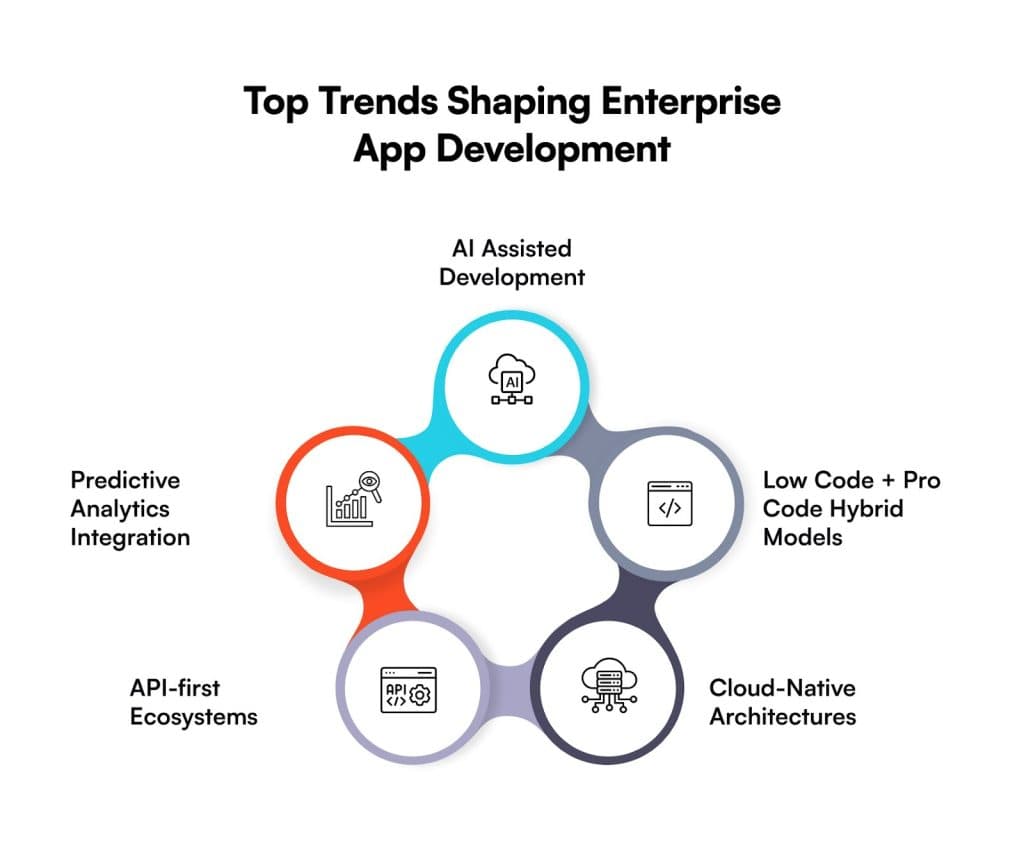
- AI Assisted Development
Enterprises are leaning on AI to speed up coding and detect risks earlier. Development cycles shorten. Errors reduce before they scale. Delivery feels more predictable, which leadership tends to value.
- Low Code + Pro Code Hybrid Models
Speed matters, but architectural strength matters more. Hybrid models allow teams to release faster while developers maintain control over complexity. Agility improves without weakening the foundation.
- Cloud-Native Architectures
Cloud-built applications scale with fewer constraints. Downtime risks drop. Operations stay accessible across locations. Custom application development becomes easier to expand as demand rises.
- API-first Ecosystems
Applications designed around APIs are cleaner. Systems communicate without unnecessary friction. Expansion feels structured, not reactive. Enterprises gain the flexibility they usually wish they had earlier.
- Predictive Analytics Integration
Forecasting is moving into the application layer. Leaders see patterns sooner. Decisions shift from reactive to informed. Small advantage perhaps, but it compounds quickly at enterprise scale.
Common Myths About Custom App Development — Debunked
Misconceptions tend to slow enterprise decisions. Especially when the investment feels significant. Many leadership teams hesitate, not because the strategy lacks value, but because outdated assumptions still circulate.
Let’s address a few that deserve reconsideration:
- Custom apps are only for large enterprises: Custom app development is no longer confined to global enterprises. Mid-sized organizations are investing earlier, often to stabilize operations before complexity expands. It creates clarity, strengthens process control, and prevents systems from getting messy.
- They take years to build: That was closer to reality once. Not anymore. Modern development frameworks, cloud infrastructure, and modular architectures allow phased releases. Enterprises deploy core capabilities first, expand gradually, and refine as usage grows. Progress becomes visible earlier.
- Maintenance is too expensive: Maintenance exists with any software. The difference is control. With custom platforms, enterprises decide when to upgrade, what to optimize, and where to invest. Over time, reduced licensing dependency and fewer operational inefficiencies tend to balance the spend, sometimes more than expected.
How to Choose the Right Custom App Development Partner
The partner you select influences far more than the application itself. It affects scalability. Security readiness. Even the speed at which teams begin trusting the system. This decision requires deliberation. Quick selections often introduce complications later, typically when operations expand.
- Technical Depth
Engineering strength is essential. Seek teams capable of handling architectural complexity, not only visible features. In custom app development, limited expertise tends to surface during high-demand phases.
- Industry Experience
Sector familiarity reduces misalignment early. Partners who understand compliance pressures, operational patterns, and user behavior usually design with stronger accuracy. Context reduces costly revisions.
- Architectural Thinking
Many vendors build applications. Fewer architects for endurance. Scalable structures, integration readiness, and long-term adaptability originate in thoughtful design. Within custom application development, architecture often determines whether the system supports growth or restricts it.
- Security Expertise
Enterprise systems carry exposure. Protection must be intentional. Assess how the partner approaches governance models, access frameworks, regulatory alignment, and threat prevention. Security should exist within the foundation, not around it.
- Post-launch support
Release is only a milestone. Applications mature through iteration. Performance tuning, feature refinement, and ongoing monitoring all require continuity. Reliable enterprise app development extends beyond deployment into a sustained partnership.
Custom Apps Are No Longer Optional: They’re Strategic Infrastructure
Enterprises are reaching a quiet realization. Technology is no longer just operational support. It is becoming the structure the business stands on.
Custom app development now sits closer to strategy than IT. It shapes speed. Influences resilience. Determines how confidently an organization can respond to market shifts. Standard platforms still serve a purpose, yes, but differentiation rarely grows from shared systems.
Well-architected applications create something enterprises value deeply: control. Over data. Over workflows. Over security posture. Over future expansion that has not fully arrived yet. The investment may appear significant at first glance, though the long-term operational stability often reframes that perspective.
Execution, however, matters as much as intent. The right development partner brings architectural clarity. Engineering discipline, and the ability to translate business complexity into scalable platforms.
The real question now may be simpler than it seems.
Is your enterprise building systems for where the business is today, or for where it is clearly heading next?
FAQs
Q. Is custom app development worth it for enterprises in 2026?
A. In many cases, yes. Custom app development gives enterprises a tighter operational fit, stronger data ownership, and room to scale without structural strain. The initial investment may seem substantial. Over time, efficiency improves. Vendor dependency reduces. Competitive positioning strengthens.
Q. How much does enterprise custom software cost?
A. There is no single number. Costs shift with complexity, integration depth, compliance needs, and architectural expectations. Enterprise builds often move into six-figure territory, sometimes higher. What matters is cost control over time. Well-planned systems rarely demand expensive reinvention later.
Q. How long does development typically take?
A. Scope defines the timeline. Foundational platforms may take a few months. More layered ecosystems require longer horizons. Many organizations now release in phases, core capabilities first, enhancements after. Progress becomes visible earlier, which leadership tends to prefer.
Q. Are custom apps more secure?
A. They often are. Security frameworks are designed around enterprise policies rather than generalized standards. Access controls stay precise. Governance feels intentional. When executed correctly, risk exposure usually declines.
Q. Can custom apps integrate with legacy systems?
A. Yes. Frequently, that is the objective behind custom application development. APIs and middleware connect older infrastructure with modern layers, improving data continuity without immediate full replacement. Enterprises preserve stability while advancing capability.