The AI agent development cost can range from a few thousand dollars for a simple, single-purpose agent to $100,000 or more for a complex enterprise system. The price depends on what the agent needs to do, which systems it must connect with, how much autonomy it has, and how reliably it must perform.
For example, an agent that answers questions using company documents requires less development than one that reads customer records, makes decisions, updates a CRM, and coordinates tasks across several applications.
But development is only part of the budget. You also need to account for model usage, hosting, monitoring, security, and ongoing maintenance.
This guide breaks down the estimated cost of building an AI agent, explains the factors that affect pricing, and shows you how to estimate your budget before approaching an AI development partner.
How Much Does It Cost to Build an AI Agent?
For initial budgeting, businesses can use the following planning ranges. These are indicative estimates for AI agent development cost, not fixed industry prices or vendor quotes. Actual costs vary by requirements, location, team composition, and delivery model.
| AI agent type | Estimated development cost | Typical scope |
| Basic AI agent | $3,000–$10,000 | A focused task, basic instructions, and limited integrations |
| Custom AI agent | $10,000–$30,000 | A business-specific workflow with external tools and structured data |
| Advanced AI agent | $30,000–$100,000 | Multiple workflow steps, several integrations, evaluation, and stronger controls |
| Enterprise agent system | $100,000–$300,000+ | Complex workflows, multiple agents, extensive integrations, governance, and production infrastructure |
These ranges are useful for early planning, but they should not replace a project-specific AI agent development cost estimate. A narrowly scoped agent with a difficult integration can cost more than a broader agent built on well-documented systems.
What do these budgets typically cover?
Basic AI agent: $3,000–$10,000
This level may suit a small business that wants to automate a clearly defined task.
Examples include:
- Answering questions from an existing set of documents.
- Classifying incoming support requests.
- Extracting basic information from structured documents.
- Routing leads based on predefined criteria.
The project assumes the data is reasonably clean and the number of integrations is limited.
Custom AI agent: $10,000–$30,000
A custom agent requires more business logic and integration work. So, the cost of developing AI agents is higher in this case.
Examples include:
- A sales agent that qualifies leads and updates a CRM.
- A support agent that retrieves order information and drafts responses.
- A document-processing agent that extracts information and flags missing fields.
The budget may cover workflow design, API integration, error handling, testing, and a basic monitoring setup.
Advanced AI agent: $30,000–$100,000
This range may apply when an agent must handle several steps, use multiple tools, or make decisions based on changing information.
Examples include:
- An agent that reviews applications, validates data, and prepares recommendations.
- A research agent that gathers information from approved sources and produces structured reports.
- An operations agent that coordinates tasks across multiple business applications.
Testing becomes more demanding because errors in one step can affect everything that follows. The additional testing efforts scale the AI agent development cost in custom projects.
Enterprise agent system: $100,000–$300,000+
Enterprise projects often require more than agent logic. They may include multiple agents, legacy-system integration, role-based permissions, audit trails, load testing, and compliance requirements.
The AI development budget must also account for production readiness, including monitoring, failure recovery, and support for business-critical workflows.
AI Agent Development Cost Breakdown
The total cost of AI agent development comes from several parts of the project. Understanding these categories helps you compare vendor proposals and identify where you can save without compromising reliability.
| Cost component | What it covers | Why it matters |
| Discovery and planning | Requirements, workflow mapping, feasibility, and architecture | Prevents spending on the wrong solution |
| Data preparation | Data cleaning, document processing, access, and retrieval | Poor data can reduce accuracy and increase rework |
| AI model and agent development | Model selection, prompts, reasoning logic, and orchestration | Determines how the agent handles tasks |
| Integrations | APIs, databases, CRM, ERP, and other tools | Connects the agent to real business processes |
| Testing and evaluation | Accuracy, task completion, edge cases, and failure handling | Shows whether the agent works reliably |
| Security and governance | Permissions, audit logs, safeguards, and compliance requirements | Reduces the risk of unauthorized actions |
| Deployment and infrastructure | Hosting, environments, scaling, and monitoring | Makes the solution usable in production |
| Maintenance | Updates, bug fixes, model changes, and performance improvements | Keeps the agent useful as requirements change |
The proportion of agentic AI development cost spent on each category depends on the project. A document-based agent may need more work on data preparation and retrieval. An agent that changes customer records may require more investment in integration testing, permissions, and auditability. Thus understanding different components help determine a more accurate estimate for AI agent development cost.
A useful budgeting rule: Ask vendors to separate one-time AI agent development expenses from recurring operating costs. A low implementation quote may not include production monitoring, ongoing support, or the infrastructure needed to handle real usage.
What Factors Influence the Cost of Developing an AI Agent?
Two projects can use the same AI model and still have very different development budgets. The difference usually comes from what the agent must accomplish and what it takes to make that work safely.
1. Agent complexity and autonomy
The more steps an agent must complete independently, the more engineering and testing it generally requires. Consequently, the more cost of developing AI agent you will incur.
Consider two customer support solutions:
- Agent A: Answers common questions using approved help documents.
- Agent B: Identifies a customer’s problem, retrieves order information, checks a refund policy, updates a support ticket, and escalates exceptions.
Agent B needs more integrations, decision logic, and safeguards. It also needs more tests to confirm that it handles unusual situations correctly.
Autonomy should be based on the task, not treated as a goal in itself. If a fixed rule can solve a problem reliably, adding an LLM-based agent may increase costs without adding enough value.
2. Number and complexity of integrations
Connecting an agent to an application can be straightforward when the application has well-documented APIs and stable authentication.
Your AI agent development cost rise when:
- The business relies on older systems.
- Several applications use different data formats.
- Access permissions vary by user or department.
- API limits restrict the number of requests.
- The agent must handle failed or delayed responses.
Each integration also creates a maintenance responsibility. A change to a third-party API can break a workflow even when the agent’s model has not changed.
3. Data quality and availability
An agent can only work with the information it can access and interpret.
If company documents are outdated, records are inconsistent, or important information is scattered across disconnected systems, the development team may need to prepare the data before building the agent.
For a knowledge-based agent, this could involve document extraction, chunking, indexing, retrieval testing, and access controls. For a predictive use case, it may require additional data preparation and model evaluation.
If the project needs a specialized predictive model, custom AI model development may be relevant. If it mainly needs to generate responses grounded in existing information, a retrieval-based approach may be enough.
This also affects how much AI agent development costs you will incur.
4. Model selection
Different models have different capabilities, latency, and usage costs. Choosing the most expensive model for every task is rarely necessary.
A cost-conscious design might use:
- A smaller model for classification or routing.
- A retrieval system to find relevant information.
- A more capable model for complex reasoning.
- Conventional code for calculations and predictable business rules.
This approach can reduce usage costs while preserving quality where it matters.
The important point is to test models against your actual tasks. A cheaper model is not a bargain if it makes more mistakes and requires costly human review.
5. Security, privacy, and compliance
An agent that only answers public questions has a different risk profile from one that processes financial, healthcare, employment, or customer data.
Higher-risk projects may need stronger authentication, restricted permissions, audit trails, human approval, data retention controls, and additional testing.
These requirements add work upfront, but leaving them until the end can lead to expensive redesigns. Security and privacy should be part of the initial architecture, not an optional feature added after the agent works.
Adding them early in the development phase can help you avoid rework and reduce the overall AI agent development cost.
6. Testing and production readiness
A working demonstration is not the same as a production-ready agent.
The development team needs to test whether the agent:
- Completes the intended task correctly.
- Uses the right data and tools.
- Handles missing or contradictory information.
- Stops rather than repeating failed actions.
- Requests human review when necessary.
- Respects permissions and business rules.
Testing may require a set of realistic scenarios, automated evaluations, human reviews, and ongoing monitoring. The more consequential an agent’s actions are, the more important these checks become.
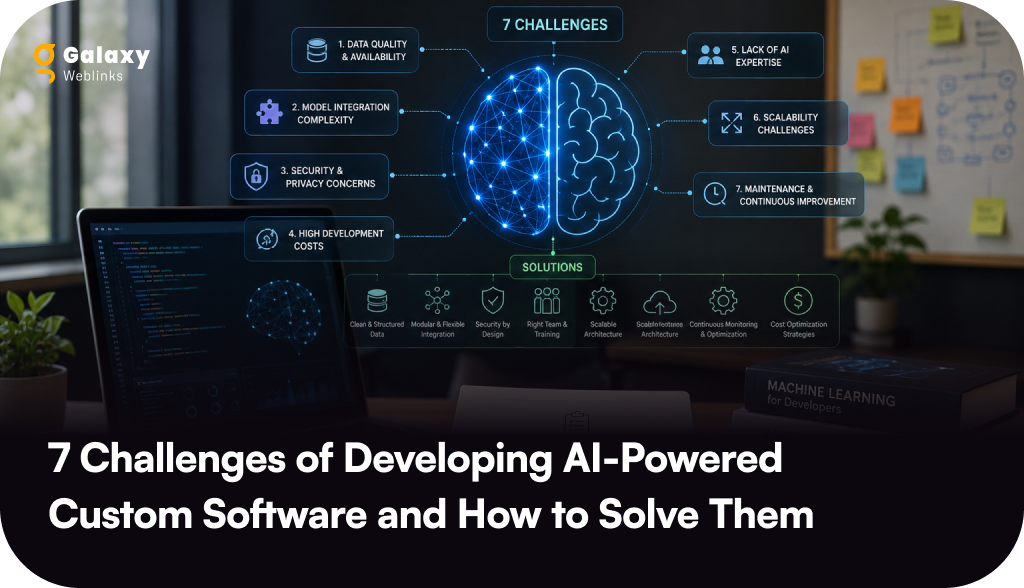
For a broader view of the engineering challenges, see our guide to the challenges of developing AI-powered custom software.
AI Agent Development Cost per Hour
The hourly rate is one part of the AI agent development budget, but it does not tell you the total cost of a project.
Rates vary according to geography, seniority, technical specialization, and engagement model. For preliminary planning, some buyers compare blended engineering rates in the following broad bands:
| Team or engagement type | Indicative hourly rate |
| Lower-cost offshore development team | $25–$50 |
| Experienced AI engineering team | $50–$100 |
| Specialized or US-based engineering team | $100–$200+ |
These are planning assumptions rather than verified market averages. Actual quotes can fall outside these ranges, particularly for specialized research, enterprise architecture, or regulated projects. However, the average hourly rates usually fall in this range, and they can help you estimate your AI agent development cost.
How does the hourly rate affect the total?
Suppose a project requires 400 engineering hours.
- At $40 per hour, development labor totals $16,000.
- At $75 per hour, it totals $30,000.
- At $125 per hour, it totals $50,000.
The calculation is simple, but it leaves out any costs that are not included in the quoted rate, such as model usage, cloud infrastructure, third-party tools, or separate security reviews.
Do not choose a vendor based on the hourly rate alone. Compare the expected hours, team experience, deliverables, testing approach, and support included in the quote. This gives you a comprehensive view of the cost of AI agent development.
AI Agent Cost per Month: What Does It Cost to Run?
Once development is complete, the agent still needs resources to operate.
Monthly expenses may include model API usage, hosting, vector databases, data storage, monitoring, third-party software, and maintenance.
For a small agent with limited usage, these costs may remain modest. A production agent with frequent requests, long reasoning chains, several integrations, and persistent memory can cost substantially more.
For early planning, consider the following illustrative operating budgets. These are examples, not universal monthly price ranges.
| Usage profile | Illustrative monthly budget | Typical considerations |
| Small proof of concept | $50–$300 | Limited traffic, basic model usage, minimal infrastructure |
| Production agent for a small team | $300–$2,000 | Regular requests, integrations, monitoring, and hosting |
| Higher-volume business agent | $2,000–$10,000+ | Greater usage, multiple workflows, more infrastructure, and stronger operational controls |
A small proof of concept may fall below these figures, while an enterprise deployment can exceed them. Human oversight and maintenance may also be billed separately.
What causes monthly costs to increase?
More model calls: An agent may call an LLM several times to complete one task. Long prompts, large documents, and repeated reasoning increase token consumption.
More tool calls: Database queries, external APIs, and third-party services may introduce separate usage charges.
Persistent memory: Saving and retrieving context can require databases, storage, and additional processing.
Higher availability requirements: Business-critical systems may need redundancy, alerting, and more robust infrastructure.
Maintenance and evaluation: Engineers may need to investigate failures, update integrations, test new models, and improve the agent’s behavior.
One useful metric is cost per successfully completed task, rather than cost per model call alone. A cheap agent that frequently fails may cost more overall once human review and rework are included.
AI Agent Development Cost Calculator: Estimate Your Budget
You can build a useful first estimate for AI agent development cost without knowing every technical detail. Start by calculating development labor, then add the other project expenses.
Step 1: Estimate development hours
Break the work into discovery, data preparation, agent development, integrations, testing, and deployment.
For example:
| Workstream | Illustrative hours |
| Discovery and solution design | 30 |
| Data preparation | 40 |
| Agent development | 120 |
| Integrations | 80 |
| Testing and evaluation | 70 |
| Deployment and handover | 30 |
| Total | 370 hours |
These figures are an example for budgeting, not a prescribed effort estimate for every agent.
Step 2: Multiply by the blended hourly rate
Using 370 hours at an assumed blended rate of $75 per hour:
Development labor = 370 × $75 = $27,750
Step 3: Add other project costs
Suppose the project also needs $3,000 for initial infrastructure, tooling, and other setup expenses.
The estimated initial budget becomes:
$27,750 + $3,000 = $30,750
This example does not include every possible expense. Additional security work, data licensing, complex integrations, or specialist consulting could increase the total.
Step 4: Estimate monthly operating costs
Suppose model usage, hosting, monitoring, and routine support cost an estimated $800 per month.
The first-year budget would be:
| Expense | Estimated amount |
| Initial development and setup | $30,750 |
| Operating costs for 12 months | $9,600 |
| Estimated first-year total | $40,350 |
This is a simple budgeting model to get a rough idea of how much AI agent development costs. It assumes the monthly operating cost remains constant and excludes major new features or unexpected changes.
For a more useful estimate, test low, expected, and high usage scenarios. That reveals how the budget changes when traffic increases or tasks require more model calls.
How Can You Reduce AI Agent Development Costs Without Sacrificing Quality?
The goal should not be to make the initial quote as low as possible. It should be to avoid spending money on unnecessary complexity and prevent expensive problems after launch.
1. Start with one valuable workflow
Avoid building a general-purpose agent that tries to do everything.
Choose one measurable problem, such as reducing manual document review or shortening the time needed to qualify leads. A narrow scope makes it easier to test the solution and understand its value.
Our guide to the AI MVP reality check can help you think through what belongs in the first version.
2. Use the simplest architecture that works
Not every project needs multiple agents.
A single agent may be sufficient for a focused task. A retrieval-based assistant may be better for answering questions from internal documents. A conventional workflow may be more reliable for deterministic actions.
Use multiple agents when the tasks genuinely benefit from separate responsibilities—not simply because a multi-agent architecture sounds more advanced. A more focused approach helps you avoid unnecessary expenses to reduce AI agent development costs.
3. Match the model to the task
Use lighter models for straightforward tasks when they meet your quality requirements. Reserve more capable models for work that needs complex reasoning.
Measure accuracy, task completion, latency, and cost together. The cheapest model is not necessarily the most economical choice.
4. Reuse existing infrastructure
Before building a new data pipeline or integration, check whether the required components already exist.
Reusing approved authentication systems, APIs, data stores, and monitoring tools can reduce implementation time. However, existing infrastructure should be reused only when it meets the project’s security and reliability requirements.
Cutting your costs of AI agent development shouldn’t be at the expense of model efficiency and accuracy.
5. Automate testing early
Create a test set from realistic business scenarios before the agent reaches production.
Automated evaluations can catch regressions when a prompt, model, or workflow changes. This reduces the need to discover basic problems through customer complaints or manual troubleshooting.
6. Set limits on usage and autonomy
Use request limits, timeouts, maximum tool-call counts, and approval steps for sensitive actions.
These controls help prevent runaway workflows and reduce the chance that a failed task triggers repeated calls and unnecessary costs. This will keep the overall AI agent development cost in check.
For further guidance, read about ethical AI, consent, privacy, and trust.
7. Track cost and value together
Monitor total operating cost, successful task completion, error rates, and the amount of human work still required.
If an agent costs less per request but creates more manual review, the business may not be saving money. Optimize for the cost of a successful outcome, not an isolated technical metric.
Real-World Example: Reducing AI Processing Costs with Galaxy Weblinks
A useful way to evaluate AI development costs is to look at a real project where the team had to balance accuracy, scale, and operating expenses.
Galaxy Weblinks’ Automated Resume Builder case study showcase our work with ResAI, a career intelligence platform that needed to process growing volumes of resumes and provide more relevant job and career recommendations.
The problem
ResAI was processing tens of thousands of resumes per week. Manual review and existing parsing tools struggled with inconsistent formats, missed skills, poor job matches, and high processing costs.
The challenge was not simply to introduce AI. It was to make resume processing more scalable and useful without allowing costs to rise with volume.
The approach
Galaxy Weblinks developed a modular AI platform with specialized agents for different parts of the workflow:
- Resume parsing: Extracting education, work experience, and certifications.
- Skill mapping: Connecting skills and job roles through a shared taxonomy.
- Gap analysis: Identifying missing skills and suggesting learning resources.
- Personalization: Using additional profile information to support recommendations.
- Career navigation: Suggesting possible career paths based on user information and historical patterns.
The platform also integrated with applicant tracking systems, including Greenhouse, Lever, and Workday.
The reported results
According to the published case study, the platform achieved:
- A 90% reduction in resume-processing costs.
- A 40% improvement in job-match accuracy compared with the baseline.
- Three times higher user retention after implementation.
- An implementation time averaging two to three weeks, compared with months previously.
These results are specific to the ResAI project and should not be treated as guaranteed outcomes for other implementations.
The broader lesson is that development cost and operating cost need to be evaluated together. A well-designed agent system may require upfront engineering, but improvements in processing efficiency and task quality can create value over time.
Businesses looking for AI solutions can leverage our AI development services and build a custom solution that can fit your systems and business goals.
Should You Build a Custom AI Agent or Use an Existing Platform?
Building from scratch is not always the best choice. The right approach depends on how closely your requirements match available tools. And the method you choose also affects the total AI agent development cost for you.
| Consideration | Existing platform | Custom development |
| Initial cost | Often lower | Usually higher |
| Time to launch | Often faster | Depends on scope and integrations |
| Custom workflows | Limited by platform capabilities | Greater flexibility |
| Data and system integration | Depends on available connectors | Can be tailored to requirements |
| Ongoing costs | Subscription and usage fees | Infrastructure, model usage, and maintenance |
| Control over architecture | Limited by platform | Greater control |
| Vendor dependence | May be substantial | Depends on chosen models, tools, and architecture |
Choose an existing platform when it meets your requirements with little customization. Consider custom development when the workflow is central to your business, requires specialized integrations, or cannot be handled reliably by available products.
A hybrid approach can also work: use existing models and infrastructure while building the workflow logic, integrations, and controls that make the solution specific to your business. Obviously, reusing existing platforms or working on a hybrid approach will result in lower AI agent development costs than creating a custom solution from scratch.
How to Know Whether Your AI Agent Investment Is Worth It
Before approving the budget, compare the full cost of the solution with the business value it can reasonably deliver.
For example, suppose an agent reduces manual work by 200 hours per month. If the fully loaded labor cost is $30 per hour, the theoretical labor value is $6,000 per month.
However, that does not automatically mean the business saves $6,000 in cash. The value depends on whether those hours translate into lower staffing costs, more work completed, shorter turnaround times, or improved service.
Include the following in your assessment:
- Initial development and integration costs.
- Monthly model, hosting, and maintenance expenses.
- Human review and exception-handling time.
- Expected reduction in manual work or processing delays.
- Error costs and the consequences of incorrect actions.
- The time required to achieve measurable benefits.
A useful financial measure is the expected cost per successful task compared with the current cost of completing that task. This provides a clearer basis for deciding whether to expand the agent, improve it, or use a simpler approach.
Final Thoughts
The cost of developing an AI agent depends less on the label attached to it and more on the work it needs to perform. A focused agent that answers questions from existing documents is a very different investment from a system that coordinates decisions and actions across business-critical applications.
Start by defining one valuable workflow, identifying the data and integrations it needs, and deciding which actions require human approval. Then estimate development, deployment, and ongoing operating costs separately.
If you need a custom AI solution, Galaxy Weblinks can help assess the use case, identify a suitable architecture, and plan the development work around your business goals. Reach out to us to discuss your requirements and build a reliable and long-term solution for your business workflows.
Frequently Asked Questions
What is the average AI agent development cost?
There is no reliable universal average because projects vary widely. For initial planning, a focused custom agent may cost several thousand dollars, while advanced systems with multiple integrations and enterprise controls can cost $100,000 or more. A project estimate should be based on the required workflow, integrations, testing, and deployment needs.
How much does agentic AI development cost?
Agentic AI development costs depend on the degree of autonomy, the number of steps and tools involved, data access, and the controls required. A narrowly scoped agent may be relatively affordable, while multi-agent systems that coordinate several business applications can require substantial engineering and ongoing operational investment.
Can I make an AI agent for free?
Yes. You can experiment with free tiers, open-source frameworks, and local models to build a basic prototype. However, free tools do not eliminate the cost of engineering time, hosting, integrations, data preparation, security, and maintenance. Free experimentation is not the same as running a reliable business system.
What is the AI agent development cost per hour?
Hourly rates vary by region, seniority, and specialization. For preliminary budgeting, you might compare blended rates of $25–$50 per hour for some offshore teams, $50–$100 for experienced engineering teams, and $100–$200 or more for specialized or US-based teams. These are planning assumptions, not guaranteed market averages.
How much does an AI agent cost per month?
Monthly operating expenses may range from a small amount for a limited prototype to thousands of dollars for a high-volume production system. Model usage, hosting, tool calls, persistent memory, monitoring, and support all affect the total. Estimate costs using expected task volume and the resources each task consumes.
What is the biggest factor affecting AI agent development cost?
The most important factor is usually the scope and complexity of the workflow. The more systems an agent must access, the more decisions it must make, and the greater the consequences of failure, the more engineering and testing it generally requires.
How can I reduce custom AI agent development costs?
Start with a narrowly defined use case, reuse suitable existing infrastructure, select models based on measured performance, and avoid unnecessary agent complexity. Build testing, monitoring, and usage limits into the solution early to prevent expensive failures after launch.
How do I calculate the ROI of an AI agent?
Compare the total development and operating costs with the value created through reduced manual effort, improved throughput, fewer errors, or better customer outcomes. Measure successful task completion and human review requirements rather than relying only on model usage or the number of automated interactions.