


Imagine a farmer walking through his field at dawn, and they’re simply checking their mobile phones for AI-driven forecasts. Sounds quite futuristic, right? Because in earlier times, farming was all about the strong intuitive power, but now, it’s all about data, algorithms, and smart machines.
However, the shift from traditional to modern approach isn’t subtle. With AI stepping in, the world has moved from ‘maybe’ to ‘practical,’ reshaping even the farming industry. According to Global Market Insights, the market size of AI in agriculture is estimated to register a CAGR of 26.3% between 2025 and 2034.
The future of farming is promising – all thanks to AI development for making it sustainable during the time of climate uncertainty. But what exactly is AI in agriculture, or how is it reshaping the future, and more?
To learn the depths of how AI is used in agriculture, challenges, risk considerations, and more, read this in-depth guide till the end.
What Is AI in Agriculture
Are you imagining robots in the fields as soon as you hear about “AI in Agriculture?” Before we get to that stage, it’s worth looking at how AI is actually shaping agriculture today.
In simple terms, AI is just helping farmers make better decisions using data, and there’s a lot of it. As a result, it helps in turning the data into actionable insights, making the lives of farmers much easier.
There are 5 broad types of AI in agriculture, as follows:
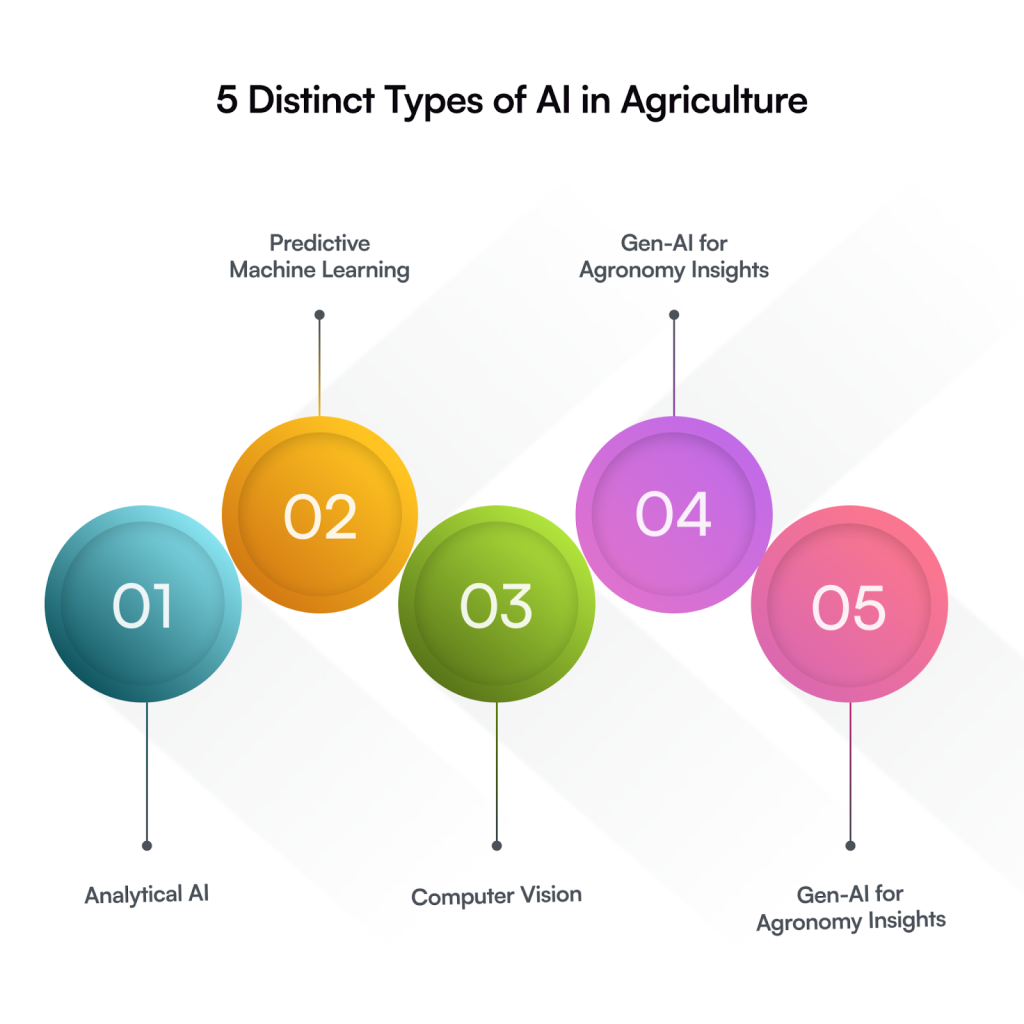
Analytical AI
With the help of Analytical AI, you can utilize the enormous amount of both historical and current data to discover various patterns. If you were to check the moisture levels of the soil and the production records for the past few years, the AI would come up with an ideal irrigation schedule and also recommend the use of a different fertilizer.
It is really a relief because these intelligent farm management platforms are becoming more and more efficient thanks to Analytical AI, which is leading to less guessing and better implementation of plans.
2. Predictive Machine Learning (ML)
By leveraging the power of predictive machine learning models, farmers can forecast their crop yields or the ongoing market demands to estimate pest outbreaks, rainfall patterns, etc.
Such algorithms allow farmers to create an effective plan and be ready for any unavoidable circumstances. How grateful it sounds that farmers can predict a week before regarding the disease that might spread in the field.
3. Computer Vision
Drones and cameras allow AI to see what we would not be able to with our naked eye. Computer vision allows computer systems to detect signs of nutrient deficiency, weed invasion, and disease in large amounts of crops. Farmers can now see everything from above and target their actions, ultimately lowering the cost of producing and protecting their yield.
4. Robotics & Autonomous Systems
AI is the combination of machines and technology. Such examples are self-driving farm vehicles, robotic weeders, and robotic harvesters. With the help of robots, farms are able to reduce labour costs, increase the efficiency of their inputs, and keep working 24/7 at a very high level of accuracy. This tech has been a major relief for farms that have difficulty with labor supply.
5. Generative AI for Agronomy Insights
Generative AI is the next frontier. We will use generative A.I. (using large language models and advanced algorithms) to not only create agronomic knowledge but also to translate agronomic advice into the languages of each area. Generative A.I. will also allow for the simulation of possible crop scenarios via the input to the generative A.I. systems.
Top AI Use Cases in the Agriculture Sector
AI is no longer confined to research labs or experimental farms; it’s actively shaping day-to-day agricultural operations. From seed to market, here are the most impactful AI use cases in farming today:
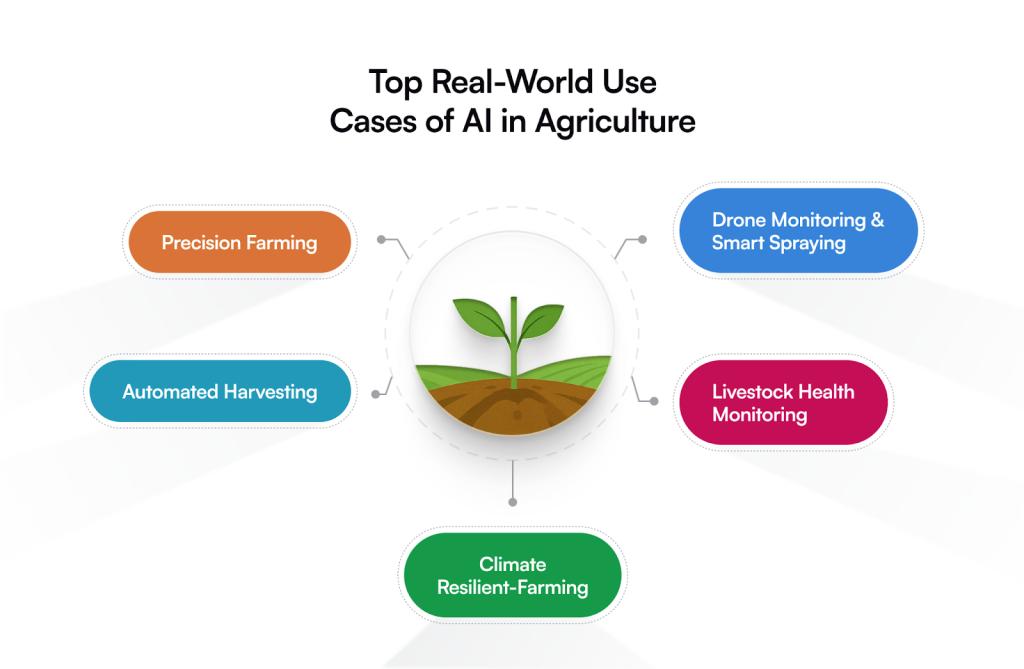
Precision Farming
Through precision agriculture, AI assists farmers in managing their crop inputs, including fertilizer, pesticides, and water. As a result, each acre can have lower operating costs while also producing higher yields than before.
For example, CropX, a startup in the field of agriculture technology, combines the data from soil sensors with AI to provide irrigation and fertilization plans that are customer-specific. The farmers who partake in the program say that up to 40% of water is saved.
Drone Monitoring and Smart Spraying
Farmers’ aerial scouts are drones equipped with artificial intelligence and computer vision that allow for mapping fields, tracking the condition of crops, as well as performing precision applications of pesticides.
Drones are used by farmers to offer crop treatment through their drone systems instead of applying pesticides haphazardly. This has allowed farmers to decrease their chemical application by 80%.
Automated Harvesting
Harvesting is typically the most work-heavy process in farming. AI-powered automated harvesters are supporting farmers to get through the lack of available workers, together with the use of technology, which also significantly lowers their dependence on seasonal labour.
As an example, the company known as Agrobot has created a nifty strawberry-picking machine that not only sees but also picks the ripe berries without damaging them. Large farms are starting to use these kinds of machines more and more, even though they are quite costly at the moment.
Livestock Health Monitoring
Artificial intelligence (AI) is not solely focused on agriculture; however, it can be of great help in the livestock industry as well. AI-powered wearable devices and computer vision systems keep a close watch on the animals’ behaviour, signal the onset of disease, and make the feeding more efficient.
Climate-Resilient Farming
Climate change is a major source of concern for the future of food supply worldwide, and AI is playing a major role in helping farmers adjust to the changes. Accurate models draw in the data on local weather, soil conditions, and plant growth to recommend sustainable agriculture.
In India, the AI Sowing App, powered by Microsoft, has already brought about a 30% increase in the output of smallholder farmers [Source]. The app guides the best time to sow based on the weather forecast and soil conditions.
Supply Chain Optimization
Farming is not the only thing that agriculture includes; it has an impact on storage, transportation, and markets as well. Supply chain platforms that are powered by AI predict the need, administer the stock, and find ways to decrease food waste.
To give you an example, the Watson Decision Platform for Agriculture, developed by IBM, combines data from the weather, the Internet of Things and the market to give supply chain management a new, efficient way for agribusinesses.
Benefits of AI in Agriculture
AI is changing the agriculture industry to one that is data-driven, efficient, and environmentally friendly, whereas it used to be a labour-intensive and intuition-driven practice.
Although the use cases demonstrate the functioning of AI, the main worth is in the measurable advantages that it provides to the farmers, the agribusiness sector, and also the consumers.
Here are the key benefits explained in depth:
Increased Productivity and Crop Yields
Artificial Intelligence (AI) will allow farmers to experience higher productivity of farm produce. Farmers have, for many years, relied on Soil Data, Satellite Imagery, and Predictive Analytics as ways to assist in making decisions towards Increasing Farm Production through Evidence-Based Agricultural Decisions that are supported by Data.
Because AI is allowing farmers to have better data-driven Farm Management Systems, it has reduced the amount of time taken for farmers to conduct trial and error in the management of their farm operations.
Cost Reduction and Resource Efficiency
By using AI to manage their resources, farmers are able to significantly reduce their costs through efficient use of these same resources. Because of this, they will be able to direct more of their finances towards the highest return on investment.
Efficient resource allocation means less dependency on guesswork. With better planning, farmers avoid overspending while also protecting valuable resources that contribute to long-term financial sustainability.
- Risk Mitigation Against Uncertainty
Agricultural producers face the challenges of unpredictable events such as weather changes, shifts in market prices and pests. Through advances in artificial intelligence (AI), agricultural producers can forecast risks and allow them time to develop risk management plans.
- Labor Optimization and Automation
Labor shortages are a global challenge, especially in regions where younger generations are moving away from farming. AI-powered robotics and automation fill this gap. This reduces dependency on manual labour while improving overall efficiency. As a result, farms can operate smoothly even with fewer workers available.
Labour optimization not only saves time but also enhances productivity at every stage. By minimizing human error, automation ensures higher consistency and greater precision in daily operations.
- Sustainability and Environmental Protection
The concept of eco-friendliness has transitioned from being a mere option to a mandatory requirement in the current world. By the use of Artificial Intelligence, the efficiency can be enhanced, and the quantity of chemicals used in agriculture can be reduced.
Thus, the agricultural production will have less negative impacts on the environment through better monitoring and planning and by facilitating the implementation of green farm practices. As a result, this will ensure a sustainable balance of growth and sustainability in agriculture.
- Data-Driven Decision Making
Maybe the most significant change that AI gives to the world is the supply of data to farmers. Smallholder farmers in India or Africa, who have been dependent on gut feeling, can now decide on the basis of AI predictions that are given even through a basic mobile app.
It assists them in selecting the appropriate time for planting, harvesting, and managing the resources in a way that is effective, thus making sure that the decisions are smart throughout. Making decisions based on data lowers the risk and increases the level of control over the results.

How to Optimize AI in Agriculture
Introducing AI in agriculture is not only a case of a mere acquisition of high-tech equipment; it demands a wise approach to make the technology truly beneficial. A large number of farmers and agribusinesses do not achieve outcomes as they expedite the process of adoption by skipping the proper planning stage.
The ways of optimization of the AI implementation by the agricultural stakeholders are as follows:
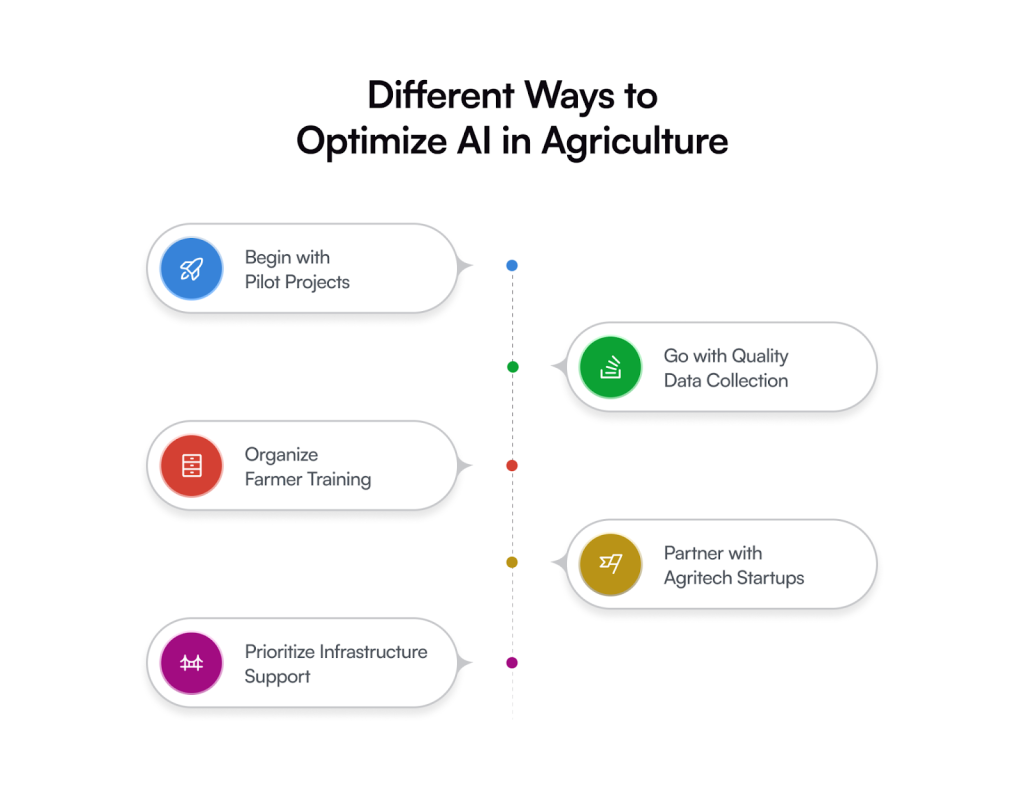
Start Small with Pilot Projects
Using AI on a huge scale immediately may seem overwhelming and cost-intensive for farmers. For that reason, it is advisable to implement small “pilot” AI projects first.
Monitoring fields from drones, irrigating crops with AI and developing new tools to detect pests are all examples of AI applications that farmers could begin with. After successful pilots show a return on investment, these technologies can be scaled up and used on larger areas of the farm.
Invest in Quality Data Collection
Artificial intelligence (AI) essentially utilizes the datasets to which it has access for its strength and flexibility. Lack of or inconsistent datasets will provide an AI with inaccurate results, and therefore it is essential for a farmer to make sure that all sensors, drones and Internet of Things (IoT) devices are calibrated correctly and maintained consistently.
A good approach is to partner with an agritech provider that has expertise in validating datasets, as well as offering software tools for cleaning, standardizing and integrating datasets.
Build Farmer Training and Awareness Programs
AI adoption often fails because farmers aren’t trained to use it effectively. Agricultural organizations, governments, and AI solution providers must conduct capacity-building workshops to help farmers understand:
- How to interpret AI insights.
- When to trust algorithms versus intuition.
- To blend AI with the existing agricultural approach.
Farmers can avoid viewing artificial intelligence as a “black box” and instead view it as a partner in the decision-making process.
Collaborate with Agritech Startups and Research Bodies
Agribusiness partners with research institutions, technology companies, governments and others to create a collective relationship that helps develop successful Artificial Intelligence (AI) projects in Agriculture.
By building partnerships, these producers can connect technology with local knowledge, allowing them to be successful when integrating AI into their business practices. For instance, Microsoft partnered with ICRISAT (International Crops Research Institute for the Semi-Arid Tropics) to develop the AI Sowing App.
Ensure Policy and Infrastructure Support
AI thrives in ecosystems where there is digital connectivity, reliable power, and supportive government policies. For example:
- Subsidies for smart farming equipment.
- 5G-powered rural connectivity for real-time AI insights.
- Open-data policies for agricultural research.
Governments and agribusiness leaders must work hand-in-hand to provide the infrastructure backbone AI requires.
Why Partner with an AI Software Development Company Like Galaxy Weblinks
Artificial intelligence is not a futuristic concept anymore; it has already changed the agriculture sector massively. The technology has empowered farmers to adopt a smart way of working instead of the hard way. Actually, the whole force of AI can be made available only when it is effective and simple, facts-oriented for a farmer and an agri-business.
In such a case, you can avail the advantage of tailor-made AI solutions by collaborating with an established AI software development company such as Galaxy Weblinks.
We make use of certain technologies in the agribusiness sector that can simplify the task of the human decision-maker. It will help the farmers monitor crops, forecast yields and also detect the occurrence of pests.
Consequently, it will not only boost their output but also implement best practices and save the use of resources. So, contact us and be a part of futuristic AI-based agriculture.
FAQs
1. How is AI used in agriculture today?
Artificial intelligence in the agricultural field can be implemented in various ways to achieve precision farming, drone monitoring, predictive analytics, and automated equipment. The use of AI is now on the rise as farmers are rapidly adopting new technologies to diagnose plant diseases, manage water, estimate crop yields, and improve animal health. In this way, the farmers have a chance to operate cost-effectively and in a more eco-friendly way.
2. Can small farmers benefit from AI in agriculture?
Yes. Contrary to the belief that AI is only for large-scale agribusinesses, small farmers also benefit through mobile-based AI apps, low-cost IoT sensors, and chatbot advisory systems. For example, AI sowing apps in India have helped smallholder farmers increase yields by up to 30% without heavy investments.
3. What are the main benefits of AI in agriculture?
The key benefits include higher crop yields, reduced costs, better risk management, optimized labor use, and sustainable farming practices. AI helps farmers make data-driven decisions instead of relying solely on intuition, which is especially valuable in the face of climate change and market volatility.
4. Does AI replace farmers in agriculture?
No. AI does not replace farmers—it assists them. The role of AI is to reduce manual effort, automate repetitive tasks, and provide insights that help farmers make smarter decisions. Farmers remain central to agriculture, while AI acts as a powerful decision-support and productivity tool.
5. What is the future of AI in farming?
The future of AI in agriculture lies in climate-smart farming, autonomous machinery, generative AI for agronomy insights, and farm-to-market supply chain optimization. As technology becomes more affordable and accessible, AI will play a crucial role in feeding a growing global population while ensuring sustainability.