

In 2026, AI-powered eCommerce is expected to reach $9.9 billion. Not hype. Real money. And it’s heading toward $22.6B by 2032, riding a 14.6% CAGR that’s not slowing down. Online retail isn’t “adding AI.” It’s being rebuilt by it.
For business owners, this shift isn’t optional. It’s just math. AI development now decides what your customers notice, what they ignore, and what they end up buying, sometimes before they even realize it. That’s the game.
Teams using AI in eCommerce move more quickly. Fewer manual loops. Less waste. More signal, less noise. They catch revenue leaks early, before finance notices, before churn shows up on a dashboard.
This is what modern eCommerce looks like now. Messy, fast, data-led. AI isn’t helping the business anymore; it’s making the critical decisions. And honestly, that’s either a threat or an advantage. Depends on whether you’ve adopted it yet.
This blog breaks down how AI is actually reshaping online stores today, pricing, challenges, decisions, all of it. No fluff. Just practical use cases, real benefits, and clear strategies to implement without blowing up your stack.
Read this blog till the end as your online store’s success depends on it.
What is AI in eCommerce?
AI in eCommerce is no longer some experimental tech that only large enterprises talk about. It has quietly become the engine behind many high-performing online stores. In simple terms, it is the use of intelligent systems that analyze customer behavior, learn from data, and help businesses make faster and smarter decisions, often in real time.
Think about how people shop now. They want relevance, instantly, and products that make sense. Search that works fast. Delivery dates that are actually true. Support that doesn’t ghost them.
AI is what makes that happen. It spots behavior patterns most teams never see. It predicts intent before it’s obvious. It smooths out the bumps in the buying journey, the small frictions that kill conversions.
For a business owner, this changes everything. Fewer missed chances. Less manual work. And more conversions without hovering over every tool, team, or workflow. That being said, AI won’t be a differentiator anymore. It’ll just be how successful online stores run.
Why AI Adoption is Accelerating the eCommerce Landscape
AI isn’t growing because it’s a trend. It’s growing because eCommerce pressure is real. Demand is unpredictable. Margins are thinner than they look. And customers switch stores in seconds.
Below is the list of top benefits of AI in eCommerce:
- Cart Abandonment Is a Quiet Revenue Killer
Nearly 70% of shopping carts are abandoned. And no, it’s not just a UI/UX design problem. Hidden fees. Long checkout steps. Shipping uncertainty. Too many decisions are stacked at once.
AI pinpoints exactly where intent drops. It analyzes checkout behavior, flags friction points, and reacts in real time. Dynamic incentives. Smarter prompts. Simplified paths to purchase.
Revenue that used to vanish mid-checkout can now be recovered systematically, and not manually.
- Demand Forecasting Is No Longer Predictable
Demand doesn’t move in clean lines anymore. It jumps, spikes, and collapses. Sometimes within hours.
Seasonality still matters, but it’s no longer predictable on its own. Promotions, social platforms, and external events now influence buying behavior in ways spreadsheets can’t model fast enough. By the time manual forecasts are updated, the damage is already done.
- Margins Are Shrinking, Quietly
Margins don’t disappear overnight. They erode quietly, order by order.
Customer acquisition costs rise. Shipping gets more expensive. Returns compound. Small inefficiencies stack up across thousands of transactions. Most teams only see the impact after profitability drops.
AI helps protect margins at the operational level. It automates repetitive processes, optimizes pricing based on demand and inventory, and reduces waste across fulfillment and returns.
- Experience Is the Only Real Differentiator Left
Customer experience is no longer a nice-to-have. It’s the deciding factor.
Shoppers can find similar products anywhere. Price differences are minimal. What separates brands now is how easy it is to buy, get help, and come back again.
AI enables relevance at scale. Smarter product recommendations, faster issue resolution, personalized journeys that reduce friction instead of adding noise. As a result, customers spend less time searching and more time purchasing.
Applications of AI That Are Redefining How Online Stores Operate
AI is no longer experimental in eCommerce. It’s becoming infrastructure.
Not a side project. Not a pilot. It’s how modern stores run day to day, understanding intent, automating operations, predicting risk, and reducing guesswork where mistakes are expensive.
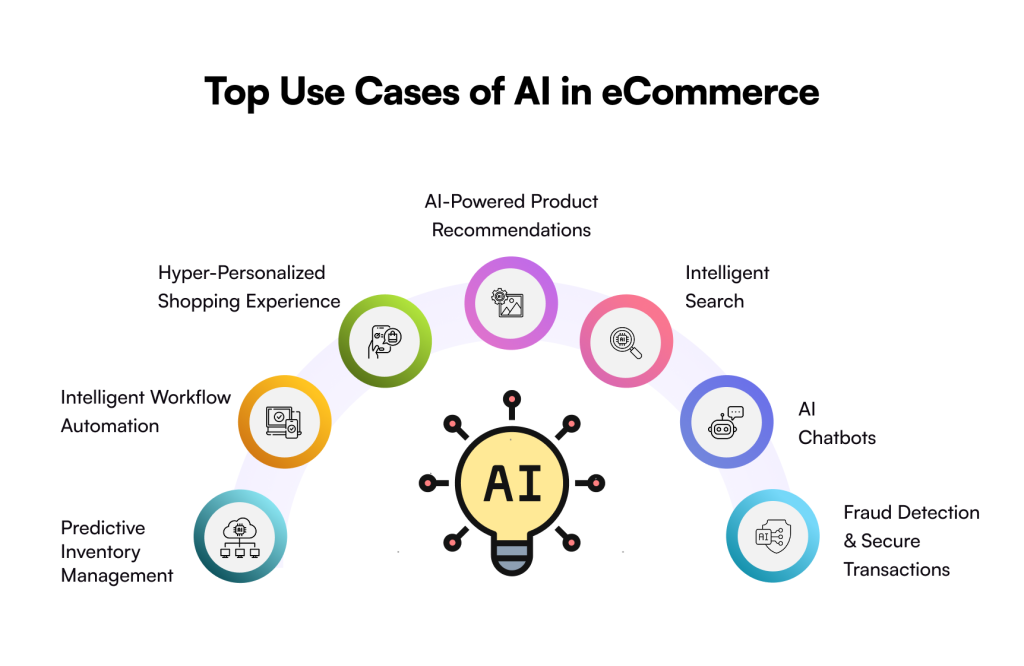
Let’s check out the top AI use cases in eCommerce:
- Predictive Inventory Management
Forecasting engines rely on machine learning models trained on historical and real-time data to anticipate demand fluctuations. These systems help businesses plan inventory smarter, reducing both stockouts and surpluses that strain cash flow.
- Intelligent Workflow Automation
Most eCommerce teams lose time on repeat work. For instance, order status updates. Ticket routing. Campaign execution. Data handoffs between tools.
AI automates these workflows end-to-end. Smaller, task-focused models handle high-volume actions fast and cheaply. No lag. No overengineering. The value is simple: faster execution, fewer manual errors, enabling teams to focus on decision-making.
- Hyper-Personalized Shopping Experience
Personalization isn’t about first names anymore. Customers expect relevance across the entire journey.
AI analyzes behavior, context, and intent in real time. It adapts messaging, product content, and on-site flows to match what a shopper actually wants right now. This reduces friction. Shoppers move faster. Decisions feel easier. Conversion rates improve without adding more steps.
- AI-Powered Product Recommendations
Bad recommendations kill trust, and good ones shorten the path to purchase.
AI evaluates browsing behavior, purchase history, and product similarity to surface items with high buying intent. Lightweight models handle this in real time, even during traffic spikes.
The outcome is measurable. Higher average order value. Faster product discovery. Less reliance on discounts to drive sales.
- Intelligent Search
Search is no longer keyword matching because shoppers don’t think in keywords.
AI-powered search understand intent behind natural language queries like “budget office wear” or “gift for a first-time runner.” It interprets context, price sensitivity, and category intent. This reduces abandonment. Customers find what they want faster. Fewer dead searches. Less frustration.
- AI Chatbots
Support doesn’t scale with people alone. And scripted bots don’t help.
LLM-powered chatbots handle real conversations. They explain products, answer questions, guide decisions, and resolve common issues without escalation. The business impact is clear. Lower support load. Faster resolution times. Better experience without increasing headcount.
- Fraud Detection & Secure Transactions
Fraud doesn’t announce itself. It hides in patterns humans don’t notice.
AI monitors behavior across transactions and flags anomalies before damage spreads. Specialized models identify risk without slowing checkout or adding friction for real customers. The result is protection without penalty. Fewer chargebacks. Safer transactions, and trust stays intact.
Challenges Businesses Must Understand Before Adopting AI
Below is a list of challenges businesses must understand before they leverage the capabilities of artificial intelligence for their eCommere store:
- Data Quality & Security
AI is powerful, sure, but it won’t rescue bad data. If your catalog is messy, customer info is outdated, or security is weak, the system learns the wrong things. And wrong insights cost money. Clean data now influences revenue, personalization, and even trust. Ignore it, and AI becomes a liability instead of an advantage.
- Limited Talent & Expertise
Many businesses buy the tool first and figure out people later. Rarely works. AI needs direction. Teams that understand workflows, customers, and model behavior extract real value. Without that, adoption slows. Confidence drops. The tool just exists, is expensive, and underused.
- High Cost & Unclear ROI
AI requires upfront spend, yes. But uncertainty is the bigger risk. If success isn’t defined early, more conversions, lower costs, faster ops, and leadership gets uneasy. When AI ties directly to outcomes, though, it stops feeling like a gamble and starts looking like smart leverage.
- Legacy System Integration
AI doesn’t just plug in and start performing. Older platforms weren’t built for real-time intelligence, so integration can drag a bit, sometimes more than expected. Still, once systems align, workflows smooth out, decisions speed up, and the early friction fades.
- Ethical & Legal Risks
AI moves fast. Mistakes move faster. Bias, unclear data usage, weak governance; they don’t just create operational issues, they erode brand trust. Understand the constraints beforehand, plan around them, adjust as you go, and what feels risky today often becomes tomorrow’s growth engine.
How Much Does It Cost to Implement AI in eCommerce
The cost of implementing AI in eCommerce depends less on the technology itself and more on how deeply you want AI embedded into your operations. Some businesses start with lightweight automation, while others invest in fully integrated AI-powered ecommerce solutions that transform the entire AI in the online store experience.
Here’s a realistic breakdown based on app complexity:
| App Type | Estimated Cost | Features |
| Basic AI Integration | $15K to $40K | AI chatbotsBasic product recommendationsSimple automation |
| Mid-Level AI Integration | $40K to $1,20,000 | Intelligent searchAdvanced recommendation enginesMarketing automation |
| Advanced Level AI Integration | $1,20,000 to $3,50,000 | Real-time personalization enginesDynamic pricingFraud detection |
Future Trends: Where AI in eCommerce is Headed
- Predictive Commerce: Already used by major retailers for demand forecasting and behavioral targeting. The trend is toward deeper prediction, not basic analytics.
- Conversational Shopping: Rapidly accelerating because of generative AI. Search is shifting from keywords to natural language queries. Even platforms like Shopify are experimenting here.
- Hyper-Personalization: No longer optional. Customers now expect relevance automatically. The future is full-experience personalization, not just recommendations.
- Autonomous Operations: AI is steadily moving from “assistive” to “decision-support.” Full autonomy is far off, but operational automation is absolutely increasing.
- AI Shopping Agents: This is early-stage but VERY real. Tech leaders are betting big on agent-led commerce, where AI helps users evaluate and purchase.
- Frictionless Fraud Detection: Already a heavy investment area because eCommerce fraud keeps rising globally.
How to Successfully Implement AI in Your Online Store
AI doesn’t create impact just because you installed a tool. It needs direction, structure, and business intent.
Many stores rush in chasing innovation, and then struggle to see returns. The smarter approach is slower, deliberate, and tied to outcomes. Do it right, and AI becomes a serious growth lever. Do it casually, and it turns into another expensive experiment.
- Define Clear Objectives
Start with the “why,” always. AI without a business goal is just noise disguised as innovation. Maybe you want fewer abandoned carts, better forecasts, lower support load, pick something measurable. Clear objectives keep investments grounded and prevent teams from drifting into endless testing that never really moves revenue.
- Audit and Structure Data
Before AI, fix the data. Not exciting work, honestly, but it shapes everything that comes next. When product data is scattered, customer records are duplicated, and formats are all over the place, AI doesn’t correct it. It scales the mess. Bad inputs turn into misleading insights, and decisions start drifting away from reality. Clean, connected data changes that. Models learn faster, predictions sharpen, personalization actually feels relevant.
- Choose the Right AI Solutions
Complex doesn’t always mean better. Some problems need advanced models, others just need smart automation. The real win is choosing tools that fit your stack, your budget, and your team’s ability to manage them. Overbuilding too early slows momentum and, honestly, drains capital.
- Prioritize Security and Privacy
AI touches sensitive data, transactions, behavior, and identities. One weak control can damage the trust you spent years building. Strong governance, access controls, compliance checks, not glamorous work, but necessary. Customers notice when brands handle data responsibly, even if they never say it out loud.
- Start Small and Scale Strategically
You don’t transform a store overnight. Begin with a focused use case, recommendations, search, and maybe support automation. Prove the value first. Early wins calm stakeholder nerves, justify budgets, and create internal pull for expansion instead of resistance.
- Train Your Team
Tools don’t replace people; they elevate the teams that know how to use them. Give employees context. Help them understand outputs, question anomalies, and step in when needed. Familiarity builds trust, and trusted systems actually get used in daily workflows.
- Monitor and Optimize Continuously
AI isn’t “set it and forget it.” Customer behavior shifts, markets change, models drift. Keep watching the performance. Adjust when signals weaken. Optimization is quiet work, ongoing, but it keeps AI aligned with business reality instead of yesterday’s data.
When implementation is thoughtful, AI stops being a shiny add-on. It becomes operational muscle, supporting smarter decisions, smoother experiences, and growth that doesn’t rely purely on guesswork.
Conclusion
AI in eCommerce is no longer a future conversation. It’s already shaping how stores attract buyers, make decisions, and compete. Customer expectations keep rising. Margins keep tightening. And the brands that adapt early tend to stay visible, while the hesitant ones slowly fade into the background. It sounds harsh, but the market rarely waits.
Every move you make with AI compounds over time. The right models sharpen personalization. Smarter forecasts prevent costly mistakes. Intelligent automation frees teams to focus on growth instead of constant firefighting.
AI doesn’t replace business instinct; it strengthens it. When strategy leads, and technology follows, online stores become more resilient, more responsive, and easier to scale.
At Galaxy Weblinks, we help businesses approach AI with clarity and intent. From identifying practical use cases to building solutions that actually hold up under real traffic and real customers. No unnecessary complexity. No chasing trends. Just systems designed to support growth and keep you competitive in a landscape that changes faster than most expect.
Because in eCommerce today, standing still is the real risk.
FAQs
1. How is AI transforming the eCommerce industry?
AI is pushing online stores to run smarter, not harder. It personalizes journeys, sharpens product discovery, predicts demand, and blocks fraud. Less manual chaos. Faster decisions. Customers notice the ease, and conversions usually follow.
2. Is AI in eCommerce only for large businesses?
Used to be, not anymore. AI tools are far more accessible now. Mid-sized stores are adopting fast, and even smaller brands are testing the waters. Start focused, maybe recommendations or chatbots, prove value, then expand.
3. What are the biggest benefits of implementing AI in an online store?
Think higher conversions, tighter inventory control, lower operational drag, better retention. AI turns scattered data into direction. Decisions feel less like guesses, more like strategy backed by signals.
4. Is AI expensive to implement in eCommerce?
It can be, if you jump in blindly. The smarter move is linking AI to clear outcomes early: revenue lift, cost savings, operational speed. When impact is visible, the investment stops feeling heavy.
5. What should businesses consider before adopting AI in eCommerce?
Get the basics right first. Clear goals. Clean data. Systems that can integrate. Teams are ready to adapt. AI rewards preparation, rush it, and it becomes noise instead of leverage.