


Embedded software runs the world quietly. Cars. Medical devices. Factories. Smart products. None of them work without it. And yet, this kind of software is nothing like web or mobile apps. It lives under pressure. Tight memory. Strict timing. Real hardware. Real consequences.
That’s why embedded software development can’t start with code. It starts with limits. Power budgets. Clock cycles. Safety rules. Miss these early, and fixes later get ugly. Expensive too.
This guide breaks down the complete embedded software development process. From concept to deployment. No fluff. Just how real systems are actually built. Requirements. Hardware–software co-design. RTOS choices. Drivers. Testing. Security. Updates.
If you’re building devices that must run for years, not weeks, this matters. Whether you’re a startup, OEM, or enterprise team, understanding this process helps you avoid silent failures and build systems that simply don’t break when it counts.
Complete Process to Build Embedded Software
Embedded software development doesn’t start with code. It starts with constraints. Hardware limits. Timing rules. Power budgets. Miss these early, and everything breaks later. Good embedded software development services follow a structured, reality-first process. Not theory. Not shortcuts.
Starting by understanding the constraints and focusing on actual needs helps build robust embedded applications. Let’s check out the different steps in developing such a software solution.
1. Requirement Analysis & System Understanding
This phase sets the direction. Teams study the hardware. Microcontroller type. Memory size. Clock speed. Interfaces. Sensors. Actuators. Then come functional requirements. What must the device do. And non-functional ones. Response time. Power usage. Safety. Compliance. In embedded software development, vague requirements are dangerous. Precision matters.
2. Hardware–Software Co-Design
Here, software and hardware teams align. Pin configurations. Communication protocols. Interrupt priorities. Power modes. This is where many projects fail quietly. Good embedded software development services validate assumptions early. They simulate. They prototype. They avoid late surprises that cost weeks.
3. Architecture & RTOS Selection
Next comes system design. Bare-metal or RTOS. Task scheduling. Memory layout. Error handling. The choice depends on complexity. Simple device? Bare-metal works. Multi-tasking system? RTOS makes sense. FreeRTOS (popular for embedded systems). QNX (automotive, medical). VxWorks (popular for critical systems). Architecture defines scalability. Get this wrong, refactoring hurts.
4. Driver and Low-Level Development
This is the foundation. Writing drivers for GPIO, UART, SPI, I2C, CAN. Talking directly to hardware registers. Timing is critical here. One wrong delay and sensors misbehave. Embedded software development demands patience at this stage. Debugging happens with oscilloscopes, not print statements.
5. Application Logic Implementation
Now the device starts to “think.” Business logic. State machines. Control algorithms. Data processing. Everything runs on top of the low-level layer. Code must be efficient. Memory leaks are unacceptable. CPU cycles are precious. Clean logic keeps systems stable over years.
6. Integration & Middleware Setup
Many devices talk to the outside world. Cloud. Mobile apps. Other machines. Middleware handles this. MQTT. HTTP. BLE. Modbus. CANopen. Integration complexity is often underestimated. Embedded software development services plan for retries, packet loss, and unstable networks.
7. Testing at Every Level
Testing is not a phase. It’s constant. Unit tests for logic. Integration tests for modules. Hardware-in-the-loop testing for real-world behavior. Stress tests. Fault injection. Power cycling. Good embedded software development treats testing as insurance, not overhead.
8. Security & Compliance Hardening
Modern devices must be secure. Secure boot. Firmware signing. Encrypted communication. Role-based access. Compliance checks follow. Medical. Automotive. Industrial standards. Skipping this stage invites disasters later. Security in embedded software is not optional anymore.
9. Optimization & Power Management
Once stable, teams optimize. Reduce CPU usage. Lower memory footprint. Improve battery life. Sleep modes. Interrupt tuning. This step separates average builds from production-grade systems. Embedded software development lives in these details.
10. Deployment, Monitoring & Updates
Finally, the software ships. But work doesn’t end. Devices need updates. OTA mechanisms. Rollback strategies. Field monitoring. Good embedded software development services plan for the next five years, not just launch day.

Key Components of Embedded System Software
Embedded systems look simple from the outside. A device turns on. Does its job. Stays quiet. Inside, it’s controlled chaos. Every layer matters. That’s why embedded software development focuses less on flashy features and more on solid building blocks. Software development in embedded system environments depends on these components working together. No room for guesswork.
Bootloader
This is the first thing that runs. Every time.
It initializes hardware. Sets memory. Loads the main firmware. If the bootloader is sloppy, the device won’t even start. Updates fail. Devices brick. Good embedded software development treats the bootloader like sacred ground.
Real-Time Operating System (RTOS)
Not all systems need it. Many do.
An RTOS manages tasks, timing, and priorities. It ensures critical operations happen exactly when they should. No delays. No surprises. In software development in embedded system projects with sensors, motors, or real-time control, an RTOS keeps things predictable.
Device Drivers
Drivers talk directly to hardware. Sensors. Displays. Motors. Communication chips.
Bad drivers cause flaky behavior. Random crashes. Weird bugs no one enjoys debugging at 3 a.m. Clean drivers make hardware feel reliable and boring. That’s a compliment.
Firmware Application Layer
This is where product logic lives. The rules. The workflows. The behavior users actually care about.
In embedded software development, this layer must be lean. No wasted cycles. No bloated logic. Every line should earn its place. Performance here directly affects battery life and responsiveness.
Communication Stacks
Devices rarely work alone now. They talk. A lot.
UART, SPI, I2C for local comms. CAN for automotive. TCP/IP, MQTT, BLE for connected systems. These stacks handle data flow. When poorly implemented, data drops. Latency spikes. Systems desync. Users notice.
Memory Management
Embedded systems don’t have infinite RAM. Or storage.
Memory leaks aren’t “minor bugs” here. They’re system killers. Good software development in embedded system projects plans memory usage early. Static allocation. Careful buffers. No surprises in production.
Security Modules
Security isn’t optional anymore.
Secure boot. Encryption. Authentication. Key storage. These components protect firmware and data from tampering. Weak security turns devices into liabilities. Strong security builds trust quietly.
Diagnostics and Logging
When something fails, you need answers. Fast.
Logs, error codes, health checks. These components help teams debug issues in the field without physical access. Skipping this layer saves time early. Costs months later.
Key Benefits of Embedded Software Development
Embedded systems don’t shout. They just work. When done right, no one notices them. That’s the real power of embedded software development. It sits quietly inside devices and makes everything reliable, fast, and efficient. Software development in embedded system environments is less about screens and more about outcomes.
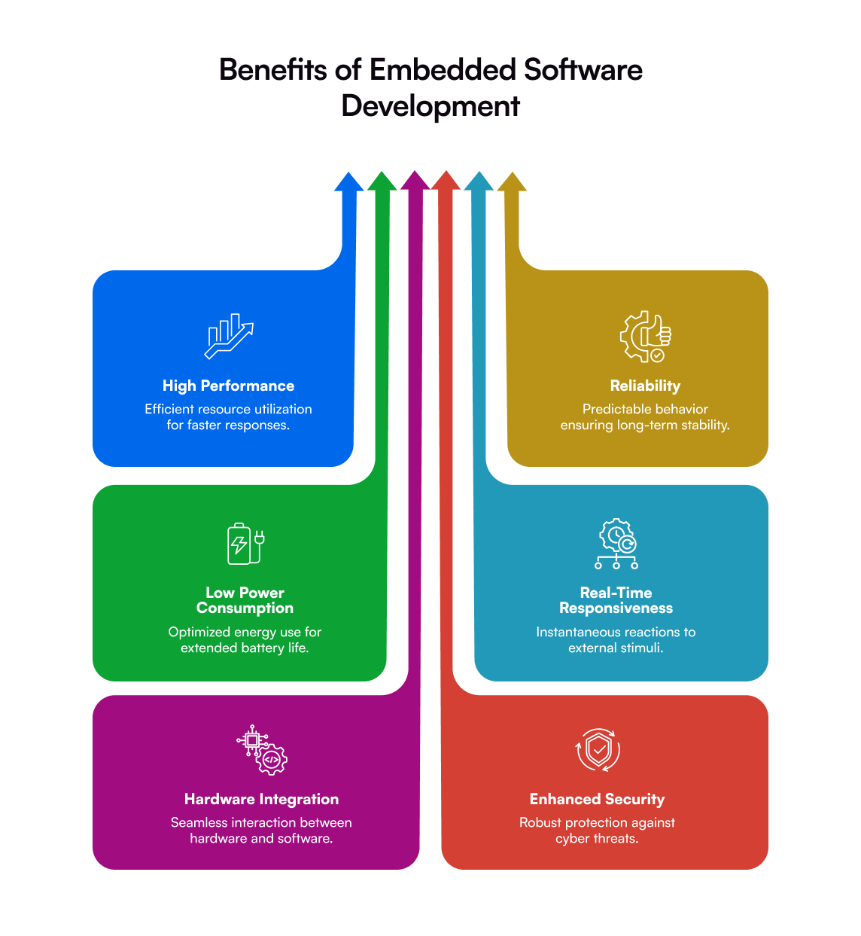
High Performance With Minimal Resources
Embedded software is built to do more with less. Limited memory. Limited power. Tight timing.
Well-written firmware squeezes every cycle. Every byte. Devices respond faster. Boot quicker. Run smoother. This efficiency matters in real-world conditions, not demos.
Improved Reliability and Stability
These systems run for years. Sometimes nonstop.
Embedded software development focuses on predictability. No random crashes. No memory leaks slowly killing the system. Stability here isn’t a nice-to-have. It’s the product itself.
Lower Power Consumption
Battery life is everything.
Optimized software reduces CPU usage, controls sleep states, and avoids waste. In software development in embedded system projects, small improvements add up. Longer battery life. Less heat. Happier users.
Real-Time Responsiveness
Timing matters. A lot.
Embedded software reacts instantly to inputs. Sensors. Buttons. Signals. With real-time logic, systems respond exactly when required. Not late. Not “almost.” That precision enables medical devices, automotive controls, and industrial automation to work safely.
Tight Hardware Integration
Hardware and software aren’t separate worlds here. They’re one system.
Custom firmware talks directly to sensors, motors, displays, and chips. This deep integration unlocks capabilities generic software can’t. Better accuracy. Better control. Better performance.
Enhanced Security at the Device Level
Security starts inside the device.
Secure boot. Encrypted communication. Access control. Embedded software development protects systems before data ever reaches the cloud. This reduces attack surfaces and keeps sensitive operations safe from the ground up.
Long-Term Cost Efficiency
Well-built embedded software lasts.
Fewer failures. Fewer recalls. Fewer field fixes. Software development in embedded system environments reduces maintenance costs over time. Upfront effort saves money later. A lot of it.
Scalability for Product Families
One solid firmware base supports many devices.
Different models. Different features. Same core logic. This makes scaling product lines easier and faster without reinventing everything.
Better User Experience Without UI Noise
Users feel quality even if they don’t see it.
Fast responses. No glitches. Predictable behavior. Embedded systems shape experience quietly. When devices feel “solid,” software is usually the reason.
Embedded software development isn’t flashy. It’s foundational. When it’s done right, devices earn trust. And trust is hard to replace.

Essential Tools for Embedded Software Development
Embedded systems don’t forgive sloppy tooling. One wrong config and the device just sits there. Dead. That’s why embedded software development depends heavily on the right tools. Not fancy ones. Reliable ones. Especially in regulated spaces like automotive embedded software development, tooling can make or break timelines.
Integrated Development Environments (IDEs)
This is where everything starts.
Tools like Eclipse, Keil, IAR, and VS Code (with extensions) help developers write, compile, and debug firmware in one place. A good IDE speeds things up. Bad ones slow teams down quietly. In embedded software development, clarity matters more than polish.
Compilers and Toolchains
Code must talk to hardware. Exactly.
GCC for ARM, LLVM, and vendor-specific toolchains handle this translation. Optimization flags matter here. A lot. The right compiler setup improves speed, reduces memory use, and avoids weird runtime bugs.
Debuggers and Emulators
You can’t fix what you can’t see.
JTAG and SWD debuggers like SEGGER J-Link or ST-Link let developers step through code on real hardware. Breakpoints. Register views. Memory inspection. In automotive embedded software development, this is non-negotiable. Safety depends on it.
RTOS and Middleware
Bare metal works. Until it doesn’t.
FreeRTOS, Zephyr, VxWorks help manage tasks, timing, and resources. Middleware handles communication stacks, file systems, and device drivers. These layers reduce complexity without killing performance. When chosen carefully.
Version Control Systems
Embedded projects aren’t small anymore.
Git is standard. No debate. It tracks changes, supports collaboration, and prevents “who broke the build” moments. Embedded software development teams rely on clean versioning to manage firmware across devices and releases.
Build and Automation Tools
Manual builds don’t scale.
CMake, Make, and CI pipelines automate compilation and testing. This reduces human error. Especially useful when firmware variants multiply across hardware models.
Testing and Simulation Tools
Hardware is expensive. Bugs are worse.
Simulators and hardware-in-the-loop (HIL) testing tools validate logic before full deployment. In automotive embedded software development, simulation helps catch failures early. Before they hit the road.
Static Analysis and Code Quality Tools
Some bugs hide too well.
Tools like Coverity, MISRA checkers, and SonarQube scan code for memory leaks, race conditions, and safety violations. These are critical for long-running systems where failures appear months later.
Communication and Interface Tools
Devices talk. Constantly.
CAN analyzers, protocol sniffers, and serial monitors help debug communication. Especially important in automotive and industrial systems where timing and data integrity matter.
Good embedded software development tools don’t get in the way. They stay invisible. They help teams build faster, safer, and cleaner systems. Choose them wisely. Changing tools mid-project hurts more than people expect.
Cost to Develop Embedded System Software
Cost in embedded software development is never one-size-fits-all. It depends on hardware, risk, and how critical failure is. A simple firmware for a consumer device costs far less than safety-critical embedded systems software development used in automotive or medical products. Complexity drives everything.
Start with hardware dependency. If the software runs on off-the-shelf MCUs, cost stays reasonable. Custom boards increase effort. More testing. More tuning. More time. Costs climb fast.
Next comes system complexity. Basic control logic is cheap. Real-time scheduling, sensor fusion, communication stacks, and OTA updates aren’t. Each layer adds engineering hours. Each hour adds cost.
Regulatory requirements matter a lot. Automotive embedded software? Expect ISO, MISRA, and heavy validation. Medical devices? Even stricter. Compliance alone can take 25–40% of the total budget. Painful, but unavoidable.
Team composition also impacts pricing. Senior embedded engineers cost more. But junior teams often burn time. And money. Good embedded systems software development balances expertise with velocity.
Typical cost ranges look like this:
- Simple embedded firmware: $15,000 – $40,000 (Basic device logic. Limited interfaces. Minimal testing)
- Mid-level embedded systems: $40,000 – $120,000 (RTOS, communication protocols, performance tuning)
- Complex or safety-critical systems: $120,000 – $300,000+ (Automotive, industrial, or medical use cases. Heavy validation)
Hidden costs exist too. Debugging hardware quirks. Long test cycles. Maintenance after launch. Embedded software lives for years, not months. Updates matter.
Bottom line? Embedded software development is an investment, not a line item. Cheap builds fail quietly. Solid builds last. Choose scope wisely. Budget realistically.
Key Real-World Applications of Embedded Systems Software
Embedded systems are everywhere. Quietly running things. Making decisions in milliseconds. You don’t notice them until they fail. That’s the power of embedded systems software development. It sits deep inside hardware and just works. Most of the time.
Automotive Systems
Modern cars are computers on wheels. Engine control units. ABS. Airbags. Infotainment. ADAS. All powered by embedded software development. The code has to be fast. Predictable. Safe. One bug here is not a “minor issue.” It’s a recall. Or worse. That’s why automotive embedded systems demand strict standards and insane testing depth.
Medical Devices
Pacemakers. Infusion pumps. Patient monitors. Imaging machines. These devices rely on embedded systems software development to operate accurately, nonstop. Timing matters. Data integrity matters. Failure is not an option. Software must meet regulatory rules and still stay usable for clinicians under pressure.
Industrial Automation
Factories run on embedded logic. PLCs. Robotics. Sensors. Controllers. They manage speed, temperature, pressure, and motion. Embedded software keeps production lines moving without human input. Downtime costs real money. So reliability beats fancy features every time.
Consumer Electronics
Smart TVs. Washing machines. Wearables. Smart speakers. They all depend on embedded software development to balance performance with low power usage. Users want smooth UX. Engineers want tight memory control. The device has to do more with less. Always.
IoT and Smart Infrastructure
Smart meters. Street lighting. Home automation. Environmental sensors. These systems run in the background for years. Embedded systems software development here focuses on connectivity, power efficiency, and remote updates. Physical access is rare. Software must survive harsh conditions and bad networks.
Aerospace and Defense
Avionics. Navigation systems. Flight control. Embedded software runs under extreme constraints. Real-time response. Redundancy. Zero tolerance for failure. Development cycles are long. Testing is brutal. But the software must behave perfectly, every single time.
Telecom and Networking Equipment
Routers. Switches. Base stations. Embedded systems process massive data volumes at wire speed. Latency matters. Stability matters more. One crash can take down entire networks.
In short, embedded software development is not niche. It’s foundational. If hardware does something intelligent, embedded software is behind it. Quiet. Reliable. Critical.
Types of Embedded Software Systems
Embedded systems aren’t all the same. They vary by timing needs, complexity, and how critical failure would be. That’s why embedded software development looks different across industries. Same core idea. Very different execution.
Real-Time Embedded Systems
Timing is everything here. Miss a deadline, system fails. Think airbags, braking systems, medical devices. These systems respond instantly. Predictable behavior matters more than raw speed. Embedded software development here follows strict real-time rules. No surprises allowed.
Stand-Alone Embedded Systems
These systems work on their own. No network. No cloud dependency. Microwave ovens. Digital cameras. Simple controllers. They take input, process it, give output. Straightforward. But still needs reliable code. A crash still annoys users.
Networked Embedded Systems
Connected systems are everywhere now. Routers. Smart meters. Industrial controllers. They talk to other devices constantly. Embedded software development here focuses on communication protocols, security, and uptime. One weak link breaks the whole chain.
Mobile Embedded Systems
Portable devices with limited power. Wearables. Handheld scanners. Medical monitors. Software must be lightweight. Power-efficient. Fast enough without draining batteries. Memory optimization becomes a daily fight.
Distributed Embedded Systems
Multiple embedded units working together. Cars. Factory automation. Smart grids. Each node handles part of the job. Coordination matters. Latency matters. Embedded software development ensures these pieces don’t drift out of sync.
Safety-Critical Embedded Systems
Failure isn’t acceptable. Aviation. Defense. Healthcare. These systems go through intense testing, validation, and certification. Code changes are slow. For a reason.
Common Challenges Faced in Embedded Software Development
Embedded software development looks clean on diagrams. In reality, it’s messy. Tight. Unforgiving. Most challenges don’t show up in code reviews. They surface late. In the lab. Or worse, in the field. These challenges aren’t edge cases. They’re normal. Strong embedded software development teams plan for them early. Others learn the hard way.
Hardware constraints come first, Always
Limited RAM. Limited flash. Fixed clock speeds. You don’t get to “just add more resources.” In embedded firmware development, every byte matters. Poor memory planning early leads to random crashes months later. The worst kind.
Timing issues are brutal
Miss a deadline, system fails. Especially when RTOS in embedded systems is involved. Task priorities. Interrupt storms. Context switching overhead. One wrong configuration and critical tasks starve quietly. Debugging timing bugs takes days. Sometimes weeks.
Architecture decisions are hard to reverse
Bad embedded system architecture hurts long-term. Monolithic logic. Tight coupling. No separation between drivers and application code. It works early. Then scaling becomes painful. Refactoring embedded systems is expensive. Hardware doesn’t forgive rewrites.
Hardware–software mismatch is common
Specs lie. Or change. Sensors behave differently in real environments. Power noise exists. Temperature shifts matter. Software written without real hardware testing breaks assumptions fast. Simulation helps. But only to a point.
RTOS misuse is another trap
Teams add an RTOS too early. Or too late. Overusing threads. Poor stack sizing. Ignoring priority inversion. RTOS in embedded systems is powerful, but unforgiving when misunderstood. Complexity grows silently.
Debugging is slow and limited
No logs. No screens. Sometimes no debugger access. You rely on LEDs, registers, oscilloscopes. Embedded software development demands patience here. Traditional debugging habits don’t apply.
Security often comes last. That’s risky
Hardcoded keys. No secure boot. Open debug ports. These shortcuts ship fast. Then become liabilities. Security fixes later are painful, sometimes impossible.
Lifecycle planning gets ignored
The embedded software lifecycle doesn’t end at launch. Devices need updates. Years of them. No OTA strategy means physical recalls or dead products. That’s expensive.
Integration complexity is underestimated
Protocols fail. Networks drop. Cloud APIs change. Embedded systems live in imperfect environments. Code must assume failure. Always.

Why Embedded Software Fails: Common Mistakes and How to Avoid Them
Embedded software rarely fails all at once. It degrades. Quietly. Then one day, the device hangs. Or reboots. Or worse, fails in the field. Most failures in embedded software development aren’t caused by complex bugs. They’re caused by small, repeated mistakes.
Rushing requirements
Teams jump straight to code. Hardware details stay vague. Timing assumptions go unchecked. This always backfires. Avoid it by locking requirements early. Document constraints. Revisit them when hardware changes. Because it will.
Overengineering from day one
Too many features. Too many layers. Too much abstraction. For a device that barely needs it. Complex designs slow development and increase failure points. Start lean. Design for extension, not speculation.
Ignoring memory limits
Desktop habits sneak in. Dynamic allocation everywhere. No tracking. Memory leaks don’t crash instantly. They wait. Then strike months later. In embedded software development, plan memory upfront. Prefer static allocation. Measure constantly.
Poor handling of timing and concurrency
Tasks block. Interrupts stack. Priorities clash. Especially when an RTOS is involved. Systems look stable in testing. Then fail under real load. Avoid this by modeling timing early. Test under stress. Not just happy paths.
Treating hardware as “stable”
It isn’t. Sensors drift. Power fluctuates. Temperature changes behavior. Software built on ideal assumptions breaks in the real world. Test on actual hardware. In bad conditions. Repeatedly.
Weak error handling
Errors are ignored. Retries aren’t planned. Edge cases are skipped. Devices then freeze instead of recovering. Good embedded software development expects failure. Handles it. Logs it. Moves on.
Security as an afterthought
Default credentials. Open debug ports. No firmware validation. These shortcuts ship faster. They also invite attacks. Build security in early. Retrofits are painful.
Skipping long-term lifecycle planning
No update strategy. No rollback. No diagnostics. When bugs appear in the field, teams panic. Plan updates from day one. Devices live for years.
Essential Regulatory Compliances to Build Embedded Software
Embedded software development doesn’t live in a vacuum. Real devices ship into regulated environments. Ignore compliance, and products stall. Or worse, get recalled.
- Automotive compliance comes first for vehicles. ISO 26262 defines functional safety. MISRA C/C++ sets coding rules. These standards reduce risk. They slow teams down early. They save lives later.
- Medical device regulations are stricter. IEC 62304 governs the software lifecycle. FDA and MDR rules demand traceability, testing, and documentation. In embedded software development, missing one artifact can block approval for months.
- Industrial and electrical standards matter too. IEC 61508 covers safety-critical systems. It forces redundancy, validation, and fault handling. No shortcuts allowed here.
- Security and privacy rules now apply even to small devices. Secure boot. Encrypted firmware. Access control. Standards like ISO 27001 and regional data laws shape how systems communicate and store data.
- Wireless and connectivity certifications can’t be skipped. FCC, CE, and regional radio standards control emissions and interference. Fail these, and devices can’t legally ship.
Final Thought
Embedded software development is never just about writing firmware. It’s about thinking long-term. Hardware limits. Real-world failures. Regulations. Updates that happen years later. When teams respect the full process, systems last. When they rush, products fail quietly.
From architecture to deployment, every decision compounds. Good ones build reliability. Bad ones create risk. That’s the difference between a device that survives the field and one that gets recalled.
At Galaxy Weblinks, we help teams get this right with end-to-end custom software development. From concept to deployment. From constraints to scale. We build software that’s stable, secure, and ready for real-world pressure. Because in embedded systems, failure isn’t an option.