


Developing a stock trading app helps you enter a thriving market and reach a huge audience of investors. According to Statista’s forecast, the global online trading market grows at a rate of 6.4% per year and is expected to reach $13.3 billion in 2026.
The data speaks for itself; building a stock trading app could be a huge win in terms of innovation and business growth as the demand for financial literacy and investing keeps rising. However, creating the best app for stock trading requires intuitive UI/UX design, user-friendly features, and USPs that can make it stand out from the competition.
That’s why choosing the right mobile application development company makes a difference, and you get the best expertise to accomplish the goal. However, turning your idea into reality requires careful planning and execution. You need to know several things about stock trading app development before you dip your toes in it.
In this detailed guide to stock trading mobile app development, we’ll walk you through its nitty-gritty.
From an estimated budget, considerations, and the right tech stack to essential features, we will explain everything to make a good plan for your stock app development project.
So, without any further ado, let’s get started.
Why Business Owners Should Invest in Trading App Development
Stock trading applications allow investors to be kept in the loop about the performance of their portfolios.
Due to this comfort, customers tend to be more willing to take up a subscription and thus become paid members of the platform. Thereby, availing of financial app development services is a good decision to get a solution that will attract investors and keep their loyalty.
In a nutshell, the potential to benefit both financially and in terms of popularity is very high when it comes to stock trading app development. Let’s have a look at its benefits briefly:
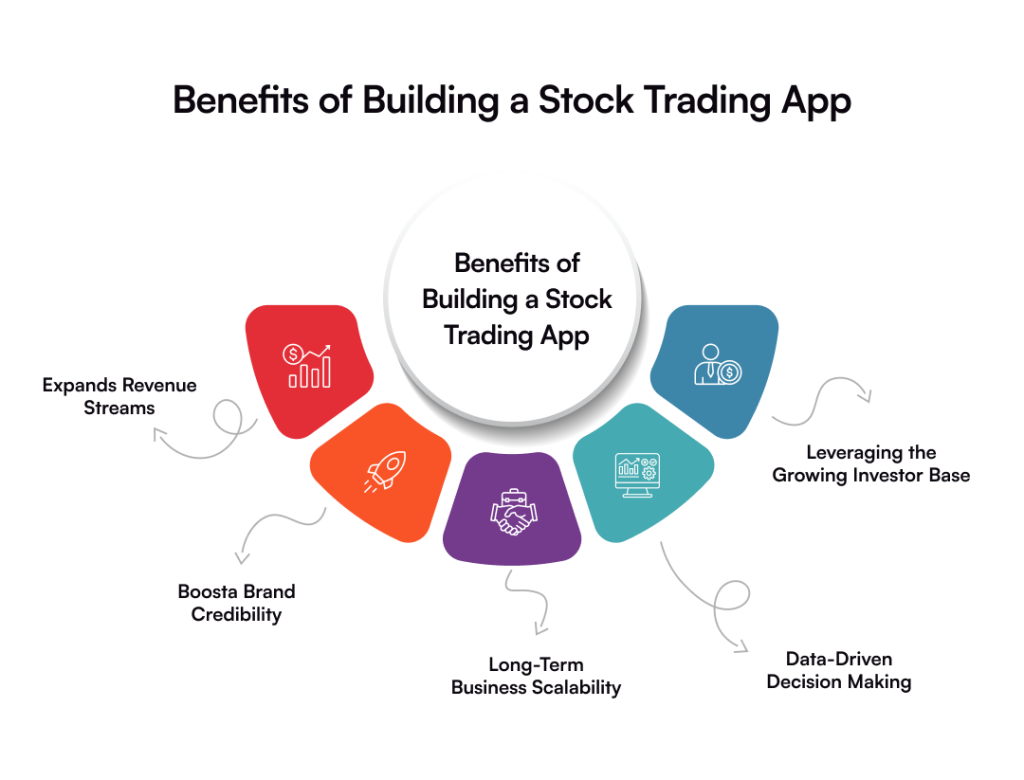
- Expanding Revenue Streams
Building a stock trading application brings various monetization options to the table for you. Regular income can be made by you from trading commissions, subscription models, premium account upgrades, and collaborations with financial institutions.
- Boosts Brand Credibility
By introducing a stock trading application, you are essentially branding your company as one of the financially tech-savvy next movers in the market. This way, you enhance your brand’s reputation, draw the attention of potential investors, and also get the approval of those users who are most concerned about transparency, security, and innovation in electronic finance.
- Long-Term Business Value
As the number of users grows, you have the option to implement advanced tech, AI-based analytics, personalized investment suggestions, and real-time notifications. Such a method allows you not just to maintain the level of user engagement but also to progress your company.
- Data-Driven Decision Making
Stock trading apps have valuable insights into user behaviour. Such information can help you lead the way in making tactical decisions by feature optimization, marketing campaign improvement, customer experience enhancement, etc.
- Leveraging the Growing Investor Base
The world trading environment is seeing a rise in the number of retail investors who are in search of user-friendly mobile solutions. When you make your app, you are reaching out to an audience that is growing very fast, and that is highly interested in accessibility and in trading in real-time.
Must-Have Features to Integrate in Your Stock Trading App
Creating a highly optimized trading app goes beyond an eye-catching design. Essentially, it is about providing those features that raise user confidence, make trading easy, and give a trouble-free app functioning.
These are the indispensable features that you need to embed in your stock trading app to make it attract users and focus on their needs.
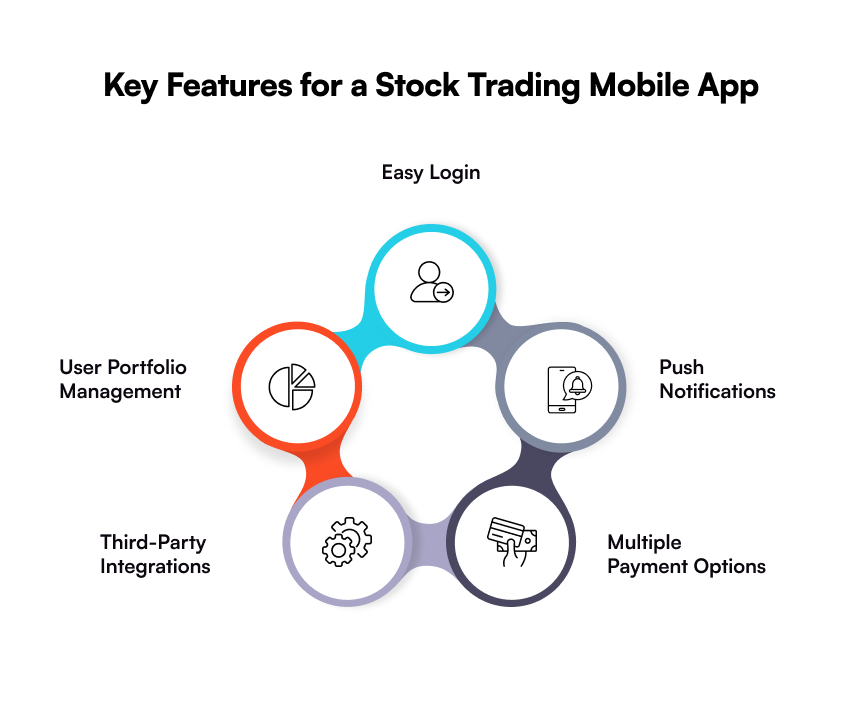
- Easy Login
Log in is the initial stage of getting access to an app, and thereby, you need to come up with the most straightforward way. An excellent online trading application may offer multiple login methods, such as biometrics and PIN codes, in order to facilitate users.
- Push Notifications
A stock trading app should have a push notification feature so that users can be notified instantly of any price changes, news, or account activities. In this way, they are empowered to make the right decisions on the spot.
- Multiple Payment Options
It is becoming increasingly necessary to offer users different payment methods with the booming number of fintech apps. It is indispensable for users to make payments via UPI, debit cards, or any other payment options that they prefer to use.
- Third-Party Integrations
Incorporating third-party APIs enables users to incorporate their accounts with other trading tools and applications, allowing them to analyze a wide variety of data.
- User Portfolio Management
An easy-to-understand portfolio management dashboard visually presents the user’s current investments, revenues, and expenses at a glance in real-time. This way, users can make more appropriate financial decisions.

How to Build a Stock Trading Mobile App
Building a stock trading app is not only about coding or choosing an ideal framework, but it is essentially about making a safe, simple-to-use, and regulation-compliant platform to be able to win the trust of the investors.
The following is a guide on the way you can convert your app concept into a real trading platform that is in line with business and user requirements.
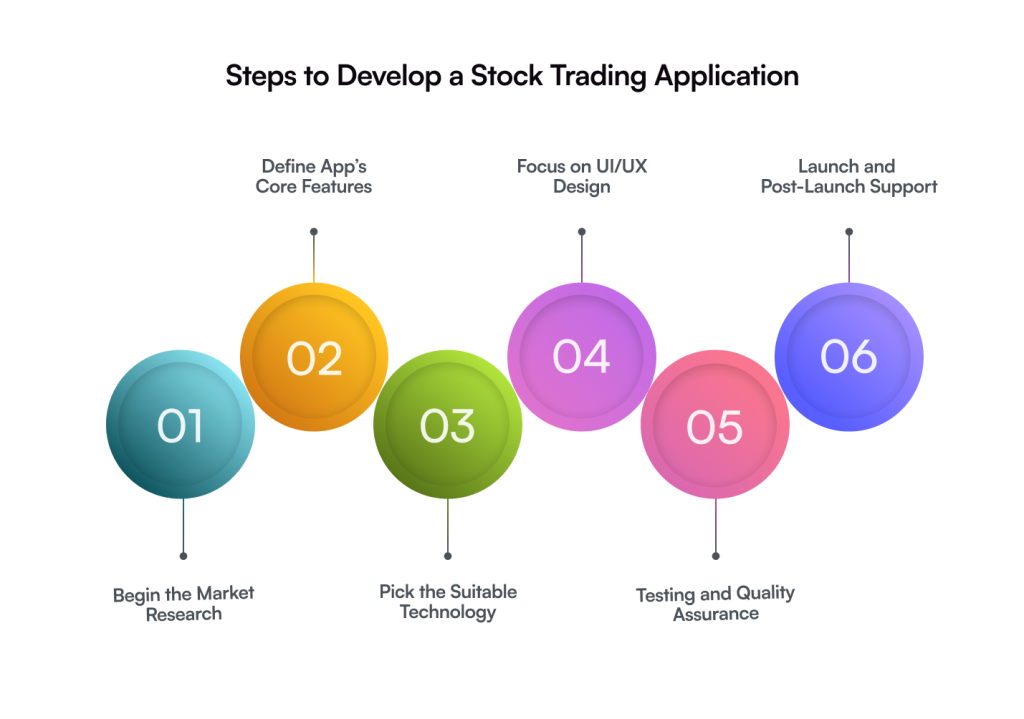
- Step 01: Begin the Market Research
Prior to launching your product, do some market research to determine the niche it fits into. Other than this, think about the audience. What difficulties do they encounter? How can you help potential clients address them with your product? Remember your rivals: how do you differentiate yourself in the very competitive stock trading app market?
Recognize their shortcomings and take advantage of them by adding new features, enhancing accessibility, and developing an intuitive design. You can browse through their reviews or engage specialists to do this for you.
- Step 02: Define Core Features and App Functionality
Consider the features you plan to add to your stock market app. Dashboards and payment APIs are essential. At this stage, you should also think about any more nice-to-have features you’re going to offer that can set your firm apart from your competition.
- Step 03: Pick the Right Tech Stack
Your app’s performance, scalability, and security rely heavily on the technologies you choose.
- Frontend: React Native or Flutter for cross-platform compatibility
- Backend: Node.js, Python, or Java for robust processing
- Database: PostgreSQL or MongoDB for secure data management
- APIs: Real-time stock data APIs, analytics, and third-party financial integrations
Partnering with an experienced provider ensures that your app is equipped with modern, scalable, and compliant technologies.
- Step 04: Focus on UI/UX Design
Picking an appealing design is a vital stage in stock trading app development. Remember unaligned and clunky design degrades the users’ perception of an app. Therefore, select a strong UI/UX team and collaborate with them to develop your app’s design.
- Begin the Code Development and Test MVP
Now that you have a team and a basic concept for a stock market app, it’s time to begin developing a trading platform, namely the initial version. The group will consider the nuances of the stock trading app industry. The product will be developed as planned, with excellent UI/UX design, functionality, and compliance with all applicable regulations.
Testing the MVP before release is essential. In this manner, you may correct the bugs before making the app live.
- Step 06: Work on User Feedback
Even after it is released, the development of stock market apps is still ongoing. In order to improve the app and add features that your users felt were missing, you’ll need to examine user feedback.
Tools and Technologies Used to Build a Stock Trading App
Before developing a stock trading mobile app, choosing the right tech stack is essential to ensure your app meets business goals while staying secure, scalable, and future-ready. Here is a list of the most used tools and technologies for developing a stock trading app.
| Category | Technologies / Tools |
| Frontend Development | React Native, Flutter, Swift (iOS), Kotlin (Android), HTML5, CSS3, JavaScript. |
| Backend Development | Node.js, Python, Java, .NET, PHP |
| Database Management | PostgreSQL, MongoDB, MySQL, Firebase |
| APIs & Integrations | REST APIs, GraphQL, WebSocket, Market Data APIs (e.g., Alpha Vantage, Yahoo Finance, IEX Cloud) |
| Cloud & DevOps | AWS, Google Cloud, Microsoft Azure, Docker, Kubernetes |
| Security Tools | SSL Encryption, OAuth 2.0, Two-Factor Authentication, Biometric Verification |
| Analytics & Monitoring | Google Analytics, Firebase Analytics, Mixpanel, New Relic |
| Payment Gateways | Stripe, Razorpay, PayPal, Braintree |

How Much Does It Cost to Develop a Stock Trading App
There are various factors that influence the cost of developing a stock market app, such as the complexity of the app, features, cloud solutions, operating systems, time of production, and many others.
Developing a Fintech solution is not an easy job, but the app should always be user-friendly to get more customer engagement. Your development team will need nearly 6 to 12 months to make a trading app.
The total trading app development cost can be anywhere between $25,000 and $300,000. It goes without saying that the price of app development will be different depending on the selection of features and functionalities, and the level of the application.
Partner with Galaxy Weblinks for Stock Trading App Development
Stock trading app creation is a large-scale project which necessitates complicated app logic and architecture for its production. In short, by integrating suitable features and functionalities, a tech stack, and keeping up a steady development pace, the success probability is going to be higher.
In case you plan to develop a trading app with good prospects, the best way is to follow a custom fintech app development process.
Alternatively, you can employ a company that provides stock market app development services like Galaxy Weblinks to develop an app that is not only unique and feature-rich but also profitable. Contact us now and let our experts make it easy for you to go from an idea to a top-notch trading platform development.
FAQs
Q. How much does it cost to build a stock trading app?
A. The cost to construct a stock trading app typically ranges from $25,000 to $3,00,000+, depending on the app’s functionality, design complexity, and technological stack. The price of a simple trading app with essential features like portfolio tracking and market data is lower.
Q. Why should I invest in a stock trading app development?
A. Investing in a stock trading app development has several significant benefits, including a growing market, an emphasis on mobile-first adoption, varied revenue methods, and a greater possibility for market expansion in niche areas.
Q. Do you provide post-launch support and maintenance?
A. Yes. As a trustworthy fintech app development company, we deliver post-launch support for your trading app even after the initial release. Our team will take care of feature updates, bug fixes, performance monitoring, and scalability changes to make sure your app stays competitive and meets all the necessary regulations.