


There was a time when patient records lived on paper files. Lost folders. Duplicate entries. Manual errors. Care teams worked in silos. Managing patient data was messy, risky, and inefficient. EHR software development changed that narrative.
Modern EHR systems centralize data, streamline workflows, and improve care delivery across departments. Doctors get real-time access. Administrators gain visibility. Patients experience continuity of care. No delays. Fewer mistakes.
But benefits alone are not enough. Building a reliable EHR system requires the right strategy, architecture, compliance planning, and execution.
The global EHR market is projected to cross $40 billion by 2030, driven by digital health mandates and operational efficiency goals as per GrandViewResearch.
However, building systems like this isn’t theoretical work. It comes from hands-on experience with regulated healthcare platforms.
For example, while developing a HIPAA-compliant wellness and health tracking platform for a leading U.S. university, our teams worked closely with researchers to securely capture, store, and analyze sensitive health data across mobile apps, wearables, and cloud dashboards.
That experience shaped how we approach EHR software development today—compliance-first, data-secure, and built for real clinical and research workflows.
This guide goes beyond advantages. It breaks down how to design, develop, and scale a robust EHR software system—step by step.
From technology choices to development process, everything that matters is covered.

What is Electronic Health Record System or EHR in Healthcare?
So, what exactly is an EHR system? In simple language, it is a digital version of a patient’s paper chart. But it’s way better than a dusty folder. It’s a smart platform used to manage all patient data in one spot.
We’re talking about lab reports, prescriptions, medical history, and even those allergy warnings. Such medical records software makes sure doctors don’t have to guess what happened during a patient’s last visit.
When a healthcare institution or hospital invests in EHR software development, they are building a bridge between different departments. Everything is instant. No more waiting for faxes!
The core of EHR development is about making data move fast and staying secure. It helps providers see the full picture of a person’s health.
Using EHR software means less mistakes and much faster treatments. It’s basically the “brain” of a modern hospital. If you want better care, you need a solid system.
EHR is often taken synonymous to EMR because they share similar functions and goals, though there are a few differences. Hence, EHR and EMR are used interchangeably.
Considerably, EMR hospital software programs are used for a single unit, while EHR is used by multiple providers and health systems.
How to Develop EHR Software: Complete Process to Build Custom EHR Systems
Building EHR software is complex. No shortcuts here. It touches clinical workflows, patient data, compliance, and long-term scalability. That’s why EHR software development requires more than coding skills. You need domain knowledge.
Regulatory awareness. And real healthcare experience. A competent EHR software development company like ours brings all of that together. They understand how hospitals work, how clinicians think, and how systems must scale securely.
Without the right expertise, even well-funded EHR system development efforts fail fast. Below is a practical, end-to-end process for custom EHR software development, broken down clearly.
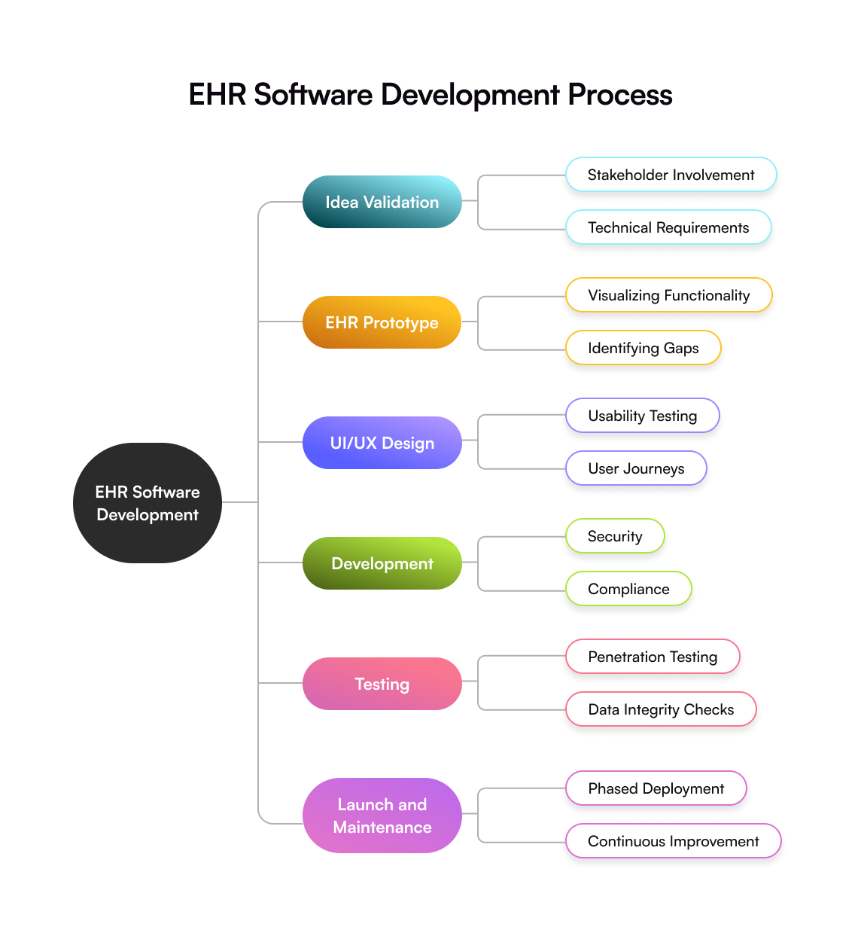
Idea Validation
Every EHR starts with a problem. Usually many problems.
Inefficient workflows. Poor data access. Legacy systems that don’t integrate. Before writing code, these issues must be validated. Properly.
This stage involves stakeholders. Clinicians. Admin teams. IT leaders. Everyone who will use the system. An experienced EHR developer helps translate real-world pain points into technical requirements.
The goal is clarity. What to build. What not to build. And why. Skipping this step leads to bloated EHR software. And wasted budgets.
EHR Prototype
Once the idea is validated, teams move fast to prototyping.
An EHR prototype shows how the system might work. Not perfect. Not final. But tangible. Screens. Flows. Core interactions.
This helps decision-makers visualize the product early. It also exposes gaps. Workflow breaks. Missing features. Confusing navigation.
For enterprise buyers, this stage reduces risk. You see the product before committing fully. Adjustments here are cheap. Later, they are not.
UI/UX Design
EHR UI/UX design is not about beauty. It’s about speed.
Doctors don’t want ten clicks. Nurses don’t want clutter. Admin teams need clarity. Design must support real clinical workflows.
Good EHR software development focuses on usability, accessibility, and consistency. Every screen should feel familiar. Predictable. Fast.
This stage includes wireframes, user journeys, and usability testing. Often with real users. Feedback matters here. A lot.
Development
Now the real build begins.
During EHR system development, teams focus on architecture, security, integrations, and scalability. Backend. Frontend. APIs. Everything comes together.
Developers implement features like patient portals, interoperability, role-based access, audit logs, and billing workflows. Compliance is baked in. Not added later.
An experienced EHS software development company ensures the system aligns with HIPAA, supports standards like FHIR and HL7, and integrates with existing healthcare systems.
Testing
Testing is not optional. Ever.
EHR software must be tested for functionality, performance, security, and compliance. Across devices. Across user roles. Under load.
This includes penetration testing, usability testing, and data integrity checks. Errors here can impact patient safety. Or trigger compliance violations.
Good testing prevents expensive fixes post-launch.
Launch and Maintenance
Launching EHR software is just the beginning.
Deployment is usually phased. One department first. Then others. Training is critical. Support matters. Adoption decides success.
Post-launch, the system needs updates. Security patches. Feature improvements. Regulatory updates. Ongoing maintenance keeps the EHR relevant and reliable.
Long-term success depends on continuous improvement. Not just a successful launch.
Budgeting for EHR Software: How Much It Costs to Build EHR Systems
Budgeting for EHR software development is rarely straightforward. There’s no flat price tag. Too many variables. Too many stakeholders.
The cost of EHR software depends on scope, compliance depth, integrations, and how customized the system really is.
A small clinic and a multi-location hospital will never pay the same. And they shouldn’t.
At a high level, the cost of implementing EHR in hospital environments usually ranges from mid five figures to several hundred thousand dollars.
Sometimes more. Especially when legacy systems are involved.
Let’s break it down.
EHR Implementation Cost Breakdown
Typical cost components include:
- Discovery, planning, and compliance mapping
- UI/UX design for clinicians, admins, and patients
- Core development and integrations (labs, billing, devices)
- Security, audits, and regulatory compliance
- Testing, training, rollout, and ongoing support
Each phase adds up. Skipping one only increases risk later.
Estimated Cost Based on Different Development Rates
Where your development team is located makes a big difference. Let’s see how.
| Region | Average Hourly Rate | Estimated Project Cost |
| North America | $120–$180/hr | $150,000 – $500,000+ |
| Western Europe | $80–$130/hr | $120,000 – $400,000 |
| Eastern Europe | $50–$80/hr | $70,000 – $250,000 |
| South Asia | $25–$50/hr | $40,000 – $180,000 |
| Australia | $100–$160/hr | $130,000 – $450,000 |
Lower rates don’t always mean lower quality. But healthcare experience matters. A lot.
Key Factors That Influence the Cost to Build Custom EHR Software
Some things drive costs up fast. Others keep it sane.
- Customization level: Off-the-shelf logic is cheaper. Custom workflows cost more. Worth it, usually.
- Compliance requirements: HIPAA, GDPR, regional health laws. Security isn’t optional. It adds effort.
- Integrations: Labs, pharmacies, billing systems, devices. Each integration has a price.
- Scalability needs: Single facility vs hospital network. Architecture changes everything.
- Post-launch support: Updates, audits, user feedback, new features. EHRs are never “done”.
In short, EHR software development is an investment. Not an expense. The right budget avoids rework, downtime, and compliance risk later. Cheap systems fail quietly. Good ones scale with care delivery.
Must-Have Features in Custom EHR Software (2026 Checklist)
Building a custom EHR system isn’t just a tech decision. It’s a long-term investment. It affects clinical work, operations, compliance—everything.
EHR software has to support real workflows. Not ideal ones. It needs to be compliant, must integrate with existing systems, and scale when the organization grows. Because one department today could expand to many locations tomorrow.
In large hospital environments, EHR platforms rarely operate in isolation. They form part of a wider-ranging hospital management ecosystem responsible for processing admissions, billing, staffing, and operations on a large scale. They work coherently with a hospital management system.
The success of custom EHR software development depends heavily on its features. Not how modern it looks. Not buzzwords. Features that actually work in daily healthcare operations.
So, you must build an EHR software solution that can efficiently handle real world operations, scale with your growth, and align with what industry regulators want. Not shiny software.
Besides, building software with cutting-edge functionality like cloud, IoT, blockchain, and AI in healthcare is also crucial to craft modern-day solutions.
Listed below are the key features of custom EHR software that a healthcare organization should focus on to achieve efficiency, security, interoperability, and scalability.
Patient Portal with Secure Access
A patient management portal is an essential component of an EHR system that lets them view records, lab results, prescriptions, visit history, and other data easily and securely. Also, they can book appointments. Fill out admission forms. Message providers and pay bills.
A special ID is generated for every patient in the system that electronic medical software uses to track all interactions with them.
For healthcare organizations, this reduces admin workload. Improves engagement. Supports value-based care. HIPAA compliance here is non-negotiable.
Data Security, Privacy, and Compliance Controls
Security is not a feature. It’s the foundation. It must be built with strong security features. Custom EHR systems must control who sees what.
Doctors, nurses, admins—each role needs limited access. Nothing extra. Implement encryption for data at rest and in transit, MFA, and secure authentication. Besides, use automated backups and disaster recovery to easily restore data in case of an incident.
HIPAA and regional data protection compliance must be built into the architecture. Not added later.
E-Prescribing
E-prescription is also one of the major features that an electronic health record system should support. It digitizes prescriptions written by practitioners for their patients to make them more accessible, secure, and shareable.
It removes manual errors. No illegible handwriting. No guesswork. It makes sharing information about a patient’s conditions, treatments, and diagnosis convenient.
This improves safety. And keeps systems aligned with healthcare regulations.
Clinical Dashboard
Clinicians need clarity. Dashboards show key data at a glance. They can see, for example, whether the patient is having normal or abnormal vitals, lab trends, treatment history, etc. All these are put up on a single screen in just a click.
This component of EHR software enables clinicians to access and record patient information. It centralizes data for patients that improves workflow efficiency, patient care, and reduces administrative burden.
Secure Messaging and Care Team Collaboration
Secure communication is not optional in healthcare systems. We’ve seen this firsthand while building enterprise-grade virtual care platforms where providers exchanged medical files, consultation notes, and patient messages in real time.
In HIPAA-compliant telehealth systems we developed, secure messaging, role-based access, and audit logs were foundational—not add-ons.
These same principles apply directly to custom EHR software features, where data leaks are simply unacceptable.
Billing and Financial Dashboard
A financial and billing dashboard provides healthcare teams with visibility into claims, payments, denials, and outstanding balances. All in one place. No jumping between systems.
It supports automated billing workflows, insurance claims tracking, and reconciliation. Fewer errors. Faster reimbursements.
For leadership, it offers clear financial insights. For operations teams, it reduces delays and manual follow-ups.
Laboratory, Imaging, and Third-Party Integrations
Manual data entry slows everything down. And causes errors.
Custom EHR systems should integrate directly with labs and imaging platforms. Results flow in automatically.
API-driven integrations allow expansion without rebuilding core systems. Important at enterprise scale.
Scalability, Performance, and Multi-Facility Support
Healthcare organizations grow. Data grows faster.
Custom EHR software must support multiple facilities, high concurrent users, and consistent performance. Even under load.
Cloud-ready architecture coupled with a modular design enables systems to evolve without breaking the reliability.
Interoperability and Standards Compliance (FHIR & HL7)
Interoperability isn’t optional.
Custom EHR software must exchange data with labs, pharmacies, imaging systems, insurers, and third-party platforms seamlessly.
Support for HL7, FHIR, and CDA ensures structured data exchange. Less vendor lock-in. More flexibility long-term. It directly affects care coordination, reporting accuracy, and compliance.
The multi-tenant telehealth platform we developed and integrated with EMR system
Reporting, Analytics, and Population Health Management
Data alone isn’t useful. Insights are.
Advanced reporting enables compliance tracking, operational analysis, and performance monitoring. Population health analytics help improve outcomes and resource utilization.
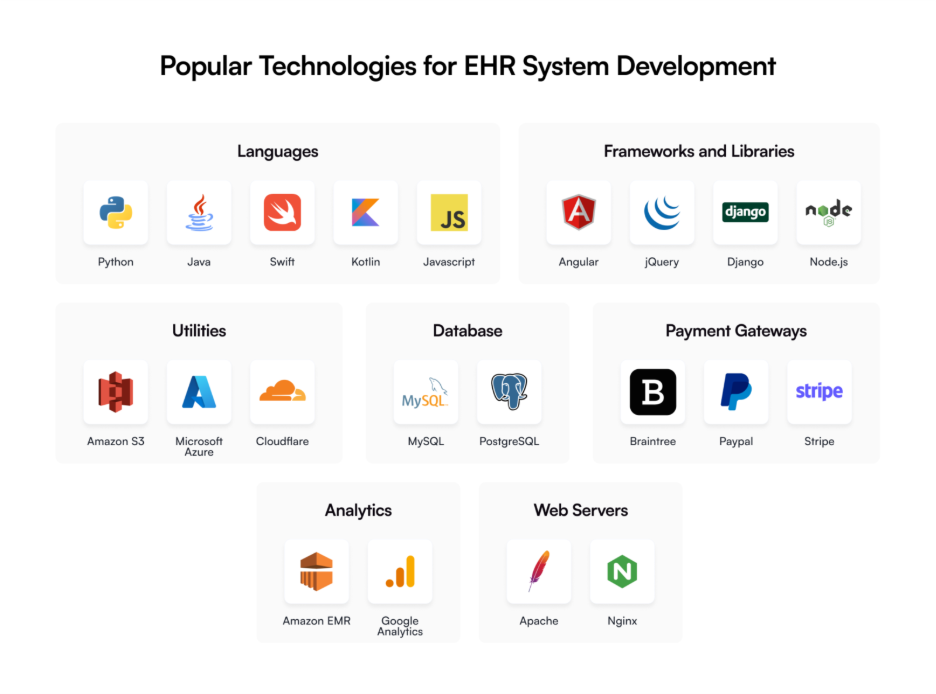
Technology Stack for EHR Software Development
Building reliable EHR software is not about picking trendy tools. It’s about choosing tech that survives audits, scales across hospitals, and doesn’t break workflows.
That’s why custom EHR software development usually needs a seasoned EHR software development company.
Healthcare systems are complex. Regulations are strict. Data is sensitive. The wrong stack costs years, not weeks.
A capable partner helps you avoid that pain by selecting proven, compliant, future-ready technologies.
Backend & Core Logic
Most enterprise EHR systems rely on Node.js, Java, or .NET. Stable. Secure. Built for long-running healthcare workloads. Microservices help when systems grow messy. And they always do.
Frontend (Web & Mobile)
React, Angular, or Vue power clinician dashboards. Clean. Fast. No clutter. Mobile access often uses Flutter or React Native for shared codebases.
Database & Data Storage
Structured data lives in PostgreSQL or MySQL. Clinical documents? MongoDB or cloud object storage. Performance matters here. A lot.
Interoperability & Standards
FHIR and HL7 aren’t optional. They’re mandatory. APIs must speak healthcare fluently or nothing integrates properly.
Security & Compliance
Encryption everywhere. OAuth 2.0. MFA. Role-based access. HIPAA isn’t a feature. It’s the baseline.
Cloud & Infrastructure
AWS, Azure, or GCP. High availability. Auto-scaling. Disaster recovery baked in.
The right stack doesn’t just run EHR software. It protects it. And that’s what healthcare teams really need.
Buy vs Build Custom EHR Software: Which Is More Economical?
This decision shows up early. And it matters a lot. Buying off-the-shelf EHR software looks cheaper at first. Faster setup. Fixed pricing.
But you inherit limits. Rigid workflows. License fees that grow every year. Customization costs add up quietly.
Custom EHR software development takes more effort upfront. No denying that. But it aligns with how your hospital or healthcare startup actually works.
You build only what you need. Integrations fit. Scaling feels natural, not forced. Over time, many organizations realize the total cost is lower.
The advantage? Fewer workarounds. Less vendor lock-in. More control.
| Factor | Buy EHR Software | Build Custom EHR |
| Upfront Cost | Lower | Higher |
| Customization | Limited | Full control |
| Long-term Cost | High (licenses + add-ons) | More predictable |
| Scalability | Vendor-dependent | Built for growth |
| Ownership | Vendor-owned | You own the system |
There’s no universal answer. Smaller organizations may buy. Large organizations often prefer to build custom solutions. The most economical option depends on scale, compliance needs, and how long you plan to run the system.
Types of EHR Software Solutions You Can Develop
Not every healthcare organization needs the same system. EHR system development looks different for a hospital chain than for a digital health startup.
That’s why EHR and EMR software development usually branches into a few core solution types. Each solves a different problem. Each fits a different scale.
On-Premise EHR Systems
Built for hospitals that want full control. Data stays inside the facility. Higher upfront cost, more IT responsibility. Still preferred by large institutions with strict governance.
Cloud-Based EHR Software
Hosted on secure cloud infrastructure. Easier to scale. Faster updates. Lower infrastructure burden. Ideal for growing healthcare networks and multi-location practices.
Web-Based EHR Platforms
Accessed through a browser. No heavy installs. Works across devices. Often used by clinics, labs, and outpatient centers that value speed and flexibility.
Mobile EHR Applications
Designed for care on the move. Clinicians access patient data, notes, and alerts from phones or tablets. Big boost for field care, home health, and emergency teams.
Hybrid EHR Systems
A mix of on-premise and cloud. Sensitive data stays local. Everything else runs in the cloud. Common in enterprise EHR system development projects.
Specialty-Specific EHR Solutions
Built for cardiology, oncology, mental health, or pediatrics. Workflows match real clinical practice. Less clutter. More efficiency.
The right choice depends on scale, compliance needs, and long-term growth plans. One size never fits all. That’s the reality of EHR and EMR software development.
Key Considerations for EHR Software Development to Overcome Challenges
Building EHR platforms is rarely smooth. Electronic Health Record System development comes with real-world constraints—clinical pressure, regulations, legacy systems.
Planning for these early saves time, money, and frustration. A capable EHR software development company knows where things usually break and how to prevent it.
Key considerations that matter:
- Don’t miss regulatory compliance as it matters more than you think.
- Software must adapt to clinicians, not the other way around. Poor UX kills adoption fast.
- Security must be integral to software right from the design stage.
- The system should handle both increase in data volume and user flow without rework.
- Training and rollout matter as much as code.
- Choose partners who’ve done Electronic Health Record System development before.
These considerations reduce risk. They keep timelines realistic. And they make the difference between software that works—and software that survives.
Regulatory & Compliance Checklist for EHR Systems
Compliance isn’t just a boring task; it is essential to avoid penalties and adhere to regulations. These compliances often define how you should approach your EHR system development project. From coding to deployment, there are several compliances you need to align with to avoid risks and penalties.
HIPAA Privacy & Security Rules
This is the big one. Protect PHI (Protected Health Information) with everything you got. Use encryption, access controls, and audit trails. No shortcuts here. Honestly, HIPAA compliance is the baseline, not some fancy extra feature. If you don’t have it, you don’t have an EHR system.
For example, as we built a HIPAA-compliant wellness platform for the University of Vermont, we implemented controlled SSO access and secure cloud data handling. It ensured that only approved study participants could access sensitive health data.
CMS & ONC Readiness
Follow the CMS requirements for billing and reporting accuracy. Also, stay ready for ONC certification. This ensures your EHR software plays nice with others and follows the 21st Century Cures Act. It’s about being “interoperable.”
FHIR & HL7 Standards Support
Data needs to move cleanly between systems. Support for FHIR (Fast Healthcare Interoperability Resources) and HL7 is basically mandatory now. It’s what allows a lab result from a different clinic to show up in your app without a glitch.
Disaster Recovery & Backup
Systems fail. It happens. But your plan shouldn’t. Set up automated backups and a real recovery strategy. In a crisis, you need to be back online in minutes, not days. EHR software development that ignores this is just waiting for a crash.
Why Software Fails: Common EHR Software Development Mistakes to Avoid
EHR software development fails more often than teams admit. Not because of bad intent. Because of missed details. Small decisions. Big impact later. Below are the mistakes that quietly derail EHR projects—and how to avoid them.
- Designing for “ideal” processes instead of real-world usage kills adoption fast. Clinicians won’t adjust. The software must.
- HIPAA and regional regulations can’t be patched in later. Miss this early, and you’re rebuilding core architecture. Expensive mistake.
- More features don’t mean better software. Bloated EHRs slow teams down and frustrate users. Build what’s needed. Nothing extra.
- Skipping HL7 or FHIR support blocks integrations with labs, billing, and devices. Data silos form quickly. Care quality suffers.
- No MFA. Poor access controls. Incomplete audit logs. One breach can shut everything down. Trust is hard to regain.
- Systems built for one clinic break when expansion begins. EHR software development must plan for growth from day one.
- EHRs aren’t “launch and forget.” No update strategy leads to performance issues and compliance risks over time.

How Galaxy Weblinks Can Help in Your EHR Software Project
EHR systems sit at the center of modern healthcare. They manage patient data, support clinical decisions, and keep operations compliant. When they fail, workflows break. Care slows down. That’s why EHR software development needs more than just technical skill. It needs healthcare understanding.
Galaxy Weblinks as a trusted software development company helps organizations build EHR platforms that actually work in real environments. We have proven experience in healthcare development and delivered HIPAA-compliant healthcare platforms for universities and health programs, including a wearable-enabled wellness tracking system developed for the University of Vermont.
We start with workflows. Then architecture. Security and compliance are baked in, not added later. Interoperability is planned from day one.
Our teams design, build, and scale custom EHR solutions for hospitals, clinics, and healthtech companies. The focus stays clear. Stable systems. Clean data. Software that supports care delivery and grows with your organization.
Frequently Asked Questions (FAQs)
1. How long does EHR software development usually take?
Depends on the scope. A basic MVP takes 3–6 months. Big enterprise systems? You’re looking at 9–18 months or more. Don’t rush it; quality code takes time.
2. What is the biggest challenge in EHR software development?
Interoperability, for sure. Making different systems talk—like labs and billing—is a headache. Legacy software is also a pain to integrate.
3. Is custom EHR software better than off-the-shelf?
For big hospitals, definitely. It fits your actual workflow. You don’t get stuck with “vendor lock-in” or useless features you don’t need.
4. What is the cost of implementing EHR in a hospital?
It’s a wide range. Small clinics might spend $40K–$90K per provider. Large networks? Easily $1M to $10M+ depending on how much you customize.
5. How do you ensure HIPAA compliance in EHR software?
Encryption is a must. You need MFA, audit logs, and secure hosting. In 2026, things like “zero-trust” access are becoming the new standard.
6. Can EHR software integrate with existing systems?
Yes, if you use the right standards like HL7 and FHIR. Good EHR software development builds these bridges from day one.
7. What’s the difference between EHR and EMR systems?
EMRs are mostly for one office. EHRs are built to travel. They share data across different providers and hospitals seamlessly.
8. Do EHR systems support telehealth?
Modern ones do. Video calls and remote monitoring are often built-in now. It’s not just a “bonus” feature anymore; it’s expected.
9. Should startups build from scratch?
Start with an MVP first. Validate the idea. Then sink the big money into full EHR development. Scaling too fast is a trap.
10. How secure is cloud-based EHR software?
Very. Usually safer than a server in a closet. Cloud providers have massive security teams, but you still gotta configure it right.
11. Can EHR software scale across facilities?
Yes. That’s the whole point of enterprise EHR software development. It handles multiple locations and thousands of users easily.