


Healthcare is no longer limited by hospital walls. The rise of AI-powered monitoring, IoT-based medical devices, and virtual consultations has brought treatment, diagnosis, and prevention right into our homes.
Simply put, how future healthcare technology is elevating at-home care is about turning traditional, reactive care into a proactive, data-driven experience. Patients can now track their vitals in real time, doctors can make informed decisions instantly, and families gain peace of mind through smarter, safer digital systems.
From wearable sensors that predict health issues to AI chatbots that provide instant guidance, these innovations are closing the gap between patients and providers — creating healthcare that’s not only advanced but also deeply human.
Understanding How Future Healthcare Technology Is Elevating At-Home Care
Healthcare has quietly shifted from a place you go to — into something that now comes to you. Over the past few years, this change has accelerated, thanks to breakthroughs in digital connectivity, data analytics, and intelligent health devices.
At-home care used to mean visiting nurses or family support. Today, it’s powered by AI-driven diagnostics, IoT-connected medical devices, and cloud-based health platforms that bring continuous, personalized care to patients — without stepping into a hospital.
The Rise of Home-Based Healthcare
- The global home healthcare market is projected to surpass $500 billion by 2028, growing rapidly as healthcare systems face cost pressures and aging populations.
- More than 60% of patients with chronic conditions say they prefer home monitoring over hospital visits.
- Providers are adopting “hospital-at-home” programs that combine technology and clinical care for faster recovery and better patient satisfaction.
What’s Driving This Transformation
| Factor | Impact |
| Aging population | Increased demand for chronic disease management and non-hospital care |
| Healthcare cost control | Remote monitoring reduces hospital stays and readmissions |
| Digital adoption | Smartphones and broadband make remote care accessible |
| Pandemic influence | Accelerated acceptance of telehealth and at-home treatment |
| Data intelligence | AI enables real-time decision-making and prevention |
The Human Side of Tech-Enabled Home Care
Beyond convenience, this shift is deeply personal.
A patient recovering from surgery can now be monitored remotely by doctors who receive real-time alerts if their vitals change. A senior living alone can get a gentle reminder from an AI assistant to take their medication. And families can rest easy knowing technology is watching over their loved ones, even when they can’t.
That’s the essence of how future healthcare technology is elevating at-home care — bringing together compassion, connectivity, and intelligence to create care that feels both advanced and accessible.
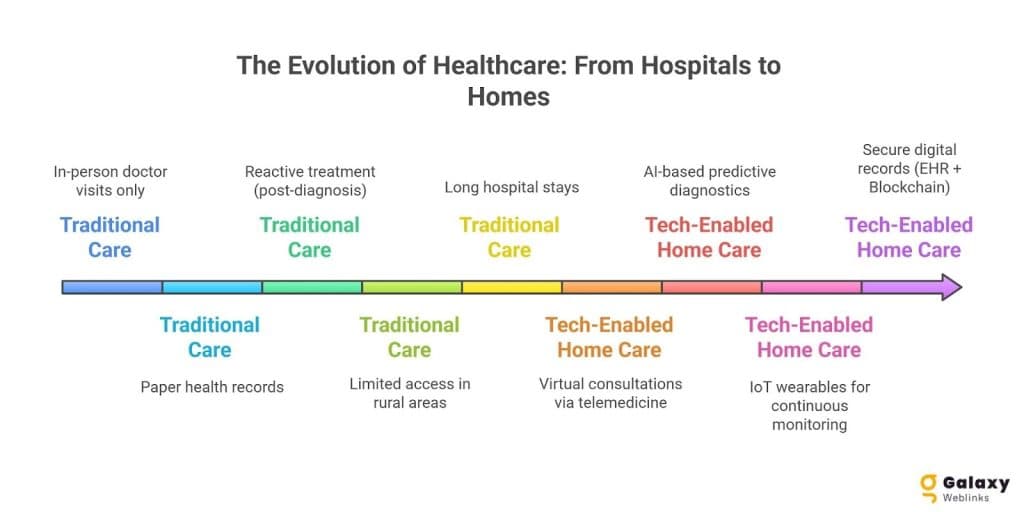
Why the Future of Healthcare Relies on Technology-Driven Home Care
The healthcare industry is facing a pivotal moment. Rising costs, an aging global population, and the demand for continuous, personalized care are forcing providers to rethink the traditional hospital model. This is why the world is seeing a rapid shift toward technology-driven home healthcare — a model that is smarter, more sustainable, and more human.
A Changing Landscape Backed by Data
- According to McKinsey & Company, up to $265 billion worth of healthcare services could shift from traditional facilities to home-based care by 2025.
- The World Health Organization (WHO) projects that by 2030, 1 in 6 people globally will be aged 60 or above, significantly increasing the need for long-term home support.
- Deloitte’s 2024 Global Healthcare Outlook found that digital health adoption among healthcare providers rose by over 60% post-pandemic — with remote patient monitoring (RPM) cited as a top investment area.
These numbers show a clear direction: healthcare is decentralizing. The hospital of the future isn’t a building — it’s a network of connected homes supported by intelligent technologies.
The Core Drivers Behind This Shift
| Core Driver | What’s Changing | Real-World Impact |
| Cost Efficiency | Hospitals spend less on bed occupancy and staffing | Reduced operational burden and readmissions |
| Chronic Disease Management | 70% of healthcare spend goes to chronic illnesses (CDC) | Continuous remote monitoring improves outcomes |
| Patient Expectations | Digital-native generations expect healthcare on-demand | Rise in telehealth and virtual consultations |
| Workforce Shortage | Global shortage of 10M healthcare workers by 2030 (WHO) | Technology bridges the staffing gap |
| AI and Data Integration | Predictive analytics enable preventive care | Shift from reactive to proactive care models |
How Technology Makes the Home a New Point of Care
Imagine this:
- A patient with heart disease wears a connected ECG patch that streams live data to their cardiologist.
- An AI algorithm analyses trends and sends a preventive alert if irregularities are detected.
- A secure cloud platform shares updates with caregivers, ensuring transparency and quick response.
This is how future healthcare technology is elevating at-home care — by transforming homes into safe, intelligent health environments.
A Sustainable Future Model
Technology-driven home healthcare isn’t just efficient — it’s sustainable.
By minimizing unnecessary hospitalizations and leveraging data-driven decisions, the system reduces carbon emissions, saves time, and builds resilience.
In short, it’s not just the future of healthcare — it’s the evolution of how we care for one another.
How Future Healthcare Technology Is Elevating At-Home Care Through AI and Predictive Analytics
Artificial Intelligence (AI) has become the beating heart of modern healthcare innovation — and its most meaningful impact is now happening inside our homes. From early disease prediction to medication management and intelligent monitoring, AI is redefining what “care” looks like.
This is how future healthcare technology is elevating at-home care: by turning passive data into proactive action.
Real-Time Intelligence that Saves Lives
AI enables real-time analysis of patient data coming from wearables, home diagnostic devices, and mobile health apps.
- Predictive analytics help clinicians forecast potential health deterioration before symptoms even appear.
- AI-driven dashboards track vitals like oxygen levels, blood pressure, and glucose trends — alerting caregivers instantly when values move outside safe limits.
- Natural language AI tools (like conversational assistants) guide patients with medication reminders or daily wellness check-ins.
According to a PwC Global AI Report, AI applications in healthcare could contribute up to $150 billion annually in savings for the U.S. healthcare economy by 2026, mainly through automation and predictive interventions.
AI in Action — Common Use Cases
| Use Case | Technology Involved | Benefit |
| Early Disease Detection | Machine learning algorithms | Detect cardiac, diabetic, or respiratory anomalies early |
| Personalized Treatment | Predictive analytics | Tailors medication and lifestyle advice |
| Smart Diagnostics | AI image recognition | Remote review of X-rays, ECGs, or scans |
| Behavioral Health Insights | NLP and sentiment analysis | Monitors mood changes and mental health remotely |
| Virtual Health Assistants | Conversational AI & voice bots | Improves patient engagement and compliance |
Real-World Example
A hospital in the U.S. partnered with an AI analytics provider to track patients with heart failure remotely.
The AI model analyzed vitals and lifestyle inputs, identifying risk factors 10 days before symptoms appeared. The result? A 40% reduction in hospital readmissions, according to Harvard Business Review.
That’s not just smarter care — it’s life-saving foresight.
Galaxy Weblinks Insight
At Galaxy Weblinks, we’ve seen how integrating predictive algorithms with patient-facing apps empowers healthcare organizations to reduce response times and optimize treatment accuracy.
Through AI-powered dashboards and predictive modeling, we help providers see what’s coming — not just what’s already happened.
👉 Explore our AI Development Services
How Future Healthcare Technology Is Elevating At-Home Care with IoT and Remote Patient Monitoring
If AI gives healthcare its “intelligence,” the Internet of Things (IoT) gives it “awareness.”
Through a network of smart medical devices and sensors, doctors can monitor patients continuously — even when they’re miles away.
This seamless exchange of data is transforming the home into an extended care environment, where every heartbeat, breath, and step can tell a story about a patient’s health.
The Scale of IoT in Healthcare
- The global IoT healthcare market is projected to reach $446 billion by 2028, growing at a CAGR of 16.8% (Statista).
- A Deloitte study (2024) found that over 60% of U.S. hospitals have implemented at least one form of remote patient monitoring solution.
- Patients using connected devices reported a 25% improvement in treatment adherence and reduced readmission rates, according to Frost & Sullivan.
These numbers reveal how IoT is not just improving care — it’s redefining how healthcare systems operate.
Common IoT Devices Powering Home Healthcare
| Device Type | Function | Benefit |
| Smartwatches / Fitness Trackers | Monitor heart rate, activity, sleep | Preventive care insights |
| Connected Glucose Monitors | Track blood sugar in real time | Continuous diabetic management |
| Digital Stethoscopes & ECG Patches | Record and transmit heart data | Instant doctor feedback |
| Wearable Oximeters | Monitor oxygen levels | Vital during respiratory illnesses |
| Smart Pill Dispensers | Automate dosage reminders | Boosts medication adherence |
A Day in the Life of IoT-Enabled Care
Imagine a patient recovering from heart surgery.
Their wearable ECG patch transmits data every few seconds to a secure cloud platform. An AI model analyzes the data, and when it spots an irregularity, it notifies the cardiologist immediately.
Within minutes, the doctor calls the patient, preventing a potential emergency.
This is how future healthcare technology is elevating at-home care — through real-time visibility, faster intervention, and smarter recovery.
The Integration Challenge
However, IoT isn’t just about collecting data — it’s about making that data usable.
Healthcare organizations face the challenge of integrating IoT device data with Electronic Health Records (EHRs) while maintaining HIPAA compliance and data interoperability.
At Galaxy Weblinks, we design connected health platforms that solve this problem by building secure, interoperable data pipelines — ensuring every data point flows smoothly between patient, device, and provider.
Discover our IoT App Development Services
How Future Healthcare Technology Is Elevating At-Home Care with Telemedicine and Virtual Consultations
In just a few years, telemedicine has gone from a niche service to a mainstream healthcare channel.
It’s one of the clearest examples of how future healthcare technology is elevating at-home care — by connecting patients and doctors instantly, no matter the distance.
With telemedicine, healthcare has finally become location-agnostic — accessible, flexible, and immediate.
The Telehealth Boom — By the Numbers
- The global telemedicine market is expected to reach $286 billion by 2030, expanding at a CAGR of 12.5% (Grand View Research).
- During the COVID-19 pandemic, telehealth utilization increased by 38x, according to McKinsey & Company.
- A Cleveland Clinic study (2023) found that 82% of patients who used telemedicine reported equal or better satisfaction compared to in-person visits.
How Telemedicine Is Transforming At-Home Care
| Transformation Area | Description | Value to Patients |
| Virtual Consultations | Live doctor-patient video calls for diagnosis and treatment | Reduced travel & faster care |
| Hybrid Care Models | Combination of AI triage + live doctor consultations | Shorter wait times |
| Remote Specialist Access | Connects rural or remote patients to top specialists | Improved healthcare equity |
| E-Prescriptions & Digital Records | Enables seamless medication management | Simplifies patient compliance |
| Post-Discharge Virtual Follow-ups | Continuous recovery monitoring | Lower readmission rates |
Real-Life Impact: The Human Connection
For elderly patients or those with mobility challenges, telemedicine offers more than convenience — it restores independence.
A patient in a small town can now consult a city-based cardiologist or therapist through their smartphone.
Families no longer need to take days off or travel long distances for checkups.
And with features like secure video conferencing, digital health records, and AI-powered symptom checkers, the quality of remote care has improved dramatically.
The Next Evolution: Virtual Health Ecosystems
The future of telemedicine isn’t just a one-on-one video call — it’s a connected ecosystem where:
- Doctors collaborate digitally with labs, pharmacies, and insurers.
- AI assistants schedule appointments and summarize consultations.
- Patients access 360° health dashboards to track their journey in real-time.
That’s how technology is reshaping the continuum of care — making it seamless, data-rich, and human-first.
Galaxy Weblinks Perspective
At Galaxy Weblinks, we build custom telehealth platforms that prioritize patient experience, HIPAA compliance, and scalability.
From real-time video infrastructure to AI-powered triage tools, our solutions ensure healthcare organizations deliver care that’s accessible to everyone, everywhere.
How Future Healthcare Technology Is Elevating At-Home Care Using Blockchain and Data Security
In a world where healthcare data moves faster than ever — across apps, devices, and cloud platforms — trust has become just as important as treatment.
That’s why how future healthcare technology is elevating at-home care isn’t only about innovation; it’s also about protection.
With billions of health records being digitized, technologies like Blockchain and Zero Trust Architecture are transforming how sensitive information is stored, shared, and secured.
Why Data Security Matters in At-Home Healthcare
- According to IBM’s 2024 Cost of a Data Breach Report, healthcare has the highest average data breach cost across all industries — $10.93 million per incident.
- The U.S. Department of Health and Human Services (HHS) recorded over 500 healthcare data breaches in 2023 alone.
- Patients are increasingly aware of privacy issues — 84% say they want control over who accesses their health data (Deloitte Insights).
These stats underline a painful truth: without trust, technology adoption stalls.
How Blockchain Reinforces Trust
| Blockchain Feature | Role in At-Home Healthcare | Benefit |
| Decentralization | Data stored across secure nodes | Eliminates single point of failure |
| Immutability | Every transaction is time-stamped | Prevents data tampering or fraud |
| Smart Contracts | Automates patient consent and data sharing | Boosts transparency |
| Audit Trails | Tracks who accessed what data | Enhances compliance with HIPAA/GDPR |
When integrated into home healthcare platforms, blockchain creates a tamper-proof medical record where every action — from a doctor’s note to a device update — is recorded transparently and securely.
Real-World Example
Estonia, one of the pioneers in digital health, has already deployed blockchain to secure patient health records nationwide.
This ensures complete traceability and zero unauthorized access, setting a global benchmark for digital trust in healthcare (Source: Estonian eHealth Foundation).
The “Zero Trust” Future
Beyond blockchain, the Zero Trust Security Model — which assumes no device or user is automatically trusted — is becoming the new healthcare standard.
It enforces continuous authentication, encryption, and least-privilege access, reducing risks in home-based digital systems.
At Galaxy Weblinks, we implement Zero Trust frameworks and blockchain integrations to help healthcare providers:
- Secure multi-device data flows
- Ensure compliance with HIPAA and GDPR
- Build patient confidence through transparency
In Short
As healthcare becomes more decentralized, data becomes the new heartbeat.
And just like a healthy heart, it must be protected, traceable, and trusted.
That’s how future healthcare technology is elevating at-home care — by ensuring innovation never compromises privacy.
Multi-Stakeholder Impact — Patients, Providers, and Payors
The impact of how future healthcare technology is elevating at-home care goes far beyond patients.
It’s transforming the entire healthcare ecosystem — from how clinicians deliver care to how insurers measure outcomes and technology partners enable innovation.
This shift isn’t just medical; it’s operational, financial, and cultural.
Patients — Personalized, Empowered, and Connected
Technology is giving patients a voice in their own health journeys.
- 24/7 visibility: Through wearables and health apps, patients can track vitals anytime.
- Predictive insights: AI algorithms help identify early warning signs of chronic issues.
- Empowerment: Remote consultations and virtual care remove barriers of geography and mobility.
- Emotional support: Digital assistants and AI chatbots provide daily motivation and reminders, enhancing mental wellness.
“Patients are no longer passive recipients — they’re active participants in their healthcare.”
Providers — Data-Driven Efficiency and Improved Care Coordination
For healthcare providers, technology reduces workload while improving precision.
- Remote Monitoring: Doctors can track hundreds of patients simultaneously using IoT dashboards.
- Predictive Analytics: AI suggests interventions before complications escalate.
- Workflow Automation: Administrative tasks (like documentation or follow-up scheduling) are automated, freeing up clinician time.
- Enhanced Communication: Unified platforms connect physicians, nurses, labs, and caregivers seamlessly.
According to a Journal of Medical Internet Research, 72% of clinicians report improved patient outcomes after implementing telemonitoring and AI tools.
Payors — Smarter Reimbursement and Risk Reduction
Insurance providers are increasingly adopting value-based models, where payouts depend on outcomes, not volume.
Technology makes this possible by providing real-time data on patient health progress.
| Benefit Area | Technology Involved | Impact |
| Claims Automation | AI + Blockchain | Faster, fraud-free claims processing |
| Outcome Measurement | RPM + Predictive Analytics | Verifiable patient data supports reimbursements |
| Risk Prediction | Machine Learning Models | Helps insurers anticipate chronic cases early |
| Cost Optimization | Digital Health Platforms | Reduces hospital stays and repeat procedures |
A report by Accenture HealthTech 2024 notes that 63% of payors are investing in AI and analytics to improve claims efficiency and member experience.
Galaxy Weblinks’ Role in the Ecosystem
At Galaxy Weblinks, we collaborate across the healthcare chain —
- Empowering patients with user-friendly apps,
- Supporting providers with interoperable AI tools, and
- Helping payors integrate analytics into decision-making.
Our goal is to create an interconnected digital ecosystem where everyone — from the patient to the payer — benefits from transparency, trust, and technology.
👉 Explore Our Healthcare Case Studies
Key Takeaway
How future healthcare technology is elevating at-home care is not a one-sided innovation — it’s a shared evolution.
Each stakeholder gains a new level of control, visibility, and efficiency that ultimately leads to one universal outcome: better, more equitable healthcare for all.
How Future Healthcare Technology Is Elevating At-Home Care Across Regions
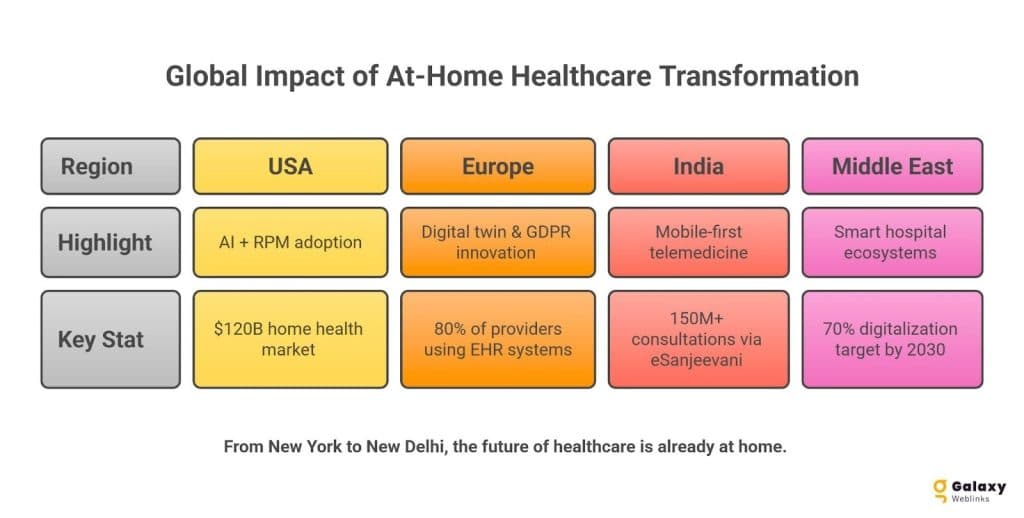
The move toward at-home healthcare isn’t limited to one geography — it’s a global transformation.
While advanced markets like the U.S. and Europe are refining digital healthcare systems for efficiency and scalability, regions like India and the Middle East are rapidly leapfrogging traditional healthcare barriers through mobile innovation and government-backed health digitization.
Together, these diverse regions show one clear pattern — technology is making healthcare borderless, continuous, and personal.
The Global At-Home Healthcare Landscape
| Region | Focus Area | Market Insight | Source |
| United States | AI & remote patient monitoring | The U.S. home healthcare market surpassed $120 billion in 2023, driven by telehealth and chronic disease management. | Grand View Research |
| Europe | Data privacy & digital integration | The EU Digital Health Strategy promotes interoperable EHR systems and AI-driven home care under GDPR. | European Commission eHealth Strategy |
| India | Accessibility & affordability | The Ayushman Bharat Digital Mission (ABDM) is building a unified digital health ecosystem; India’s telemedicine market to hit $5.5B by 2025. | IAMAI–PwC Report |
| Middle East (KSA, UAE) | Smart hospitals & health digitization | Saudi Vision 2030 and UAE’s Smart Health initiatives aim to digitize 70% of patient interactions by 2030. | Saudi Vision 2030 Health Sector Transformation |
How These Markets Differ — Yet Converge
- United States focuses on AI-driven home monitoring, reducing costs and hospital congestion.
- Europe emphasizes compliance and standardization, ensuring ethical and interoperable data flows.
- India prioritizes reach and inclusivity, bringing healthcare to remote and rural populations through mobile-first models.
- The Middle East invests in digital health infrastructure, integrating telemedicine with national health records for large-scale transformation.
Despite these differences, the end goal is identical — accessible, data-secure, and personalized home healthcare.
Real-World Case Highlights
- In the U.S., hospitals like Mayo Clinic and Kaiser Permanente are expanding hospital-at-home programs that deliver acute care remotely — reducing readmissions by 30%.
- The UK’s NHS Digital Twin Pilot (2024) uses AI and predictive analytics to personalize at-home recovery plans.
- India’s eSanjeevani telemedicine platform has already completed over 150 million consultations, proving digital health can scale affordably.
- In the UAE, the “Doctor for Every Citizen” initiative offers 24/7 virtual consultations in Dubai, integrating directly with EHRs.
Galaxy Weblinks’ Global Experience
At Galaxy Weblinks, we collaborate with healthcare innovators across continents — helping:
- U.S. and European providers deploy scalable, HIPAA/GDPR-compliant solutions
- Indian startups design affordable mobile health platforms
- Middle Eastern health systems modernize through cloud and AI adoption
By understanding these regional nuances, we build digital health solutions that are both globally aligned and locally relevant.
👉 Explore Our Healthcare Industry Solutions
Key Takeaway
Whether it’s AI analytics in Boston, digital twins in London, or telehealth in Bengaluru — the direction is the same.
The world is converging toward care that begins — and thrives — at home.
That’s the true essence of how future healthcare technology is elevating at-home care across regions.
Challenges in How Future Healthcare Technology Is Elevating At-Home Care
While how future healthcare technology is elevating at-home care paints an inspiring vision, the journey isn’t without challenges.
Healthcare organizations around the world face a complex mix of data, infrastructure, compliance, and adoption hurdles.
Recognizing and addressing these barriers is the first step toward scaling home-based digital care successfully.
1. Data Privacy and Regulatory Compliance
The more healthcare moves into the home, the more data protection becomes a concern.
- Sensitive health information flows across apps, wearables, and cloud platforms — increasing exposure points.
- Compliance with HIPAA (USA), GDPR (Europe), and NDHM guidelines (India) is crucial yet difficult when multiple vendors and devices are involved.
- According to IBM’s 2024 Data Breach Report, the average breach cost in healthcare is $10.93 million, the highest among all industries.
Solution Insight: - Adopting Zero Trust Architecture, robust encryption, and secure APIs can protect patient data even in distributed systems.
2. Integration with Legacy Systems
Most hospitals still run on outdated IT systems and siloed Electronic Health Records (EHRs).
Integrating new IoT and AI systems into those environments often leads to data duplication and interoperability issues.
| Problem | Impact | Example Solution |
| Fragmented health data | Doctors lack a 360° patient view | Use interoperable FHIR (Fast Healthcare Interoperability Resources) standards |
| Vendor lock-in | Limited scalability | Opt for API-first, cloud-based architectures |
| Manual workflows | Increased admin load | Automate data sync and reporting pipelines |
Galaxy Weblinks Approach: We build interoperable digital ecosystems that unify EHRs, IoT, and AI systems into a single source of truth.
3. Low Digital Literacy and Accessibility
Not all patients — especially seniors — are comfortable using smart devices or apps.
A Pew Research Center study found that only 44% of adults aged 65+ feel confident managing digital health tools on their own.
Solution Insight:
Simplified UX design, voice-based navigation, multilingual interfaces, and caregiver support features can drastically improve digital adoption rates.
4. Cost and Infrastructure Constraints
While telemedicine and remote monitoring reduce hospital costs in the long run, the initial investment in IoT devices, AI software, and cybersecurity can be high — particularly for smaller providers.
Infrastructure gaps like unreliable internet or low cloud maturity (especially in rural areas) further delay adoption.
Solution Insight:
Governments and insurers can accelerate adoption through public-private partnerships (PPP) and value-based reimbursement models that reward preventive care.
5. Ethical and AI Governance Concerns
As AI systems begin making health recommendations, bias, transparency, and accountability come under scrutiny.
- Who is responsible when an AI misdiagnoses?
- How can algorithms remain fair across gender, ethnicity, and socioeconomic backgrounds?
To build trust, healthcare organizations must ensure:
- Explainable AI (XAI) models
- Independent audits for bias
- Ethical frameworks for decision-making
“AI must support clinicians — not replace them.”
6. Implementation Roadmap — Overcoming the Barriers
| Step | Action | Goal |
| 1. Assess | Conduct digital readiness & compliance audit | Identify system gaps |
| 2. Plan | Choose interoperable & compliant platforms | Enable seamless integration |
| 3. Build | Develop secure cloud infrastructure | Support data scalability |
| 4. Train | Educate clinicians, patients & IT teams | Drive adoption & trust |
| 5. Optimize | Measure KPIs & refine workflows | Sustain long-term ROI |
Galaxy Weblinks Perspective
At Galaxy Weblinks, we help healthcare organizations navigate these challenges through:
- End-to-end compliance consulting (HIPAA/GDPR)
- Scalable cloud + IoT architecture design
- UX design tailored for low digital literacy users
- Continuous AI performance monitoring and bias detection
👉 Explore our Digital Transformation Services
Key Takeaway
Every innovation brings new complexity — but also new opportunity.
By addressing data security, interoperability, and human adoption head-on, healthcare providers can truly unlock how future healthcare technology is elevating at-home care in a sustainable, ethical, and patient-centric way.
How Galaxy Weblinks Is Pioneering Future Healthcare Technology for At-Home Care
At the heart of every healthcare transformation lies one question —
How do we make care more connected, predictive, and personal?
At Galaxy Weblinks, we’ve been answering that question for over a decade by helping healthcare organizations around the world design and deploy technology that brings care directly to the patient’s doorstep.
From AI-driven monitoring to cloud-native health apps, our mission is to enable the future of at-home healthcare — one secure, intelligent, and human-first solution at a time.
Our Core Capabilities
| Focus Area | What We Deliver | Outcome |
| AI & Predictive Analytics | Machine learning models that detect early health risks | Fewer hospital readmissions, improved outcomes |
| IoT & Remote Monitoring | Real-time device connectivity and data dashboards | Continuous patient oversight |
| Telemedicine Platforms | Custom, HIPAA-compliant virtual consultation apps | Enhanced access & patient engagement |
| Blockchain Security | Immutable, transparent health data systems | Patient trust & data protection |
| Healthcare UX Design | Accessible, multilingual, and senior-friendly interfaces | Higher adoption & satisfaction |
Real-World Impact
- U.S. Telehealth Network: Galaxy Weblinks built a custom teleconsultation app integrated with wearable data, enabling 5,000+ virtual consultations monthly — improving rural access to specialists by 45%.
- India’s RPM Initiative: Developed a multilingual IoT-based monitoring platform that reduced critical response times by 32% and helped doctors manage 10x more patients remotely.
- European Health Startup: Partnered to implement AI-based predictive diagnostics, increasing diagnostic accuracy by 27% while maintaining full GDPR compliance.
These outcomes show our belief: innovation is valuable only when it improves lives.
Our Approach to Healthcare Modernization
- Discover – Understand clinical workflows, compliance needs, and user personas.
- Design – Build secure, interoperable, and device-agnostic architectures.
- Develop – Leverage AI, IoT, and blockchain to create scalable digital health products.
- Deploy – Integrate seamlessly with EHR and hospital systems.
- Optimize – Monitor, analyze, and enhance performance post-launch.
This proven process ensures our partners can confidently navigate digital transformation with measurable ROI.
Why Healthcare Clients Trust Galaxy Weblinks
- ✅ HIPAA, GDPR, and HL7 compliance expertise
- ✅ Proven track record in healthcare AI and data security
- ✅ 15+ years of digital engineering experience across the U.S., Europe, and Asia
- ✅ Focus on UX, scalability, and clinical safety
“We don’t just build software — we build healthcare ecosystems that think, learn, and care.”
Let’s Shape the Future of Care
If your organization is looking to build AI-powered, secure, and scalable digital healthcare solutions, Galaxy Weblinks can help.
👉 View Our Healthcare Case Studies
How Future Healthcare Technology Will Continue Elevating At-Home Care
Healthcare is on the edge of its most transformative decade yet.
The rapid pace of innovation — from AI diagnostics to digital twins and home robotics — signals a future where personalized, predictive care will happen not in hospitals, but in homes.
That’s the next evolution of how future healthcare technology is elevating at-home care — shifting from convenience to complete autonomy.
The Next-Gen Technologies Reshaping Home Care
| Innovation | What It Means | Future Impact |
| Digital Twins | Virtual replicas of patients built using their health data | Simulates treatment outcomes before real-world application (Gartner, 2024) |
| AI-Powered Virtual Care Companions | Voice-based assistants that help with daily health management | 24/7 personalized guidance for patients and caregivers |
| Robotics in Home Rehabilitation | Assistive robots for physical therapy and elderly care | Supports aging populations safely and independently |
| Metaverse-Based Care | Immersive virtual environments for therapy, training, and consultations | Enhances patient engagement and medical education |
| Predictive Population Analytics | Combining national health data and AI for large-scale prediction | Helps prevent outbreaks and chronic disease escalation |
Each innovation moves healthcare closer to being preventive, participatory, and personalized — the “3Ps” that define next-generation patient care.
What Experts Predict
- The World Economic Forum projects that by 2035, over 50% of healthcare interactions will take place virtually or in hybrid formats.
- According to Deloitte’s 2024 Future of Health Report, AI and robotics will account for one-third of global healthcare investments by 2030.
- Statista predicts the global Digital Health market will reach $900 billion by 2030, driven largely by home-care technology adoption.
The takeaway?
Home is no longer just a place of comfort — it’s becoming the center of care.
How Providers Can Prepare for This Future
To stay ahead, healthcare organizations must start investing in:
- Interoperable, cloud-native systems that connect devices, data, and doctors seamlessly.
- AI literacy programs for healthcare professionals.
- Patient engagement ecosystems that combine wellness, prevention, and personalization.
- Strong ethical governance to ensure AI transparency and fairness.
The providers who act now will lead the next era of healthcare — where outcomes are not measured by treatment delivered, but by crises prevented.
Galaxy Weblinks’ Vision for the Next Decade
At Galaxy Weblinks, we believe the future of healthcare is a partnership between humans and technology — empathetic yet intelligent, automated yet deeply personal.
We’re already collaborating with health systems, startups, and research institutes to bring emerging technologies like AI agents, voice-based care, and digital twin simulations to life.
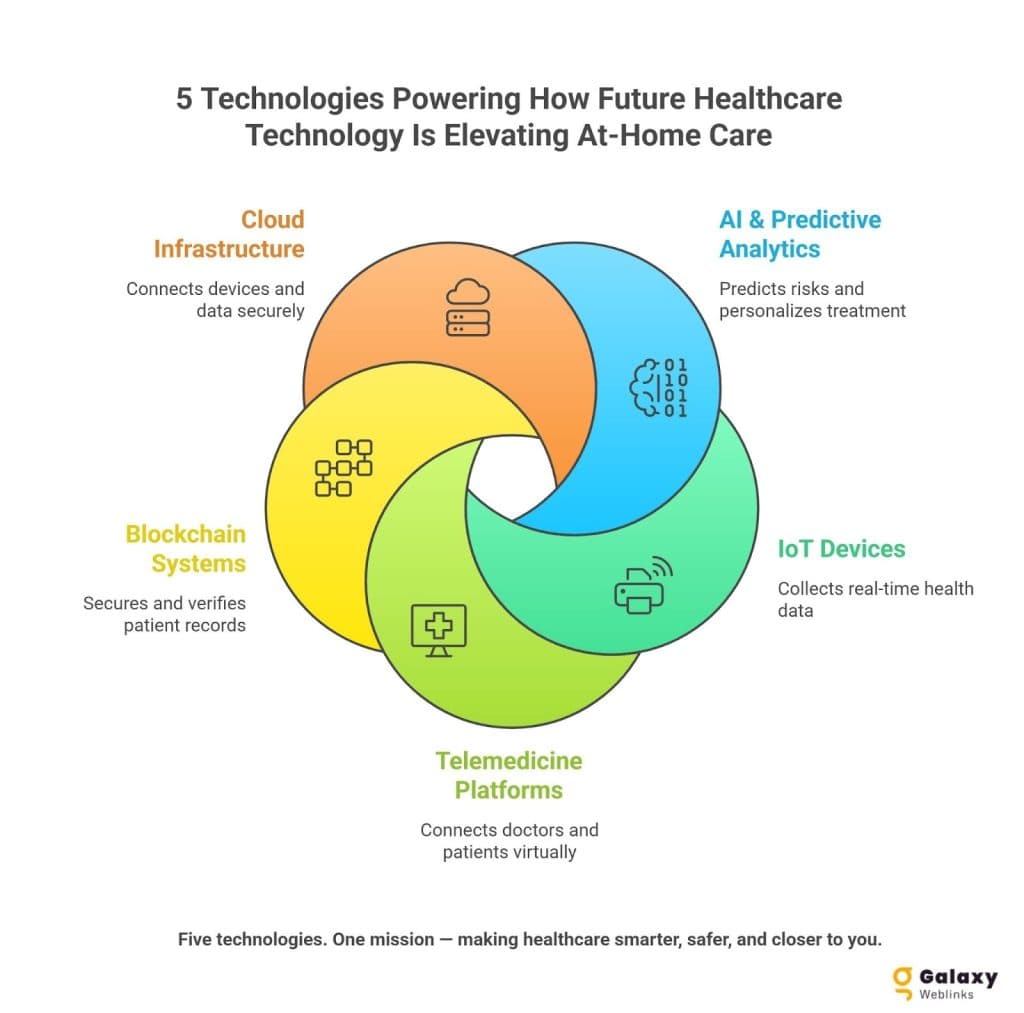
Benefits of How Future Healthcare Technology Is Elevating At-Home Care
The true power of how future healthcare technology is elevating at-home care lies in its ability to improve lives — not just systems.
From reducing readmissions to improving patient satisfaction, these innovations are making healthcare more accessible, affordable, and humane.
Key Benefits for Patients and Providers
| Benefit Area | What’s Changing | Real-World Impact |
| Accessibility & Inclusion | Remote consultations and IoT devices eliminate location barriers | Rural and mobility-limited patients can access specialists 24/7 |
| Personalized, Predictive Care | AI tailors treatment plans based on continuous data | Reduces disease flare-ups and emergency visits |
| Cost Efficiency | RPM and telemedicine cut hospital overheads | Saves 15–20% on per-patient costs (McKinsey, 2023) |
| Enhanced Patient Engagement | Gamified health apps and AI chatbots keep patients involved | Boosts long-term therapy adherence |
| Improved Clinical Outcomes | Real-time monitoring and analytics | Reduces hospital readmissions by 38% (Deloitte Health Report 2024) |
| Data Transparency & Trust | Blockchain and secure cloud systems | Patients gain control over their data, building confidence in digital care |
Beyond Treatment — Empowerment
Modern healthcare technology doesn’t just treat illness; it empowers individuals to lead healthier lives.
- Seniors can maintain independence through AI-powered reminders and health alerts.
- Working professionals can manage chronic conditions from home without disrupting their schedules.
- Families gain peace of mind knowing care is continuous and connected.
In essence, healthcare becomes not just reactive — but preventive, participatory, and predictive.
The Provider’s Perspective
For healthcare providers, the benefits extend beyond patient satisfaction:
- Streamlined workflows through automation and cloud integration
- Reduced burnout by automating repetitive administrative tasks
- Smarter data insights that support clinical decisions and improve precision
- New revenue models through subscription-based telehealth or wellness services
As a result, hospitals are transitioning from “treatment centers” to “connected care networks.”
Conclusion
The healthcare revolution is no longer on the horizon — it’s happening inside our homes.
From AI-powered diagnostics to IoT-enabled monitoring and secure digital health records, the way we experience care has fundamentally changed.
Today, how future healthcare technology is elevating at-home care can be seen in every interaction — a remote consultation that saves a hospital trip, a wearable that detects irregular heartbeats, a predictive system that prevents an emergency before it begins.
This transformation represents more than technological progress; it’s the evolution of healthcare itself — from institutional to individual, from reactive to predictive, and from treatment-based to wellness-driven.
FAQs
Q1. How does AI improve at-home healthcare?
AI analyzes data from devices and health records to predict complications early, allowing timely intervention and better outcomes.
Q2. Is at-home healthcare as effective as hospital care?
Yes. According to Harvard Business Review, home-based AI monitoring can cut readmission rates by up to 40% while improving patient satisfaction.
Q3. How does technology make care more affordable?
Telemedicine, automation, and IoT devices reduce physical infrastructure costs, lower staff workload, and enable preventive care — all leading to long-term savings.

