

Fantasy sports apps have exploded in popularity over the last few years. And honestly, it’s no surprise. This rise is driven by the shift toward interactive, skill‑based digital experiences.
Their interactive gameplay hooks users fast, and the idea of using your own sports skills and knowledge to compete makes the experience feel… personal. Real.
People love that.
Naturally, this creates strong user retention and recurring engagement—two things entrepreneurs look for when evaluating new digital product opportunities. For founders, the opportunity is real—but so are the complexities.
Building a fantasy sports app isn’t a simple “idea → launch” story. It never is. Most successful fantasy sports apps didn’t just appear one fine morning. They were the result of slow, deliberate work. Research. Planning. Smart decisions made at the right moments.
A clear understanding of features, workflows, cost structures, and yes—compliances that you can’t ignore.
Everything matters.
And that’s exactly where things get tricky for beginners. Missing even one crucial detail can derail the entire concept. Which is why you need clarity before writing a single line of code.
This guide aims to give you that clarity.
This comprehensive guide on developing apps for fantasy sports works as your playbook—your roadmap—for building the right solution, step by step. From cost to develop fantasy sports app, process, and compliance to tech stack, it offers detailed insights.

What is Fantasy Sports App Development?
Fantasy sports app development involves creating a mobile application that allows users to build virtual teams of real-life sports players. These apps are a kind of gaming application.
Users build their squads and when sportsmen play in real-world then points based on their performances are awarded based on established scoring logic.
This connection between real match performance and in-app scoring is what makes fantasy sports compelling—and technically complex.
Developing a Fantasy sports mobile app involves several steps and considerations to ensure it gets you the desired outcomes.
Coding and features are the tip of the iceberg; there is a lot more in fantasy app development like UI/UX design, backend architecture planning, integration strategy, etc.
You can target Android only with native app development or build for both iOS and Android with a cross-platform solution depending on your user segments.
Market Overview for Fantasy Sports App Development
The fantasy sports app market is rapidly growing and according to research, it is projected to grow to $563.8 billion by the end of 2030, at a CAGR of 15.2%. It shows the immense opportunities in this field that you can avail yourself of by investing in a fantasy sports app.
For founders, this means the timing is strong—consumer demand, monetization models, and market momentum are all aligned.
How to Develop a Fantasy Sports App?
Building a good fantasy sports app takes clear planning. It needs research. Building a successful fantasy sports platform requires a structured approach. Following is a complete step by step fantasy sports app development process.
Step 1: Research the Market and Plan Needs
Start by looking closely at the market. This means studying what your competitors do. Learn what users expect. Look at successful apps in this field. Find the best features they use. You need to understand the sports you choose, like cricket or football. This research informs your product scope, feature set, and monetization strategy. Like, you may focus on fantasy football app development or fantasy cricket app development or so.
Step 2: Build a Roadmap
Next, turn your idea into a clear plan. Outline user flows, MVP scope, scoring logic, and compliance needs. Decide the final list of features. This step helps define the main parts of your app. It settles the basic design. Here, the best fantasy sport app development company will offer strategic guidance to build a good roadmap for you.
Step 3: Invest in Good UI/UX Design
A clean, intuitive UX matters because users need to make fast decisions, especially in live or time‑sensitive contests. There comes the role of UI/UX design. It involves creating intuitive interfaces and smooth user flows that make user journey frictionless. The best interaction design services create smooth user interfaces that enhance user experience. Wireframes and prototypes help validate the experience early.
Step 4: Build with the Right Tech Stack
After design, development begins for your fantasy sports mobile app. You can start with MVP development to validate your core idea. This allows you to launch the app with only key features to test the idea. Then the coding begins, and app developers show their skills. This phase has two main parts.
- Frontend development: It is the user-facing side. It requires writing code for the app’s interface. Frameworks like React Native or Flutter used here. Also, languages like Java, Kotlin, or Swift are used for coding.
- Backend development: The backend of your fantasy mobile app is where the business logic resides. It manages scoring engines, contest logic, leaderboards, user data, payments, and integrations. Databases, servers, APIs, caching, and CDNs, are all part of the backend infrastructure.
Also see: Which one is the best: Flutter or React Native?
Step 5: Test Thoroughly for Best Performance
Your app is built. Great. But is it actually ready for real users? That’s where testing steps in — the phase people often rush, but really shouldn’t.
The app goes through several tests. Like, API testing. That makes sure data moves flawlessly. Functional testing ensures everything works smoothly.
Usability testing checks if the experience feels smooth, not clunky. Plus, several other checks happen. These ensure performance, accuracy, and security stay solid.
Step 6: Deploy and Launch
Once your app is ready and tested, it is deployed to App Store and Play Store with required configurations, compliance validation, and optimization.
Step 7: Invest in Maintenance
Launching is not the end. Fantasy sports apps require continuous updates—new seasons, new contests, new rules, and evolving compliance standards. This constant work is essential for scaling. The user base will grow. Post-launch support handles these challenges. You have to keep the app healthy.
Essential Features for Fantasy Sports App Development
Features play a vital role in making your fantasy sports app attractive and engaging. Here are the essential features that the right fantasy app should have.
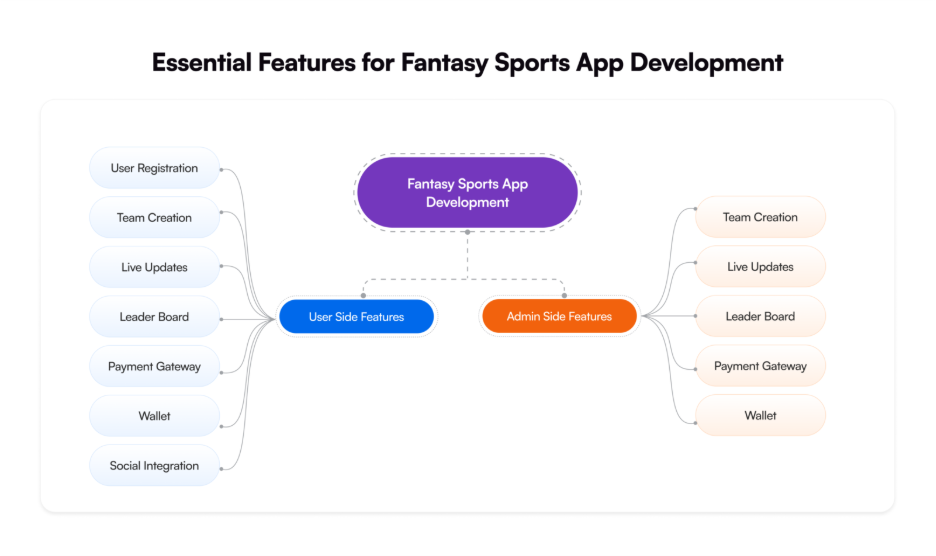
Features on User Side
These are the user-facing features that the end users directly have access to.
User Registration
Users need an easy way to sign up for the app. Registration must be simple and quick for fast access. Avoid long, difficult processes. Keep the screen clean. Use only the fields that are absolutely needed. Choosing the best UI/UX design services helps create a good interface.
Users must be able to register via email or phone number. Registration through social media like Google or Facebook has also gained popularity. It offers an easy and quick method to register.
Team Creation
This feature is the heart of fantasy sports app development that allows users to create their teams. Users can select players and build a team based on performance stats and strategy. For example, users can create fantasy cricket league teams.
Live Updates
Live updates feature includes automatic real-time scoring and tracking of points of users’ teams. These updates happen based on the actual performance of the players in the game. Scores or points are updated in real-time when a player gets strikeouts or scores a goal. Regular notifications keep users engaged and updated about the scores, live sport events, and matchup reminders.
Leader Board
Leaderboard provides a visual representation of rankings for different teams. It offers a dynamic list of teams in descending order powered by the point calculation engine. It provides ranking in easy and understandable format with team names, scores, and rank of each user.
Payment Gateway
Easy and secure payment is one of the vital features for fantasy sports app development. This requires integration of payment gateways that will enable users to add amounts to their wallets or withdraw and share amounts to their bank accounts.
Wallet
Users can manage their funds during gameplay with the use of a wallet. They can add money to the wallet or withdraw it by sending it to banks. It is a virtual vault that holds users’ funds, winnings, and bonuses. Users can deposit money here and see transaction history for all deposits, withdrawals, and winnings.
Social Integration
These are features that allow users to compete with others, connect with friends, and share data. Features like in-app chats and private leagues are part of social integration.
Features on Admin Side
These features are not available to end users, and only admins can access them to control and manage the app’s ecosystem.
Rules and Scoring
It includes custom configurations that help control the game’s rules and scoring format. The admin can set how points are awarded, manage the rules of leagues and contests, create different scoring formats, and more.
User Management
This feature provides complete control for managing user profiles and setting rules for them to the admin. The admin can restrict any account when necessary and identify and verify accounts.
Payment Handling
With this feature, the admins can manage funds. It provides control over refunds and transactions. Additionally, it helps to manage the generation and distribution of financial reports.
Managing Contests
Contest-related features enable the admin to design, edit, and remove contests. The admin can add entry or winning fees, number of participants, and other details.
Data and Analytics
Another essential feature for developing fantasy sports apps is a clean dashboard with data and analytics. It offers real-time insights into various aspects of your application including revenue, user behavior, app performance, and more.
What is the Tech Stack to Create a Fantasy Sports App?
Choosing the right tech stack plays a vital role in creating an efficient, scalable, and user-friendly fantasy sports mobile app. The following is a list of the top technologies for developing the app.
| Frontend Development | |
| Frameworks | React Native, Flutter, Ionic |
| Programming Languages | Swift, Objective-C, Kotlin, Java |
| Backend Development | |
| Server | Nginx, Apache |
| Frameworks/Platforms | Node.js |
| APIs and Services | Sports data APIs, payment gateways, Facebook SDK, Twitter API |
| Hosting and Deployment | AWS, GCP, Azure |
| Database | MySQL, SQLite, PostgreSQL, Firebase, MongoDB, Amazon DynamoDB |
| Real-Time Communication | WebSockets, Firebase |
| Security | SSL/TLS, JSON Web Tokens (JWT) |
| Tools & Platforms | |
| IDE/Code Editors | Android Studio, Xcode, Visual Studio Code |
| Project Management | Jira, Microsoft Project, Trello |
| DevOps & CI/CD | Jenkins, Git, GitHub/GitLab, |
| Analytics & Monitoring | Google Analytics, Datadog |
Native vs Cross-platform vs Hybrid: Which is Best for Fantasy Sports App Development?
Picking the right tech foundation is the biggest decision. It is the first critical step for fantasy sports app development. You got three ways to go: Native, Cross-platform, or Hybrid. The “best” choice really depends on your cash. It depends on your main goal.
Native gives you unmatched speed. It performs great. You need that speed for real-time scores. You need it for quick bidding. Cross-platform is cheaper to build. You launch it faster. It’s perfect for testing your idea first. Hybrid is the easiest way.
But it gives up too much performance. Fantasy sports apps need to be dynamic. For a serious, high-traffic app, Native is often the superior choice. It just gives users the best experience and stability.
| Technology Type | Primary Goal | Performance & Speed | Cost & Time | User Experience (UX) |
| Native | Maximum Performance | Excellent (Real-time data) | High | Best (Seamless device integration) |
| Cross-Platform | Faster Time to Market | Good (Slight lag possible) | Medium | Very Good (Shared codebase) |
| Hybrid | Lowest Initial Cost | Fair (Relies on web wrapper) | Low | Limited (Feels like a website) |

Understanding the Cost: How Much Does It Cost to Build a Fantasy Sports App?
The cost of fantasy sports app development varies due to complexity, features, and many other factors. For example, if you want to develop an app with basic features like user registration, leaderboard, scoring, and team creation, this likely cost between $5,000 – $20,000.
Similarly, a highly complex and large fantasy app will cost $80,000 – $150,000 or more. The following table shows possible ranges for the cost to develop fantasy sports app based on app complexity.
| App Complexity | Cost Range | Possible Timeframe |
| Simple App | $5,000 – $20,000 | 3-6 months |
| Moderate App | $20,000 – $80,000 | 6-9 months |
| Complex App | $80,000 – $150,000 | 9-12+ months |
Note: True cost depends on compliance, real‑time data licensing, scalability requirements, design depth, and number of sports.
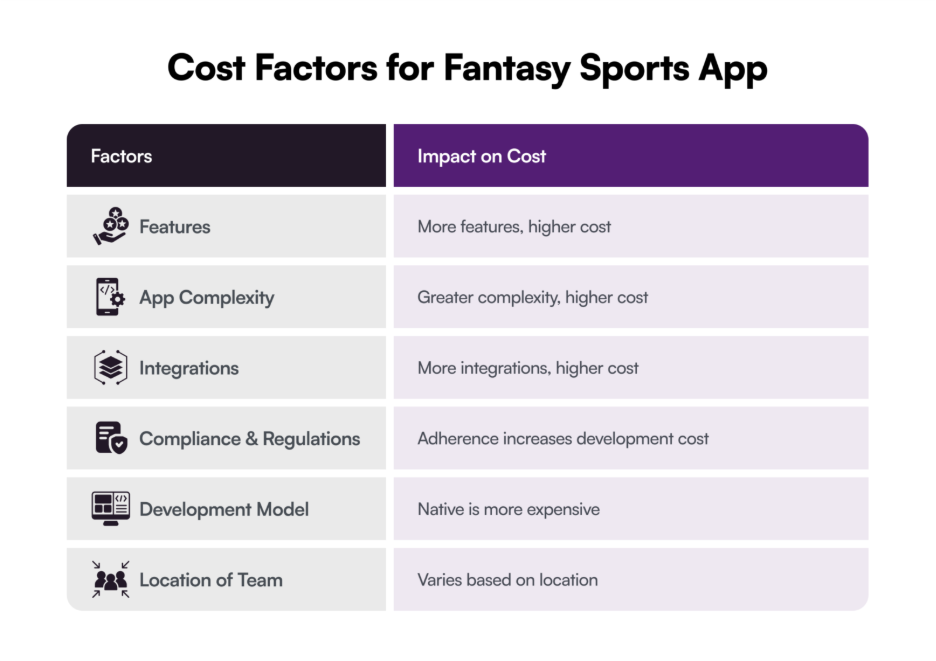
Key Factors that Influence the Cost of Fantasy Sports App Development
Features
The features you add to your fantasy sports app play a direct role in shaping the overall cost. A simple app with core features is always more affordable, but the cost increases as you start bringing in advanced capabilities.
Want multi-language support? That costs extra. Adding multi-currency capability? More money. Social integration and live chats, too. These features add up. Then you look at the truly advanced stuff. AI, AR/VR, and blockchain. Those take the cost much higher. Mobile app development costs vary greatly. It all depends on your feature mix.
App Complexity
App complexity is also directly linked to the cost. More complexity, more costs. It’s simple math. This is because you need more time and skills in integrating advanced functionalities, complex business logic, and extensive integrations. So, naturally this excessive time and effort lead to higher costs.
Integrations
Often apps require third-party integrations like payment gateways, social media, and APIs. These integrations also contribute to the increase in costs. More integrations will result in more cost to develop fantasy sports apps.
Compliance & Regulations
The requirement for legal compliances like GDPR, CCPA, and other regional regulations also affect the cost of developing a fantasy sports app. You need to develop your app adhering to these regulations and compliances that will add more to your development cost.
Development Model
The way you build the app changes how much you pay to develop a fantasy sports app. Go native (separate code for iPhone and Android) and you’re basically paying for two apps. Pick React Native or Flutter instead, write the code once, and it runs great on both platforms.
Same look, same features, half the price. Most brands today go cross-platform and pocket the savings—or use the extra cash for better design and marketing. Simple choice, big difference.
Location of Development Team
The geographical location of your fantasy sports app development company also plays a crucial role in app development costs. Development rates often vary widely by the region. It’s common to see hourly pricing in North America fall somewhere around $100–$250, while countries like India often offer ranges closer to $20–$60. These are general market patterns, not fixed standards — skill levels can be similar, but the overall cost of building an app can still differ a lot depending on where the team is based.
Types of Fantasy Sports Apps
There are different types of fantasy sports applications that you should know to make the right decision. By understanding these different apps, you can determine which one you should build. Let’s check out these apps.
| App Type | Description |
| Quick Contests (Daily Fantasy Sports) | These apps offer short-term games. Users pick teams for one day or one week. The results come quickly. They get frequent chances to win. Platforms like DraftKings and FanDuel draw both casual fans and serious competitors. They are like quick competitions. The commitment is low. It works well during major sports seasons. |
| All-Sport Games (Multi-Sport Fantasy Apps) | These apps let users build teams across many sports. Think football, cricket, basketball, or golf. This keeps people playing all year. ESPN Fantasy and Yahoo Fantasy are examples. They make it easy to switch between sports. Players get versatility. Everything is simple and in one place. |
| Long-Term Leagues (Season-long Fantasy Sports Apps) | These apps require commitment. Users draft their teams before the season begins. They manage those teams for months. This means handling trades, injuries, and performance drops. It favors long-term planning over quick wins. NFL Fantasy and CBS Fantasy Sports keep devoted players engaged. It builds deep competition and camaraderie. |
| Community Games (Social Fantasy Sports Apps) | These apps focus on connecting people. They add features like friend leagues and group chats. They allow easy sharing. Platforms like Sleeper and Discord leagues make the game interactive. They strengthen relationships. The fun goes beyond just stats and scores. |
| Specific Interests (Niche Fantasy Sports Apps) | These apps serve small, dedicated fan bases. They cover sports like MMA, cycling, or NASCAR. The fans want a game tailored to their specific interests. PlayON offers unique features. These apps give dedicated communities a customized way to play their favorite sports. |
Fantasy Sports App Development Trends: Advanced Features You Can Integrate
You need fresh ideas for your fantasy sports app. Think outside the box, seriously. Put in features that really stand out. You need unique selling points. Those points help you beat the competition. It’s just a simple business sense.
So, what are those USPs? You can leverage the cutting-edge technologies and trends in fantasy sports app development to create innovative apps with advanced capabilities. Let’s see these advanced features and trends.
AI and Machine Learning
AI and machine learning are great tools. They push fantasy apps to a new level. They give you advanced features. Think predictive analysis. Think super-personalized recommendations. They even optimize lineups for you. These features use data. Things like score histories. Player performance. Real-time game stats, too.
Users get essential insights to make better decisions and improve their game strategies. Besides, you can integrate AI-powered chatbots to help users answer their queries and offer an analysis of the game that results in higher user engagement.
Blockchain
The use of blockchain with your fantasy sports app improves security significantly. It helps in decentralized and temper-proof record-keeping to ensure fair play. Further, smart contracts make transactions more transparent and trusted to ensure fraud-proof payouts.
The immutable blockchain ledgers help record in-game transactions and player stats quite securely that maintain transparency and reduce chances of manipulation.
AR/VR
Augmented Reality (AR) and Virtual Reality (VR) can take fantasy sports experience to a whole new level. With these technologies, users can experience an immersive and interactive game environment.
With the use of VR, users can experience the game in a simulated environment. And, with the use of AR overlays, users can get real-time score updates in a more engaging and interactive way. With XR, that combines both these techs, users will get a real-life stadium-like experience.
IoT
The Internet of Things (IoT) brings a major change in how fantasy apps function. This technology enables apps to fetch data in real-time from wearable devices, smart stadiums, and other connected devices to enhance user decision making in games. Based on the advanced knowledge about a player’s performance, users can make the right decision that will increase their winning possibility.
Cloud
Cloud technology helps build a strong foundation for your fantasy app. It makes the app scalable. It keeps it efficient. This ensures top performance. Even when traffic spikes, the app stays fast. Choosing the cloud also saves money. It lowers your overall costs. The cloud provider handles the maintenance for you.
What are the Examples of Fantasy Sports Apps that are Successful?
There are many examples of successful fantasy sports apps around the world that have made a strong place in their markets. The following table shows the top examples of such apps.
| App | Type of App | Key Features | User Base |
| ESPN Fantasy Sports | Multi-sport seasonal fantasy | Wide sports coverage; expert analysis; real-time scoring; easy UI | Sports fans wanting deep seasonal play |
| Yahoo Fantasy Sports | Multi-sport fantasy with DFS options | Great draft tools; player rankings; live updates; beginner-friendly | Beginners and regular multi-sport players |
| Sleeper | Social fantasy sports app | Modern UI; strong community features; integrated chat; customizable leagues | Social players and modern fantasy enthusiasts |
| FanDuel | Daily Fantasy Sports (DFS) | Cash contests; instant payouts; expert projections; flexible teams | DFS players and competitive gamers |
| DraftKings | Daily Fantasy Sports (DFS) | Wide global sports coverage; contest variety; deep stats & insights | Strategy-driven fantasy players |
| Dream11 | Multi-sport (India-focused) fantasy | Strong cricket focus; cash contests; expert insights; private leagues | Cricket fans and casual fantasy players |
Monetization Strategies: How Can You Earn with Your Fantasy Sports App?
If you want to enter the growing fantasy sports app domain, you need to understand different monetization tactics used by these apps. This will help you build the right app with the right monetization strategy to ensure both user engagement and profitability. The following are the different strategies adopted by fantasy sports apps to earn money.
Freemium Model
The freemium model is simple. You offer your app free to users. They can choose to upgrade later. The paid features give them extra value. Think of a popular dating app like Tinder, for example. It gives limited profiles and features for free. If someone pays, they see more users and features. Offer better value in paid services. This encourages users to upgrade easily.
In-App Advertisements
Another monetization strategy you can use is integrating in-app ads, and it is popularly used by different gaming apps. Ads can be in video or banner format, or sponsored content. Companies in the sports niche often pay heavily to promote their services or products.
Subscription Plans
Subscription-based monetization gives you control over how users will use your app. You can provide different subscription models that users can pick from based on their budget and requirements. There can be different features, like expert predictions, advanced stats, and more with subscriptions.
Contest Entry Fees
You can also earn when users pay for entering a contest hosted in your app like paid tournaments and leagues that offer cash prizes. This is the common monetization strategy used in fantasy sports app development. Apps like Dream11 use this strategy.
Essential Legal Compliances to Build Fantasy Sports App
Entrepreneurs and business owners have to navigate the legal environment to develop fantasy sports apps that might be challenging. Plus, ignoring these compliances can result in heavy fines, legal action, app bans, and eroded user trust.
Since it is complex and constantly evolving, understanding and adhering to these compliances can be difficult for beginners. Here we have summed up the essential legal compliances to develop your app.
| Data Privacy and Security | Your app must follow the best data privacy and security practices to ensure users’ data remains safe. It ensures your compliance with data privacy and security regulations. |
| Fair Play Agreements | Ensure fair gameplay implementation by creating anti-cheating agreements. Such an agreement will encourage users to make a fair game approach. |
| Intellectual Property Rights | You can avoid infringing intellectual property rights by using public agreements and domains. Using data and names of real players can result in intellectual property right violations. |
| Gambling Compliance | Beware of the gambling regulations and betting app compliances in your respective region to ensure your app adheres to these regulations. |
| Ads & Promotion Compliances | Make sure that ads and promotions displayed in your app comply with local regulations and offer accurate information instead of misleading content. |
To Wrap Up
The popularity of fantasy sports apps continues to grow because users want interactive, skill‑based entertainment—and founders see strong monetization potential. The increasing demand for such apps is a golden opportunity for businesses to invest and earn.
Lots of entrepreneurs see this chance. They are eyeing the opportunity to make money. But success requires more than an idea: founders need clarity, validated scope, strong UX, reliable architecture, compliance alignment, and a long‑term product plan.
Galaxy Weblinks helps founders build stable, scalable fantasy sports apps—from discovery and UX to engineering, AI features, and ongoing maintenance. Our approach reduces risk, accelerates development, and ensures your app is ready for real users and real competition.
As a leading mobile app development company with over two decades of experience, Galaxy Weblinks has the expertise to help you develop a robust fantasy sports mobile app.
We guide you and provide expertise in developing a winning application.
Contact us now to discuss your requirements and get assistance in turning your vision into reality.
Frequently Asked Questions
How much does a fantasy sports app cost in 2026?
The fantasy sports app development cost usually falls in the range $25,000 to $250,000. It actually depends on the number of features. More features simply means the price will be higher.
How long does it take to build?
Around 2–6 months. Complex apps take longer. There’s no shortcut here.
Which app development type for fantasy sports is best?
Native is best for speed. Cross-platform is best if you want to save money. You build one app. It works for both Android and iOS.
Do I need a license to run a fantasy sports app?
In many regions, yes. Some places are strict. You must check local laws.
Is it possible to start with an MVP for fantasy sports apps?
Yes absolutely. Start small, launch fast. Then you can improve your app gradually with more features based on user feedback.
Can I integrate multiple sports in one app?
Yes you can. But it increases cost and dev timelines. More data = more work.
Do fantasy apps make money?
Yes. Entry fees, ads, subscriptions. Many monetization routes. Works well if user base grows.
Why should I hire an experienced development company?
Less risk. Better security. Faster delivery. They know what mess to avoid.