

Today, the job portal market is highly crowded. In fact, the online recruitment platform market is expected to reach $132.13 billion by 2032, growing at an impressive 12.56% CAGR. Despite that, candidates face inconsistent communication lack of trust in the process.
Apart from this, recruiters waste hours filtering unfit applicants. The experience has not improved for them either.
You might think building a job portal app means importing features from Bayt or Indeed. But copying features is noise, not strategy. It does not solve the real struggle:
- Relevance
- Trust
- Two-sided engagement
At Galaxy Weblinks, we have seen this story before. Projects flood us with “must-have features,” but what founders really need to answer is one question:
What hiring or job-seeking friction am I uniquely removing?
Because the market is not short of job boards — it’s short of better hiring experiences. Your job portal must go beyond checklists. It must close gaps that others ignore.
This is not about tech or cost yet, but about finding purpose first, followed by custom job portal app development execution.
In this complete guide on Job portal development, we’ll unpack the essential information you need to build one. From process and cost to challenges in developing job portal platforms, this guide covers all aspects to make the right decisions.
What are the Different Types of Job Portals?
Most job portals do not fail because of bad code. They fail because they are built for the wrong business intent.
Founders often say, “We are building a job portal.” But that’s not a strategy. That’s a category.
What matters is why the portal exists and who it serves. Each model comes with different risks, costs, and complexity.
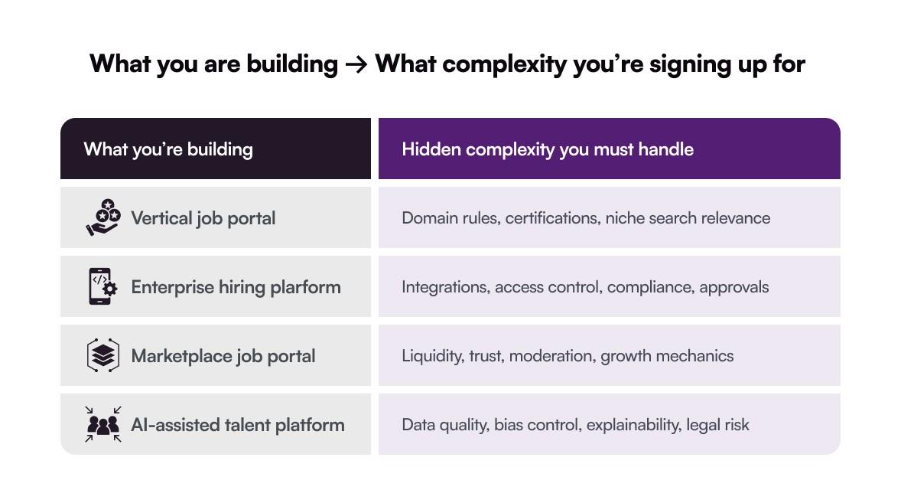
1. Vertical Job Portals
These portals focus on a specific industry or workforce type. They win on relevance, not volume. But they demand deep domain understanding—skills, certifications, pay structures, and compliance vary widely.
Best for: Niche markets with clear pain points and repeat hiring needs.
2. Enterprise Hiring Platforms
These are not public job boards. They are systems of record for hiring inside large organizations. The challenge is not traffic. It’s integration—HRIS, payroll, identity, access control, and approvals.
Best for: Large companies optimizing internal hiring, talent visibility, and workforce planning.
3. Marketplace-First Job Portals
This is the hardest model to execute. Because here you are solving the liquidity problem: enough jobs and enough candidates at the same time. Growth, trust, moderation, and incentives matter more than features.
Best for: Well-funded startups with a clear acquisition and activation strategy on both sides.
4. AI-Assisted Talent Platforms
These platforms promise speed and accuracy through automation. When done right, AI improves recruiter productivity. When done wrong, it creates bias, opacity, and legal risk.
Best for: Platforms with clean data, defined hiring criteria, and human-in-the-loop decision making.
Core Modules That Actually Matter in Job Portal Development
Most job portals look impressive in demos. Then they fail in daily use. That’s because they are built as feature lists, not value systems. What matters is how each layer reduces friction for a specific user.
Candidate Side
Data Structure
A resume is a document. A profile is a data model. If you treat them the same, matching breaks. An on-demand job portal development process should structure skills, experience, preferences, and availability in ways machines and humans can understand. Bad ones upload PDFs and hope for the best.
Smart Search & Recommendations
Search isn’t about filters. It’s about relevance. Candidates should see fewer jobs — and better ones. This requires clean data, intent signals, and feedback loops. Not just keywords.
Application Tracking
Candidates want clarity: applied, viewed, shortlisted, rejected. When status is visible, engagement stays high. When it is not, users disappear.
Employer Side
Job Posting Workflows
Hiring is not linear. Roles change and requirements evolve. Portals fail when job posting is treated as a static form instead of a living workflow.
Candidate Shortlisting, Tagging, and Collaboration
Recruiting is a team sport. Notes, tags, and shared views matter more than fancy dashboards. If collaboration happens outside the platform, the platform has already lost.
Hiring Analytics
If analytics do not support decisions, they become noise. Recruiters do not need more charts. They need answers.
- Which channels deliver quality candidates?
- Where are we losing good applicants?
- How long does hiring really take?
Admin / Platform Layer
Trust & Moderation
Fake jobs. Fake profiles. Spam applications. Ignore this, and the platform rots. Trust is not a feature. It’s an operating system.
Role-based Access
Hiring involves HR, managers, recruiters, and admins. Each needs different visibility and control. One-size-fits-all access breaks governance and compliance.
Marketplace Health Metrics
Traffic does not equal success. Applications do not equal hires.
A feature-rich job portals track:
- Job fill rates
- Candidate drop-offs
- Employer response times
- Match quality over time
These metrics tell you if the marketplace is working — or quietly failing.
The Hidden Complexity No One Tells You About Job Portals
On the surface, job portals look simple. At scale, everything cracks.
Resume Parsing ≠ Accurate Candidate Matching
Most systems extract keywords and call it “matching.” That works until senior titles mean different things across companies or skills are implied, not listed. Or if career gaps are intentional, not red flags.
What breaks at scale:
Platforms flood recruiters with “technically qualified” candidates who are contextually wrong. Recruiters stop trusting the system and go back to manual screening.
Search Relevance vs Recruiter Intent
Search engines rank by text. Recruiters think in outcomes. They do not want “Java developers.” But they want someone who can ship, collaborate, and start fast.
What breaks at scale:
As job volume grows, keyword-based search returns more results — but fewer useful ones. Recruiters scroll less. Hire slower. Blame the platform.
Spam, Fake jobs, and Low-quality Applicants
Fake recruiters. Scraped jobs. Mass applications. Bots do not care about UX. They care about loopholes.
What breaks at scale:
Candidate trust drops first. Then, the employer trusts. Once trust erodes, growth metrics lie — traffic goes up while real hiring goes down.
Cold Start & the Liquidity Problem
A job portal is a marketplace. Marketplaces do not work without balance. If there are no candidates available, then employers leave. And in case of no jobs, candidates don’t return.
What breaks at scale:
Teams overbuild features before solving acquisition on both sides. The product looks “complete” but feels empty.
Compliance is Not Optional
Hiring platforms deal with sensitive data, including personal identity, employment history, and location & legal eligibility. GDPR, regional labor laws, and data retention rules differ by geography — and change often.
What breaks at scale:
Platforms launch fast, then freeze. Data deletion requests, audit trails, consent tracking, and regional storage were never designed in. Retrofits become expensive and risky.
This is why job portal app development is a systems problem, not a feature problem. And why execution matters more than imitation.

AI in Job Portal App Development: Where It Actually Works
AI will not save a broken hiring process. But used right, it can remove real friction.
Most job portals rush to say “AI-powered.” Few ask where AI integration enhances interaction and actually earns its keep — and where it creates risk.
High-ROI AI Use Cases in Job Portal App Development
- Resume Parsing & Normalization
AI helps convert messy resumes into structured, searchable data. The real value is not parsing once — it’s normalizing across formats, languages, and experience levels so downstream systems don’t break.
- Skill Extraction & Taxonomy Mapping
AI works well when it extracts implied skills, maps them to a consistent taxonomy, and reduces noise from inflated job titles. This improves search, matching, and analytics without making final decisions.
- Match Scoring
AI-driven match scores help recruiters see who to review first. Humans still make the call. This keeps trust intact and reduces bias risk.
- Recruiter Productivity Copilots
This is where AI shines. It works well to summarize profiles, highlight gaps, draft outreach messages, and surface patterns across applicants. The goal is not replacement. It’s speed and focus.
Low-ROI / Risky AI Use Cases in Job Portal App Development
- Fully Automated Hiring Decisions
Automated rejection without human review creates bias exposure, legal risk, and reputation damage. Once candidates feel judged by a machine, trust disappears.
- “Black Box” Candidate Rejection
If you cannot explain why someone was rejected, you cannot defend it. Opaque models do not scale in regulated, human-centric systems like hiring.
- Unexplainable Ranking Algorithms
When recruiters do not understand why candidates are ordered a certain way, they stop trusting the platform — or worse, over-trust it.
Job Portal App Development Cost: What Really Drives the Budget
Below are typical ranges based on scope, not promises.
| Platform stage | What this includes | Estimated cost range |
| MVP (validation-ready) | Core candidate & employer flows Basic search Manual moderation Single region | $40k – $80k |
| Growth-ready platform | Scalable architecture Better search & matching Analytics Role-based access | $80k – $150k |
| Enterprise-grade marketplace | Multi-region support Compliance AI assist Advanced moderation & reporting | $150k – $300k+ |
These ranges assume custom job portal app development —not template job boards.
Average job portal app development cost is not driven by screens or features. It’s driven by decisions. The earlier you make them, the more predictable the budget becomes.
Here are the cost levers that actually matter.
Single-Region vs Multi-Region Hiring
A portal built for one geography is simpler. Language. Currency. Labor laws. Data storage.
The moment you go multi-region, cost rises due to localization and translations, regional compliance (GDPR, data residency), and country-specific hiring rules.
Budget impact: Moderate → High
Multi-region portals often cost 30–50% more than single-region builds.
Marketplace vs Internal Hiring Platform
An internal job portal mobile app development serves one employer. A marketplace serves many — and must keep both sides active.
Marketplaces require trust and moderation systems, abuse and spam prevention, marketplace health analytics, and more complex onboarding flows
Budget impact: High
Marketplaces are harder to build and harder to sustain.
Search & Recommendation Depth
Costs increase when you move from keyword search to intent-based relevance. Also, transition from static filters to adaptive recommendations and simple listings to ranked candidate/job results.
Budget impact: Moderate → High
Search quality directly affects hiring success — and long-term retention.
AI Readiness vs AI Hype
AI itself is not the main cost. Data readiness is. You pay more when data is unstructured or inconsistent, skills and roles aren’t normalized, and models must be retrained often.
AI done right increases upfront cost — but reduces operational cost later. AI done for marketing slides adds cost without value.
Budget impact: Variable
Depends on whether AI assists workflows or pretends to replace them.
Security & Compliance Requirements
Hiring platforms handle sensitive personal data. Security is not optional.
Costs rise with role-based access control and audit logs & data retention rules. Moreover, consent management, deletion workflows, and authentication further affect the cost.
Budget impact: High for enterprise use cases
Shortcuts here become expensive liabilities later.
Build vs Buy vs Customize: The Decision to Job Portal App Development Most Founders Get Wrong
Most founders choose based on speed. They should choose based on where they need control. When it comes to job portal mobile app development, there are three real paths. Each solves a different problem — and creates a different kind of constraint.
1. Off-the-Shelf Job Board Software
This is the fastest way to launch. Templates, plugins, and white-label job boards work when you need something live quickly. Also, if hiring is not core to your business or if differentiation does not matter yet, then off-the-shelf solutions works best.
Where it breaks
- Rigid workflows
- Limited search and matching logic
- Vendor-controlled roadmap
Hidden cost
You do not pay in money at first but in inflexibility later.
Exit & scale impact
Hard to sell or scale a product you don’t truly own.
2. SaaS APIs + a Custom Layer
This is the middle path. You combine resume parsing APIs, search or messaging services, and payments or identity provider with a custom front end and workflow logic.
Where it works
- Faster than full custom
- More control than templates
- Good for early growth
Where it breaks
- API limits shape your product
- Pricing scales with usage
- Switching vendors later is painful
Hidden cost
Recurring API fees quietly grow with success.
Exit & scale impact
Viable, but acquirers look closely at third-party dependencies.
3. Fully Custom Job Portal App Development
This is the hardest path. It’s also the most durable. You own data models, matching logic, workflows, and roadmap.
Where it works
- Clear differentiation
- Complex hiring workflows
- Long-term product vision
Where it breaks
Only if you skip discovery or overbuild too early.
Hidden cost
Upfront investment — not surprise fees later.
Exit & scale impact
Strongest position for scale, partnerships, and acquisition.
A Smarter Way to Job Portal App Development
Most job portals are built backwards. Code first. Features next. Problems later.
We do not start there. At Galaxy Weblinks, our app development process follows a structured approach that helps you succeed.
Discovery before development
Before writing code, we map how hiring actually works. This prevents building a platform that looks complete but fails in real hiring conditions.
- Who creates demand.
- Who reviews candidates.
- Where trust breaks.
- Where decisions stall.
MVP focused on liquidity and trust
An MVP is not about proving features. It’s about proving behavior. In job portals, success depends on two things early:
- Employers seeing qualified candidates
- Candidates trusting the process enough to engage again
Modular architecture for future AI
AI should extend a platform, not destabilize it. We design systems so:
- Core logic is clean and independent
- Data is structured from day one
- Intelligence layers can be added gradually
Design for recruiter and candidate psychology
Recruiters want confidence in shortlists. Candidates want clarity, fairness, and feedback. A good UI/UX design increases return usage.
Scale without rewriting the core
Growth should not punish early decisions. The goal is simple:
- Add regions without rebuilding
- Improve matching without breaking workflows
- Introduce AI without starting over
Proof this approach works beyond hiring
We have applied the same thinking to other decision-heavy, trust-driven platforms.
For example, in our home renovation estimation tool, homeowners struggled to find reliable contractors, navigate bidding, and manage communication and timelines—often leading to cost overruns and delays. The platform had to match the right professionals, structure complex inputs, enable transparent comparisons, and maintain trust across multiple parties.
The challenge was not technology. It was workflow clarity, trust, and decision confidence—the same forces that make-or-break job portals at scale.
See how Galaxy Weblinks solved this in the Home Renovation Estimation Tool case study
Conclusion
Most job portals do not fail because of poor engineering. They fail because of strategic missteps.
Teams focus on copying features instead of solving hiring friction. They optimize for traffic instead of relevance. They launch quickly without designing for trust, scale, or change.
The platforms that succeed take a different approach. They are built around clear hiring workflows, high-quality matching, and systems that can adapt as the market evolves. Trust is designed into the product. Relevance improves over time. Growth does not require rewriting the foundation.
Hiring is not a posting problem. It’s a decision and coordination problem. Job portals that recognize this early are the ones that last.
If you are exploring a job portal idea and want to pressure-test it before writing code, Galaxy Weblinks helps teams’ scope and de-risk complex hiring marketplaces—so you invest in the right product from day one.