

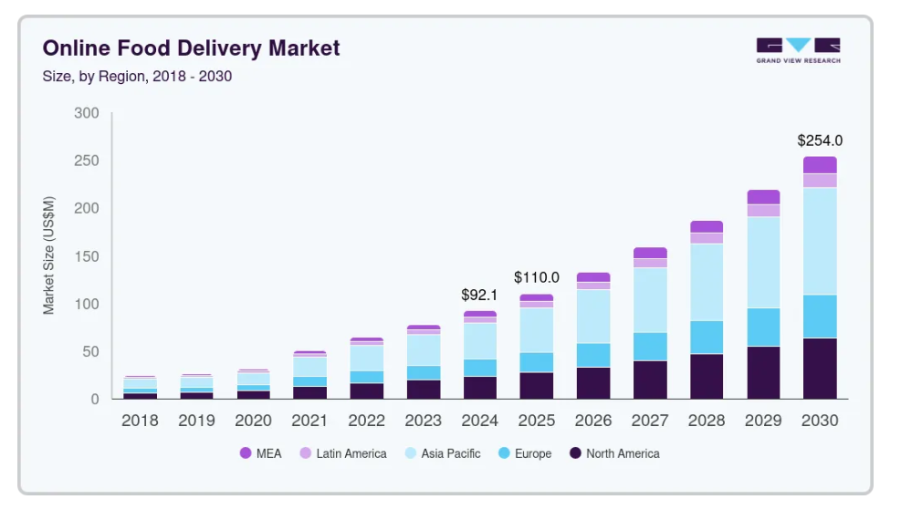
The food delivery market is growing fast. Really fast. It’s expected to cross $500 billion by 2030. That kind of expansion changes everything. Consumer habits. Ordering frequency. Expectations around speed and convenience.
In this landscape, food delivery apps aren’t optional anymore. They’re the main channel. The place where customers discover, order, complain, and come back. Or don’t. Apps now shape brand perception more than storefronts ever did.
That’s why restaurants, cloud kitchens, and entrepreneurs are building their own delivery apps. Not just to keep up. To stay relevant. To own the experience end to end.
Third-party platforms like Uber Eats and DoorDash made it easy to go online. Fast onboarding. Instant reach. That part helped.
But there’s a cost. High commissions eat margins. Workflows feel boxed in. And customer data? Not really yours.
At first, teams tolerate it. Growth hides the pain. But once online orders become the main revenue stream, cracks show up. Profits shrink. Control disappears. Scaling feels harder than it should.
So, businesses are opting out. Slowly. Deliberately. Building their own apps means control – over pricing, over data, over operations. And that control is worth far more than reach alone.
A custom food delivery app flips the script. You own the experience. You set the rules. Operations stay flexible. Data stays with you.
Over time, that control compounds. Better loyalty. Smarter decisions. More repeat orders. Real, long-term value.
This guide breaks down:
- The food delivery business models that actually work
- What to build first (and what to avoid early)
- The development process from MVP to scale
- Realistic food delivery app development costs in 2025
The Food Delivery App Development Market: Growth, Trends & Opportunities
Food delivery app experienced a sharp increase during the Covid pandemic. And, today, that momentum hasn’t faded thanks to changed consumer habits. As a result, on-demand food delivery apps have now become a steady revenue channel instead of a short-term change in consumer behaviour. Below are the latest market trends for food delivery apps.
Market Growth Backed by Data
- The global online food delivery market value will $2.02tn by 2030, growing at a 7.63% CAGR. (Statista)
- The global “Meal Delivery” segment alone is projected to generate more than $500 billion in revenue in 2029 in the USA. (Statista)
- Food delivery has tripled its global market worth since 2017, reaching more than $150 billion. (McKinsey)
Key Trends Driving This Growth
- Hyperlocal Delivery is Expanding Fast
Hyperlocal delivery services are projected to grow at over 13.32% CAGR between 2025–2032. (Fortune Business Insights)
- Dark Kitchens / Cloud Kitchens Are Accelerating
The global cloud kitchen market was valued at $73.18 billion in 2024 and is expected to reach $141.08 billion by 2030 at a 11.9% CAGR. (Statista)
The Core Interfaces of Food Delivery App Development (And Related Features)
This is the backbone of any modern on-demand food delivery app development project — and the foundation that influences everything from user satisfaction to unit economics.
| Interface | What It Is | Essential Features |
| Customer App | The primary touchpoint where users browse, order, pay, and track deliveries. | – Fast restaurant & menu discovery – Seamless cart and checkout flow – Secure, flexible payment options – Real-time order & delivery tracking – Order history, reordering, and notifications – Clear pricing, ETA, and status updates |
| Restaurant Dashboard | The operational interface used by restaurants to manage incoming orders and menus. | – Menu and availability management – Real-time order acceptance and status updates – Prep-time controls and throttling – Order history and performance insights – Simple, low-friction UI for busy kitchen staff |
| Delivery Agent App | The logistics interface guiding drivers through pickup and delivery. | – Task assignment and delivery queues – Optimized routing and navigation – Live order status updates – In-app communication with customers and restaurants – Proof of delivery and issue reporting |
| Admin Panel / Super Admin | The control layer used by founders and operators to oversee the platform. | – Real-time visibility into orders and users – Restaurant and driver onboarding & management – Payouts, commissions, and promotions control – Dispute and issue resolution workflows – Analytics and reporting for strategic decisions |
Must-Have Features for Food Delivery App Development
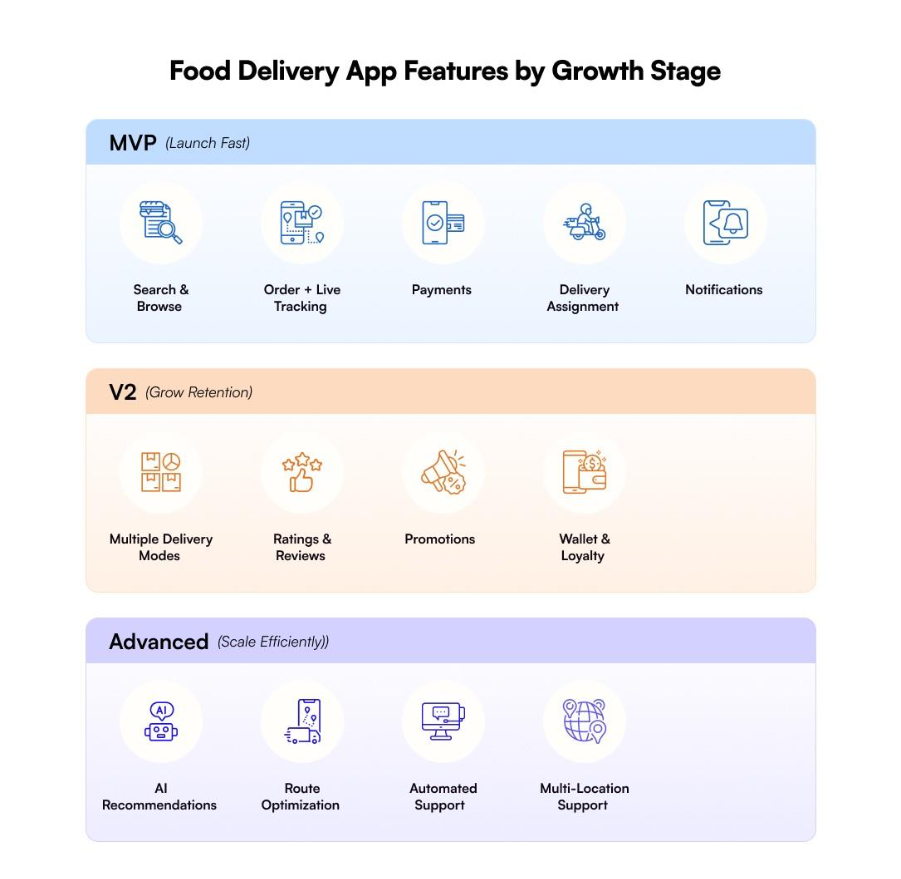
What to build now, what to add later, and what actually drives engineering cost.
Choose a mobile or web development company to validate demand, improve retention, and finally scale operationally. Below is a pragmatic breakdown of features by stage, based on how modern food delivery products evolve.
MVP Features (What you need to launch quickly)
These are the essentials. They validate the model, get real orders flowing, and give you the data you need to iterate. Most of your initial food delivery app development cost sits here, because these features set the foundation for every interface.
1. Smart Searching + Browsing: Search features with advanced filters enable users to quickly search food.
2. Real-Time Order Placement & Tracking: Customers expect transparency. Live updates also reduce support load.
3. Payments: A seamless checkout flow is non-negotiable. The fewer steps, the higher the conversion.
4. Delivery Assignment: Automatically connects orders to the right delivery partner. Critical for operational reliability.
5. Notifications: Keeps customers informed and lowers uncertainty. Also improves retention and re-engagement.
V2 Features (What you add once the app grows)
These features deepen engagement and differentiate your app once you’ve proven demand. They don’t belong in the MVP because they add complexity — and therefore cost — without accelerating early validation.
1. Multiple Delivery Modes: Expands your use cases and improves customer convenience.
2. Ratings & Reviews: Builds trust and helps restaurants improve service quality.
3. Promotions & Coupons: Boosts conversion and nudges repeat orders.
4. Wallet & Loyalty: Encourages customers to stay within your ecosystem instead of returning to aggregators.
Advanced / Scalable Features
These features support growth at scale and unlock operational efficiency. This is where the cost to build a food delivery app increases — not because of the features themselves, but because they require strong architecture, automation, and internal alignment across all user roles.
1. AI-Powered Recommendations: Personalizes the experience and lifts order value with minimal manual effort.
2. Route Optimization: Improves delivery speed and reduces chaos for riders. A major step toward predictable operations.
3. Automated Support (Chatbots): Cuts support load and improves customer response time.
4. Multi-Location Restaurant Support: Essential for franchises, cloud kitchens, and brands expanding into multiple territories.
Architecture & Tech Stack for High-Performance Food Delivery App Development
A food delivery platform lives or dies by its architecture. It’s the invisible layer doing the heavy lifting. Orders flowing fast. Systems staying calm under pressure. No cracks when traffic spikes.
The tech stack you choose isn’t just a dev call. It’s a business move. It decides how smoothly you scale. And how much pain you avoid later.
Below is a high-level look at what matters in modern food delivery app development, framed by outcomes.
| Layer | What It Covers | Typical Choices |
| Backend Architecture | Real-time updates, multi-role logic, routing, API performance | Node.js, Django, Ruby on Rails, Go |
| Frontend (Customer, Restaurant, Driver, Admin) | Mobile apps and web dashboards | React Native, Flutter, Swift, Kotlin, React (Web) |
| Real-Time Communication Layer | Live order status, tracking, driver assignment, instant notifications | WebSockets, Firebase, Pusher, Socket.io |
| Cloud Hosting & DevOps | Deployment, scaling, performance stability, monitoring | AWS, GCP, Azure, Docker, Kubernetes, CI/CD Pipelines |
| Security & Compliance | Payment safety, data encryption, access control, fraud prevention | JWT auth, SSL, PCI-compliant payment gateways, role-based access |
How to Build a Successful Food Delivery App: Step-by-Step Process
A clear, product-led approach grounded in how Galaxy Weblinks delivers digital platforms.
High-performing food delivery apps aren’t built in one big sprint. That never works. They grow in layers. With a clear process. One that cuts risk, speeds up launch, and stays close to real user behavior and messy ops on the ground.
Below is the end-to-end approach we follow when working with founders and enterprise teams on on-demand food delivery app development. It’s structured. Practical. Built for scale, not slides.
Step 1: Discovery & Scoping
Every strong product starts with clarity. Discovery identifies your business model, required interfaces, operational constraints, and success metrics. This stage defines what belongs in the MVP and what should wait until growth.
What we establish here:
- Core workflows (customer, restaurant, driver, admin)
- Feature prioritization (MVP → V2 → scale)
- Technical feasibility and platform requirements
- A realistic delivery roadmap
The outcome: a build plan that’s grounded, aligned, and avoids costly pivots later.
Step 2: UX/UI Design
Design is not decoration — it’s operational efficiency. A clean design system gives customers clarity, restaurants confidence, and drivers frictionless workflows.
What happens in this phase:
- UX journeys mapped across all interfaces
- Wireframes and interactive prototypes
- Design system foundations for long-term consistency
- Brand-driven UI for customer trust and retention
This stage shapes your product’s first impression and long-term usability.
Step 3: Architecture & Development
This is where strategy turns into software. We lay the technical foundation that supports real-time ordering, routing, multi-role access, and secure transactions.
What we build:
- Backend architecture capable of real-time updates
- Customer app, restaurant dashboard, delivery agent app
- Admin panel with full operational oversight
- Core ordering, tracking, and communication flows
The focus: shipping a stable, scalable MVP without overbuilding.
Step 4: Integrations
Payments · Maps · SMS · Multi-Restaurant Workflow
A food delivery product relies on precise integrations to function flawlessly.
Critical integrations include:
- Payment gateways for smooth checkout
- Maps & location services for accurate tracking
- SMS/Push for real-time communication
- Restaurant & menu modules for multi-merchant workflows
This layer ensures your app works in the real world — reliably and predictably.
Step 5: QA, Performance Testing & Security Checks
Galaxy Solutions: DevOps & CI/CD Accelerator
A delivery platform is a live operational system — it must work even under pressure. Before launch, we stress-test the product, validate workflows, and secure all data pathways.
What we test:
- Functional QA across all user roles
- Performance under load (peak hours)
- Security of payments, data, and API access
- Real-time flows like order updates and routing
This step prevents post-launch chaos and protects your brand from avoidable failures.
Step 6: Launch & Iterate
Data-driven updates, new modules, and growth features
Launch isn’t the finish line — it’s the starting line for optimization. We monitor how users behave, where friction appears, and which features drive repeat orders.
Post-launch improvements often include:
- Enhanced personalization and recommendations
- Loyalty and reward mechanics
- Operational automations
- Expanded restaurant or delivery partner features
- New modules based on real usage data
The goal: evolve the product into a platform that scales smoothly and outperforms competitors.
How Much Does Food Delivery App Development Cost?
| Platform Type | What’s Included | Timeline | Cost Range |
| Basic MVP | – Customer app (browse → order → track) – Restaurant dashboard – Admin panel | 10–14 weeks | $40,000–$80,000 |
| Mid-Level Platform | – Everything in MVP – Delivery agent app – Analytics dashboards – Loyalty & retention features – Multi-location workflows | 4–6 months | $80,000–$150,000 |
| Full-Scale Platform | – AI-driven recommendations – Automation for ops & routing – Multi-location or franchise architecture – Enterprise analytics – Highly extensible infrastructure | 6–12+ months | $150,000–$300,000+ |
Your app development cost depends on the product you’re building — not the category you operate in.
Food delivery platforms vary widely in complexity. An MVP built just to test demand is a very different solution from a full-scale marketplace running across cities or franchises. Scope changes everything. So does complexity.
Below is a clear, decision-friendly breakdown of what teams usually invest, based on feature depth, scale, and real operational needs.
1. Basic MVP
For early-stage validation and controlled market entry.
Who this is for:
Founders validating a model, independent restaurants launching direct ordering, or operators testing new delivery zones.
Cost range:
Varies by feature depth, region, tech choices, and design sophistication. Ideal when speed, simplicity, and learning are the priorities.
2. Mid-Level Platform
For growing operations with more roles, more volume, and more complexity.
Who this is for:
Cloud kitchens, multi-location brands, or startups moving from proof-of-concept to real operational scale.
Cost range:
Influenced by custom workflows, real-time features, and the complexity of operational logic across roles.
3. Full-Scale Platform
For brands building a high-performance, multi-tenant delivery ecosystem.
Who this is for:
Established operators, franchise networks, enterprise food brands, or VC-backed startups aiming to compete with category leaders.
Cost range:
Driven by automation depth, custom routing logic, AI layers, scale requirements, and the need for long-term extensibility.
Factors That Affect Food Delivery App Development Cost
While feature lists help frame scope, the variables below determine the actual cost of building a food delivery app.
1. Product Complexity
The number of user roles (customer, restaurant, driver, admin) and the depth of workflows determine how much logic needs to be built.
2. Feature Depth
Live tracking, advanced search, routing, personalization, loyalty, and multi-location support all add layers of engineering and testing.
3. Tech Stack & Architecture Choices
Real-time communication, multi-tenant setups, and cloud infrastructure decisions influence both initial cost and long-term operating expense.
4. Geography & Development Model
Different regions have different engineering rates. Onshore, hybrid, and offshore models each impact cost, speed, and collaboration style.
5. Design Requirements
A simple interface costs less than a bespoke, brand-driven experience — especially when multiple apps and dashboards need consistent design systems.
6. Integrations
Payments, mapping, delivery-routing APIs, identity verification, restaurant POS integrations, and communication services all add complexity.
7. Scalability Requirements
Platforms built for a single city have different needs than platforms built to support franchise networks or nationwide rollouts.
8. Timeline & Build Approach
Accelerated timelines and larger development pods can shorten delivery but raise the cost. A staged rollout keeps investment controlled.
Key Business Models for On-Demand Food Delivery App Development
One of the most important decisions is which business model your food delivery app is built to support. Each model drives different revenue mechanics, operational complexity, and scalability constraints.
The wrong model inflates food delivery app development cost and friction. The right model aligns customer experience, logistics, and unit economics from day one.
- Aggregator Model
Multiple restaurants list on a shared marketplace. Revenue comes from per-order commissions.
Best for: High-volume marketplaces focused on customer choice and discovery.
Trade-offs:
- Intense competition between restaurants
- High marketing and acquisition costs
- Thin margins due to commission dependence
- Marketplace + Logistics Model
The platform manages both ordering and delivery operations.
Best for: Brands that want consistent service quality and end-to-end experience control.
Trade-offs:
- Higher operational complexity
- Requires coordination across restaurants, drivers, and routing systems
- Greater investment in logistics and real-time infrastructure
- Cloud Kitchen / Virtual Restaurant Model
Delivery-only brands operate without physical dine-in locations.
Best for: Operators focused on speed, experimentation, and multi-brand scaling.
Advantages:
- Lower overhead
- Faster market testing
- Ability to launch multiple virtual brands from one kitchen
4. Subscription or Membership Model
Customers pay recurring fees for benefits like free delivery or exclusive offers.
Best for: Platforms optimizing for repeat orders and predictable revenue.
Outcomes:
- Higher customer retention
- Increased order frequency
- More stable revenue streams
5. White-Label / Branded App Model
Restaurants run their own branded delivery apps instead of relying on aggregators.
Best for:
Restaurants, chains, and franchises prioritizing ownership and margins.
Advantages:
- Full control over pricing, branding, and promotions
- Direct access to customer data
- Ability to build loyalty and long-term relationships
Monetization Models of Food Delivery App Development Cost That Actually Work
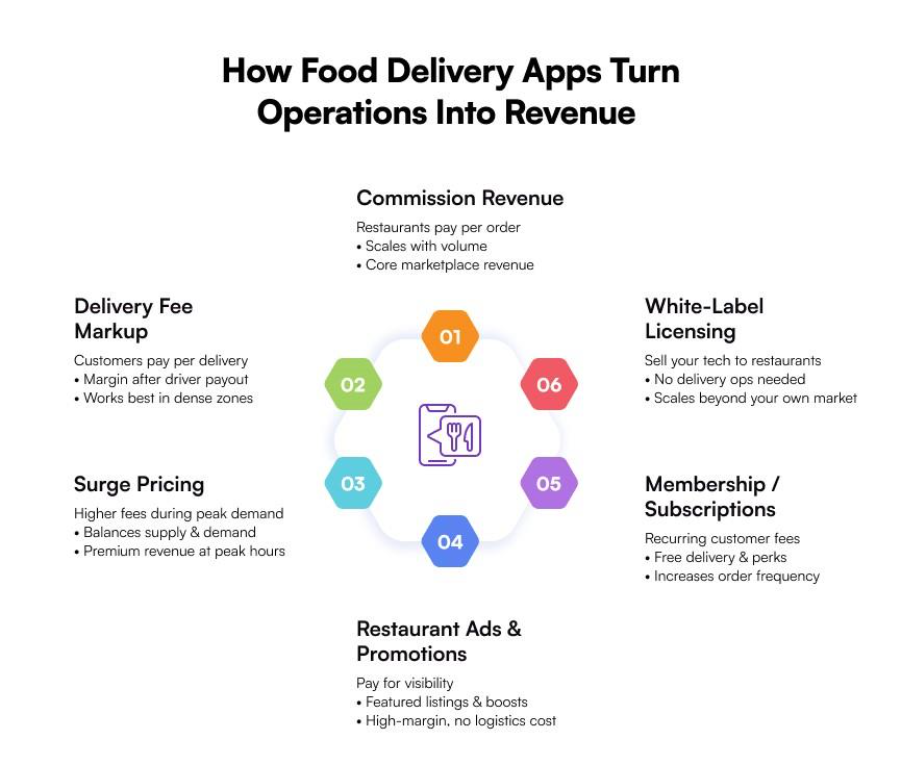
The most successful food delivery app platforms layer multiple revenue streams so they can scale without relying on a single income source. Below are the models that consistently drive predictable revenue and healthy unit economics in food delivery.
1. Commission Revenue
Restaurants pay a percentage per order in exchange for visibility and demand. When positioned correctly, this model becomes a recurring, scalable revenue stream and incentivizes more restaurants to join the platform. Great for marketplaces that want volume-based growth.
2. Delivery Fee Markup
Customers pay a fee per delivery, and the platform keeps the margin after compensating the driver. This works well when paired with smart routing and high-density delivery zones where efficiency creates natural profit.
3. Surge Pricing
During peak demand, delivery fees adjust automatically to balance order volume and driver availability. This keeps deliveries moving efficiently and creates a premium revenue layer when demand is highest.
4. Ads & Promotions for Restaurants
Restaurants pay for top placement, featured listings, spotlight menus, and promotional boosts. It’s one of the highest-margin revenue streams because it monetizes visibility, not logistics.
5. Membership / Subscription Programs
Customers pay a monthly or annual fee for perks like free delivery, exclusive offers, or priority support. This stabilizes revenue and increases order frequency — perfect for platforms aiming to build long-term loyalty.
6. White-Label Revenue Model
Restaurants license your delivery technology under their own brand. This model expands your reach without expanding your operations. It’s ideal for platforms with strong tech infrastructure looking to sell or white-label their system to chains, franchises, or regional operators.

Common Challenges in Food Delivery App Development (And How to Solve Them)
Food delivery looks simple on the surface: an order comes in, food gets prepared, a driver picks it up, and a customer receives it.
In reality, dozens of micro-systems must sync perfectly for that promise to hold. Below are the core challenges teams run into during on-demand food delivery app development — and the solutions that actually work in production.
1. Real-Time Order Synchronization
Challenge:
Customers, restaurants, and drivers all depend on live updates. Any delay or mismatch creates confusion and support load.
Solution:
Use event-driven architecture and real-time communication frameworks that sync orders across all interfaces instantly.
This is the same principle that powers high-frequency eCommerce platforms — something we’ve executed in complex inventory and fulfillment flows for brands like the beauty retailer featured in our Shopify case study. Precision syncing isn’t industry-specific; it’s architecture-specific.
2. Delivery Routing & ETA Accuracy
Challenge:
Inaccurate ETAs lead to failed deliveries, unhappy customers, and operational inefficiency.
Solution:
Implement dynamic routing that adapts to traffic, driver availability, and kitchen prep times. Pair this with continuous ETA recalculation so customers see what’s happening without guessing.
Our experience in quick-commerce and time-sensitive fulfillment translates directly into building routing logic that feels reliable, not approximate.
3. Restaurant Delays & Operational Bottlenecks
Challenge:
Most delays happen inside the kitchen, not on the road. When the restaurant dashboard isn’t optimized, orders pile up and timing breaks.
Solution:
Give restaurants clear prep-time tools, automated reminders, and workload visibility. The dashboard should feel like an operational command center, not just a feed of orders.
We’ve built similar operational workflows in eCommerce, where product teams need fast coordination between catalog, order management, and fulfillment — the same principles apply here.
4. Multi-Role Experience Consistency
Challenge:
Customer, restaurant, driver, and admin experiences often evolve unevenly, creating gaps and misalignment.
Solution:
Design all four interfaces as parts of a unified system, not isolated apps.
Shared design systems and aligned user flows reduce friction and create predictable behavior across the platform.
This approach mirrors how we build multi-touchpoint experiences in eCommerce where customers, warehouse teams, and admins all use different layers of the same ecosystem.
5. Commission & Fee Calculation Complexity
Challenge:
Fees differ by restaurant, region, time, and promotions. Manual logic becomes unmanageable fast.
Solution:
Implement a rule-based pricing engine that supports tiered commissions, dynamic markups, and promotional structures. This ensures transparency for restaurants and accuracy for finance teams.
We’ve delivered similar pricing engines in commerce platforms where tax, promotions, and multi-vendor settlements must sync cleanly.
6. Peak-Time Performance Load
Challenge:
Dinner rush, weekends, and holidays create traffic spikes that can bring poorly architected systems to a halt.
Solution:
Autoscaling infrastructure, load balancing, caching, and distributed services keep the platform stable even when volume surges.
Our work in high-traffic retail and subscription commerce — as seen in the Shopify beauty brand project — demonstrates our ability to build platforms that stay reliable under real-world pressure.
Why This Matters
Every food delivery app faces these challenges. What sets winning platforms apart is how they anticipate and engineer around them.
Galaxy Weblinks brings experience not only in food delivery and quick-commerce, but also in complex eCommerce ecosystems where reliability, real-time updates, and multi-role operations are non-negotiable.
This cross-industry foundation is what allows us to build delivery products that scale cleanly, perform consistently, and feel effortless to use.
Why Businesses Choose Galaxy Weblinks for Food Delivery App Development
A food delivery app is a multi-role, real-time system that has to feel effortless for customers, restaurants, delivery agents, and operators. Businesses choose Galaxy Weblinks because we build these systems with the same precision and scalability we bring to enterprise eCommerce, quick-commerce, and high-volume transactional platforms.
Even if a project comes from a different industry, the underlying challenges are similar: multi-step workflows, inventory or order syncing, complex admin layers, storefront-to-backend communication, and high uptime expectations. A strong example is the Shopify platform we built for a custom furniture brand, where we architected a scalable product catalog, seamless checkout flows, and a highly controlled admin system to support operational growth.
This level of system thinking translates directly into on-demand delivery ecosystems — because the operational logic is equally intricate.