

Apple devices are known for their strong ecosystem, seamless integration, and flawless user experience. Their sleek, high-quality, and user-friendly design attracts users. The love for Apple devices is a reason why there is an immense demand for iOS apps.
As iPhone usage continues to rise globally, the demand for iOS apps is only going to skyrocket. This is an immense opportunity for businesses looking to expand their operations. Investing in iOS app development services helps businesses target the premium user base.
According to Statista, there are a total of 1.5 billion iPhone users globally who believe in Apple’s robust security, smooth UI/UX design, and more. Nevertheless, only a handful of people understand that the path from ideation to execution isn’t always straightforward.
Without properly understanding the nitty-gritty of iOS app development, you are likely to end up hitting a wall. There are many considerations and a lot of questions to ask before you decide how to make an iOS app. Budget and process are just the tip of the iceberg.
We will explain to you everything in detail, from planning to technology, in this comprehensive iOS mobile app development guide to make the right decision. Whether you are a startup founder or bootstrapping your idea, this guide will help you navigate the challenges in developing an iOS app.
Let’s get started without further ado!
Why iOS App Development Matters for Businesses
Faster performance, flawless UX, and sleek design are the core USPs that make iOS apps stand out from hybrid or Android apps. But there is more to the picture; so, let’s have a quick look at the solid reasons why businesses should invest in iOS mobile applications.
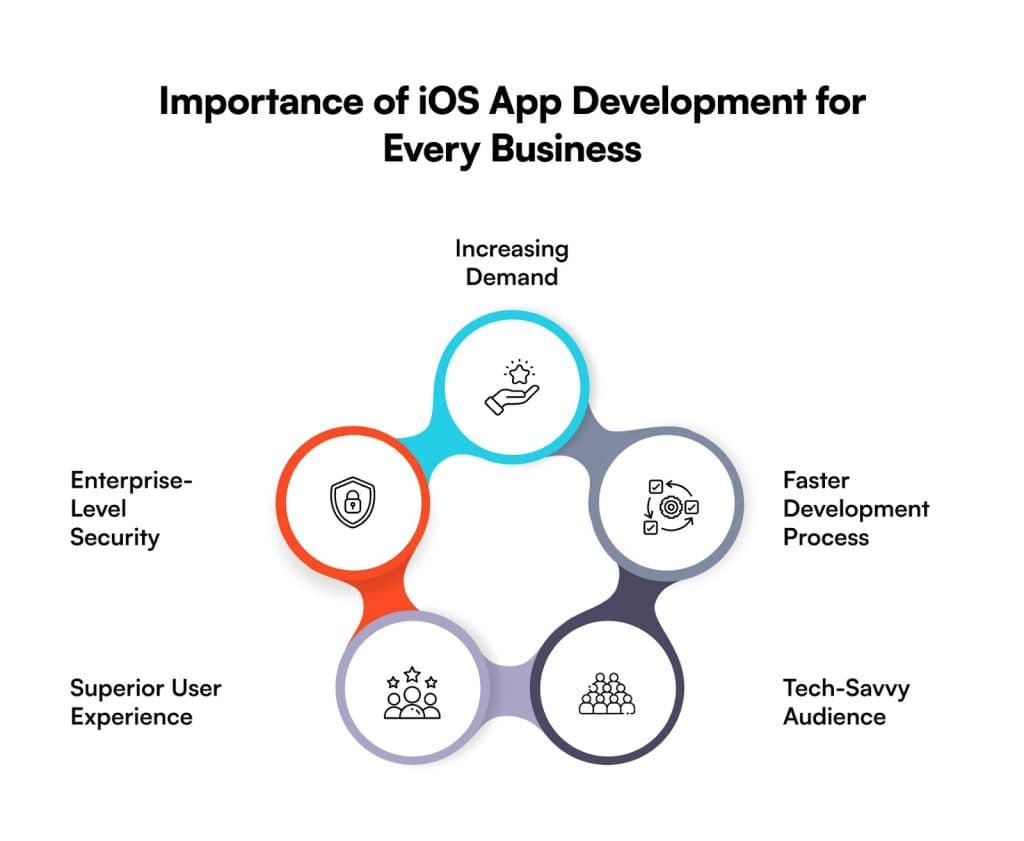
- Increasing Demand
The adoption of the iPhone continues to increase, and so does the demand to build an iOS app. Apple has a strong and loyal customer base, who prefer quality apps – thanks to Apple’s robust security standards and consistent user experience. Because of this, business owners (like you) have the right opportunity to tap into this growing market.
- Enterprise-Level Security
One of the main reasons for the success of the iOS ecosystem is Apple’s security, which is basically a fortress. It is enhanced by Apple Intelligence: the system that enables on-device AI features, and at the same time, keeps personal data secure through Private Cloud Compute. When combined with features like end-to-end encryption, tracking prevention, mail privacy protection, and passkeys, iOS delivers an even better and trusted security ecosystem.
- Superior User Experience
If you want to enhance your brand recognition, along with a robust user base, then iOS mobile application development is an excellent strategic move. Apple strictly follows Human Intelligence Guidelines, which precisely set the standards for layout, navigation, typography, and spacing. The main advantage of this uniformity is that it allows companies to give their customers an impeccable experience that seems trustworthy and familiar.
- Tech-Savvy Audience
Without a doubt, an iOS app will lure a tech-savvy audience, as they are generally the first ones to leverage the innovations and the most advanced features. In addition, they will not think twice before paying more when it comes to using premium features, which makes it a win-win situation for both users and business owners.
- Faster Development Process
Most of the business owners want a faster development methodology for their app, so they can leverage what they have built. In such case scenario, iOS is definitely a go-to choice. It has a faster and less complex development process – all thanks to less fragmentation and predictable software updates.

Choosing the Best Approach: How Will You Build Your iOS App?
Before writing a single line of code, make one critical choice: how to decide iOS app development approach. There are three main paths. Your budget, timeline, and control needs will guide your choice. Review this decision matrix to see which fits your goal:
| Approach | Best For | Timeline | Cost Range | Control Level |
| DIY Development | Tech founders, Learning | 6-12 months | $5K – $15K | Complete |
| Freelance/Developer | Most businesses, Startups | 3-8 months | $30K – $150K | High |
| No-Code/Low-Code | MVPs, Simple apps | 1-3 months | $2K – $20K | Limited |
Path #1: Do It Yourself (DIY)
Choose this path if you know how to code. It is great for a personal project or if your budget is low. Realize the cost: you need a Mac. You must pay $99 yearly for a developer account. It takes most people six months to learn the basics of Swift/SwiftUI. The first app often needs over 500 hours to complete. Only about one in four first-time builders finish and launch their app.
Path #2: Hire the Experts
This is the path for most business owners. You need professional quality. You need to launch within a few months. This is the path you can rely on. The cost ranges from $30K to over $300K. Local iOS app development service providers in the USA or Europe charge more per hour than offshore teams, usually located in Asia.
Path #3: Use Simple Platforms
If you just need to test an idea (MVP) quickly, use a no-code/low-code platform. These are fast. They are often under $20K. The downside is that they limit what you can build. Your app might not grow easily. If your app needs complex features later, you might have to rebuild the entire thing.
Native vs Hybrid: Which Type Should You Choose for iOS App Development?
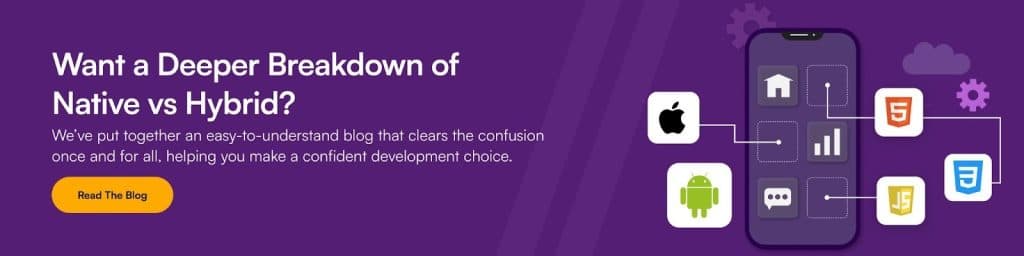
Before developing an iOS app, business owners generally have to make a choice between two approaches: either choose Native or Hybrid app development.
Both methods have their own pros and cons. Let’s have a look at each of them one by one:
- Native iOS App
Native app development refers to the process of building applications that are specifically designed for the operating systems of Apple. The development is done by using languages like Swift or Objective-C, an integrated development environment (IDE), or Xcode. As the apps are for specific operating systems, they render excellent performance and seamless integration.
| Pros | Cons |
| Optimal User Experience | Higher Development Cost |
| Full Device Access | Longer Development Time |
| Offline Functionality | Platform-Specific Knowledge |
| App Store Support | Closed Ecosystem |
| Robust Security | Complex Maintenance |
- Hybrid iOS App
Hybrid applications make use of typical web technologies such as HTML, CSS, and JavaScript and are shown via the embedded browsing library in the native shell. A hybrid framework employs a single codebase for creating apps on both platforms. This method of work can still be very efficient, as you can save a lot of time during app development.
| Pros | Cons |
| Lower Development Cost | Limited Performance |
| Faster Development Time | Inconsistent UI/UX |
| Simplified Maintenance | Framework Dependency |
| Code Reusability | App Store Rejections |
| Broader Reach | Less Optimal |
How to Develop an iOS Mobile Application: Step-by-Step Process
Developing an iOS app is not rocket science, but it surely does require careful planning and a strategic journey, keeping the targeted audience in mind.
There are several phases used in developing an iOS mobile application. The following table describes these phases with duration and estimated budget in brief.
| Phase | Duration | % of Budget | Focus | Goal |
|---|---|---|---|---|
| Planning | 2-4 weeks | 10-15% | Goals, Audience, Trends, and User Needs | Know what value your app brings and who uses it. Figure out what users want. Plan the core features (MVP). |
| Design | 3-6 weeks | 15-25% | Look and Feel | Create a simple, clean interface. Follow Apple’s design rules. |
| Development | 8-20 weeks | 50-60% | Development | Write clean code using tools like Xcode and Swift. Build the real app. |
| Testing | 2-4 weeks | 10-15% | Quality Control | Check for bugs and errors. Make sure the app is safe and works well. |
| Launch | 1-3 weeks | 5-10% | Deployment | Submit the finished app. Get Apple’s approval for the market launch. |
| Total | 16-37 weeks/4-9 months average |
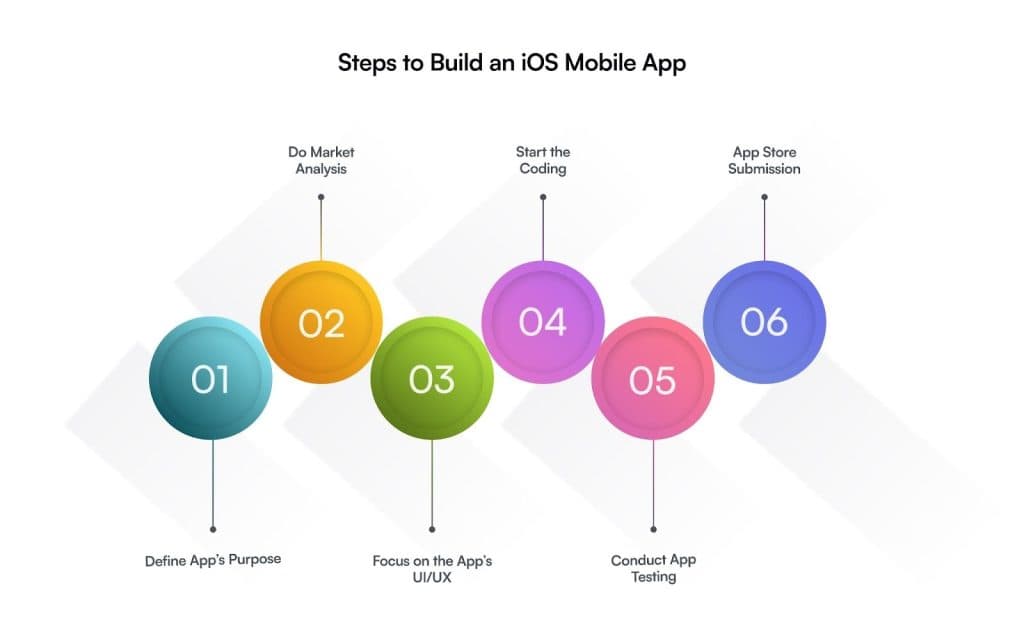
Listed below are the key detailed steps for developing an iOS application:
- Define App’s Core Purpose
Before availing of iOS app development services, make sure you have clearly defined the goals of your app or what exactly you’re aiming to deliver. It is advisable to properly study the market of your niche and then define a unique concept based on that.
Ask the following questions of yourself:
- Who is going to be your target audience?
- What value will your app add for your targeted audience?
- In what ways is your iOS app unique from others?
- What features must you integrate into the app to stand out in the market?
- Do you want to monetize your app or not?
Answer these questions, and you will know what exactly you want or what will fit the best in the market.
- Conduct In-Depth Market Research
After setting up your app goals, it’s time to evaluate the market and check out the actual trends or the new things that users are expecting. The first stage is to figure out the necessities and issues of the target audience, and then figure out the features for the minimum viable product development (MVP).
In fact, a minimum viable product is a product that helps you prove the concept of your app, carry out the basic features test with real users, and collect user feedback to enhance the app. Identify competitors in the App Store, and check what kinds of features they are offering. This will help you determine the best feature for the initial version of your app and create a roadmap for iOS app development.
- App Design & Prototyping
First impressions are the most lasting ones, so design a user-friendly interface to capture your audience’s attention at first glance. You must make sure, the designing team you have hired is in perfect harmony with the brand spirit of your company to get the desired outcome.
This step involves mapping user journeys, creating flow diagrams, and designing information architecture. It further involves wireframing different interfaces and creating interactive prototypes to test the viability of the design and features.
The team must adhere to Apple’s Human Interface Guidelines (HIG) so that the app can be perceived as a standard and common one among iOS users. Above all, the design has to be simple for the user to move through and have a clean and attractive visual.
- App Development
Now comes the most important part: coding.
This is the final stage, where your concepts will become real life (or take a form). Developers are writing clean, scalable, and efficient code that conforms to Apple’s recommended practices or guidelines. To make the app concept a tangible app and to maintain compatibility with all iOS devices, they use different tools such as Xcode, Swift, and SwiftUI.
This step involves two phases: frontend and backend engineering. While the frontend is about creating the interface and features that users will directly interact with, the backend is about setting up the infrastructure that involves the server, databases (MySQL, PostgreSQL, MongoDB, Firebase, etc), and APIs.
You may also need to integrate specific features like Apple Intelligence, Vision Pro, Live Activities, and Home screen/Lock screen widgets.
- Rigorous App Testing
It is necessary to test your iOS mobile application extensively before you launch it in the marketplace. Practice unit and integration tests, as well as performance and user acceptance tests (UAT), are conducted to prevent the occurrence of potential errors.
The main reason for such thorough testing is to keep the app safe, make it bug-free (or glitch-free), and finally, to be able to count on it 100%. It involves various tests, like manual, automated, and beta testing, as well as performance optimization.
- Launch into App Store
Voila! Here comes the step where you can finally see your dreams coming true, or rather, submitting your app to the App Store. Remember, this is the crucial phase because getting Apple’s approval is the priority here.
Get some thorough checks or final tweaks, and ensure your iOS app is all set for a smooth launch, adhering to Apple’s strict standards and guidelines.
Tech Stack Used for Building an iOS App
To create a first-rate and high-performing iOS application, the knowledge of an expert and the right mix of tools, languages, and frameworks are necessary. Using the features of a proper tech stack is what ultimately provides app performance at its best, a user experience without any hiccups, and the possibility of scaling.
Here is a list of the top technologies used for developing an iOS mobile app:
Programming Language:
Integrated Development Environment (IDE):
UI Frameworks:
Backend & APIs:
Databases:
Testing Tools:
Common Mistakes in iOS App Development & How to Avoid Them
Mistake #1: Building Features Nobody Wants: You waste time building things users will not use. The fix is simple: Launch with only the essential functions. Check usage data often and check user feedback to know what they actually need.
Mistake #2: Ignoring Design Quality: A bad design instantly drives people away. Your app must look professional from the start. Spend heavily on design, use Apple’s own guidelines, and test the look before you code.
Mistake #3: Underestimating Timeline: Every project takes more time than expected because changes will happen. Always add a 30% cushion to all your schedules. Use short, rapid work cycles to handle changes easily.
Mistake #4: Poor Post-Launch Support: Users quit fast when an app goes stale. Plan to release updates every month. Fix crashes immediately and respond to every person who leaves a review.
How Much Does It Cost to Make an iOS App
For iOS, an app development project typically costs between $40,000 and $500,000. Or even more. The price is influenced by several factors; hence, if you desire a more sophisticated iOS app, you need to allocate a higher budget.
Just a heads up: it will all be worth it in the end!
To give you a clearer picture, here is a list of factors affecting the overall cost of mobile app development for an iOS application:
- Size of the app
- Project complexity
- The advancement of features
- App design
- Any additional changes you want
Below is a table outlining the pricing range from simple to high complexity iOS applications:
| App Type | Price Range |
| Simple App | $45,000 to $95,000 |
| Medium Complexity | $85,000 to $150,000 |
| Complex App | $150,000 to $300,000 |
| High-Level Complexity | $300,000 to $500,000 |
Factors to Consider Before Hiring an iOS App Development Company
It is important to hire a mobile app development company that understands your business needs, aligns with your goals, and, most importantly, fits your budget. But how do you determine which company is the right choice?
Below, we have given some of the factors that you must consider before hiring an iOS app development company.
- Technical Background: The primary factor to keep in mind is to ensure that the iOS app developers of the company have a strong technical background, stay updated with the latest tools & technologies, along with programming languages.
- Ratings & Reviews: Don’t forget to read the company’s reviews to get an actual idea about the company’s reputation and how effectively they deliver projects.
- Development Approach: Ask which development approach the developers follow. Make sure they follow Agile methodology; this way, you’ll get to see the progress of your iOS app development at every stage and suggest changes in real-time.
- Maintains Transparency: Hire a company that maintains transparency by giving clear cost estimations and setting realistic timelines.
- Post-Launch Support: App development process doesn’t end after the launch because then comes the real thing, offering post-launch support and maintenance services. So, ask if the company maintains a long-term relationship or not.
Critical Success Factors: Things to Keep in Mind to Build a Successful iOS App
Your app needs certain things to win.
- Solving a real problem is the first rule. Many failed apps try to fix issues that do not exist. Talk to people first. Do not build until you know the need is real.
- Second, the user experience must be great. Follow Apple’s simple rules for design. Apps with good design keep users three times longer. Test it with real users constantly. Make the first sign-up process simple; most people quit right away.
- The app must also be fast and reliable. Load times should be under two seconds. Crashes are unacceptable. Aim for nearly zero errors. Core features must work even when offline.
- Next, timing the launch matters. Do not submit during busy holidays; reviews slow down. Plan your marketing for weeks before you hit the store. Build your email list early.
Finally, you must commit after the launch. Update the app often. Answer all reviews, especially the bad ones. Watch your numbers closely for the first three months. You must budget for continuous marketing. Do not stop once the app is live.
How to Make Money: Monetization Model for iOS Apps
Choosing how your app will earn money is the most important business choice you will make. You must pick the best fit from the start.
| Model | Best For | Pros | Cons |
| Free with Ads | Content, simple tools | Simple to get users | Low income per person |
| Freemium | Games, productivity | Huge potential user base | Only 2–5% ever pay |
| Paid Download | Niche, premium tools | Money right away | Very few downloads |
| In-App Purchase | Games, digital goods | Highest income possible | Hard to build well |
| Subscription | Services, ongoing value | Steady, recurring revenue | You must always add value |
The Reality Check: Most apps do not make much money. The bottom half of all apps earn less than $1,000 per year. Only the top 1% make over $1 million.
To actually make a profit, you need to think long-term. It takes 18 to 36 months on average just to break even on costs like development and marketing. To maximize your money, test different prices and make purchases simple—one tap is best. Look at setting prices lower in different countries, and always offer an annual discount to encourage commitment.

Get an iOS App of Your Dreams with Galaxy Weblinks
Simply put, creating an iOS app is not only a fantastic idea but also requires the correct development method, knowing your users, confirming the app concept, and other things. Each of these stages has its difficulties, and it might be too much for you to figure out the way through them by yourself.
This is where you need a technology partner!
At Galaxy Weblinks, we carefully plan out the complete iOS app development journey with a guarantee of the app’s success. We have the right set of team, who can turn every vision of yours that you will bring to the table.
We are not asking you to just believe our words; you can look for yourself and see if we can be the best companion for your upcoming project. Check out our portfolio. Meanwhile, if you have any queries or need assistance, we’re just a call away!
FAQs
- Why are iOS mobile applications popular among business owners?
The popularity of iOS app development is inevitable because of the following reasons:
- Higher revenue potential
- Strong security ecosystem
- Better monetization opportunities
- Consistent & premium user experience
- Early access to innovation
- How much does it cost to build an iOS app?
You cannot provide a definite answer to this question as it depends on several factors, such as the intricacy of the project, the number of features that you want to add, UI/UX, the proficiency of the development team, and so forth.
- How long does it take to develop an iOS application?
There is no specific timeframe set for the overall iOS app development. However, to give you a ballpark figure, the development can be accomplished in 2-4 months with just simple (or basic) app features. Or 6-12 months and even more for the complicated ones.
- How secure are iOS apps for business use?
One of the main reasons that iOS apps are considered to be more secure is the fact that Apple maintains a closed ecosystem. Additionally, Apple performs on-device processing, uses advanced encryption, and has a number of built-in data protection features. For this reason, iOS is always the preferred option of business owners who take the security of their data seriously.
- Building an MVP before developing a full-fledged iOS app is useful?
Definitely, an MVP development is a way to confirm the app idea, collect the real users’ feedback, and it also enables you to refine your app based on that feedback prior to a full-scale development investment.