

Do you own a startup and are thinking of developing a high-performing mobile app? If yes, read this guide till the end and discover everything you must know.
Creating a mobile app opens many opportunities for startups to grow and shine. Can you guess why it is so? Just consider this: 63% of consumers rely on apps to find information about brands on mobile devices (HubSpot report). Your brand can be the next.
You can simply increase your brand visibility and closely engage with your potential users with a mobile app. But the main question is “how can you make your mobile app unique from others?”
The market is crowded. Mobile apps are everywhere. So if yours looks and feels the same, users bounce fast. You need something different. A hook. A reason to stay.
That’s where working with the right mobile application development company matters. They help shape the experience, not just the code. Smart flows. Better performance. Fewer drop-offs. Because standing out today isn’t optional. It’s survival.
App development for startups (like yours) will be successful when they know all the prerequisites. To gain all the in-depth insights about building apps that help startups succeed, read this complete guide.
We have covered all the topics, starting from the significance of apps for startups to understanding the key challenges you might be dealing with, and everything in between.
Key Steps to Develop a Mobile App for Startups
This section sets the stage. It explains what really goes into building a startup mobile app, without drowning you in theory. You’ll see how ideas turn into something usable. How early decisions quietly affect cost, speed, and scale later. It touches on validation, design thinking, tech choices, development realities, and launch readiness. Not as a checklist. More like a flow.
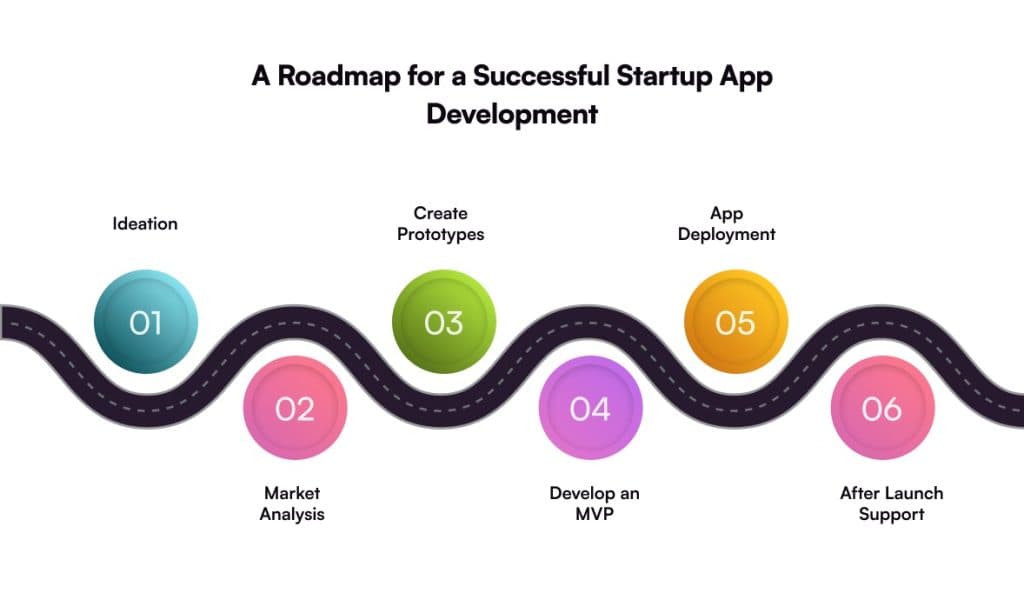
- Idea Conceptualization
To begin with your startup app development, make sure to work on your ideas carefully. You need to list down certain (yet crucial) things, like defining the app’s core purpose, your targeted audience, and what unique value it will bring. This stage is like the foundation of your app development, so make the best of it.
- Market Research & Analysis
Once ideas are conceptualized and shared, a development company begins its market research. The team conducts competitor analysis, understands user demands (or expectations), and most importantly, finds the gaps to fill in. It helps in creating an effective app strategy to make your app stand out in the market.
- Prototyping & Design
Prototyping & design is where ideas stop being vague. Screens get shape. Flows start to make sense.
For startups, this phase is about speed and clarity. Not perfection. Wireframes test assumptions early. Clickable prototypes expose friction before code is written. Cheap fixes now. Expensive ones later.
Good Ui/UX design focuses on real user behavior. Not opinions. Navigation, core actions, dead ends. Everything gets questioned. This stage reduces risk, aligns teams, and sets a solid base for development.
- MVP Development
Don’t go off the deep end and create a feature-rich application for your startup app development project from day one. Rather, begin with an MVP development: Construct the client’s and the server’s parts of the app by best practice standards.
- Keep the main features that directly contribute to solving the primary problem.
- Get your product out there as soon as possible to collect user feedback
- Work on the product based on the actual usage and not on your assumptions
By taking this lean route, you are essentially engaged in risk reduction and rapid learning and execution through your startup mobile app development.
- App Launch & Deployment
Once the MVP has been tested and adjusted, the next step is the deployment phase. This stage involves readying the store listings for a seamless release on iOS or Android. Being a startup owner, you need to take care that the app company meets the app regulations.
- Post-Launch Support
The app development process doesn’t end here; it’s time to maintain the app’s performance by offering post-launch support. From continuous monitoring to performance tracking and regular updates to fix bugs, this phase includes everything that ensures the app’s optimal performance.

What are the Different App Development Options for Startups?
Before you fully invest in building an app, understand exactly what type of app you want for your business that will perfectly align with your budget and requirements. Listed below are three main types of mobile apps.
- Native Apps
Native apps are designed for a single platform (iOS or Android) only. For this, native programming languages and tools specific to that platform are utilized. These apps deliver the best performance and smoothest user experience, but development has to be done separately for each platform.
- Hybrid Apps
Hybrid app development has the characteristics of both native and web apps in terms of functionality and is compatible with different platforms. They provide a compromise between price and performance, and, at the same time, they might not be as fast as the native ones.
- Cross-Platform Apps
Cross-platform apps: These apps are created with the help of a framework like Flutter or React Native and have the capacity to work on various platforms with the same codebase. This leads to a decrease in both time and money for the development process. Nevertheless, they may not have access to all the native features completely.
- Progressive Web Apps (PWAs)
PWAs sit in a sweet spot. Not fully native. Not just a website either. They load fast. Work offline. Install like an app. No app store drama. For startups, that’s big. One codebase. Lower cost. Faster launch. Users get push notifications, smooth UX, and instant updates. Found via search too. Not perfect for heavy hardware use. But for MVPs, marketplaces, SaaS tools? PWAs move fast. And speed matters early.
Why Mobile App Development for Startups Is Crucial
You can’t expect your startup to succeed without a mobile app. People are no longer standing in a queue at brick-and-mortar stores; they are scrolling through their screens, discovering budding businesses.
Here are 5 key reasons that tell why app development for startups is an ideal choice:
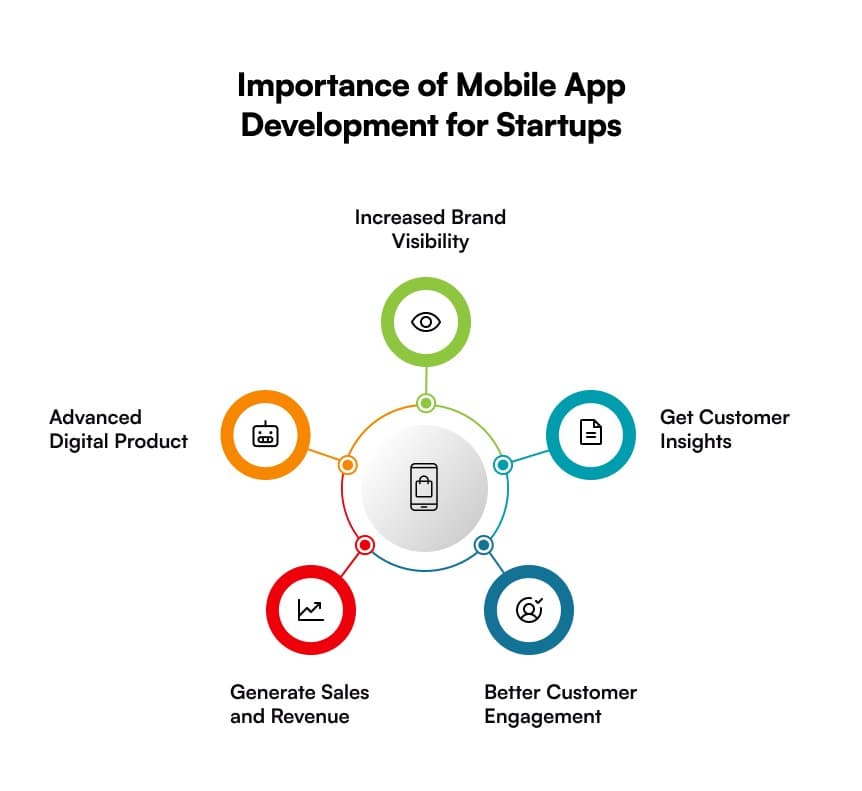
- Boost Brand Visibility
You want to boost your brand’s visibility? Building a mobile application can do that. A well-designed app will keep your brand right in front of the users. It will simply remind them of your product & services every time they use their mobile phone. That being said, an app development for startup owners can simply amplify their brand visibility.
- Gain Customer Insights
Without customer insights, no business can survive, and mobile app development is a tool that helps you gain those insights. For a startup, app development is just like having a direct line that automatically detects, collects, and processes the real-time data of your users according to their preferences, behaviours, and interactions. Ultimately, the outcome is higher customer engagement and loyalty.
- Improve Customer Engagement
As per Statista, people spent nearly 141 minutes per day scrolling through their feeds, which highlights the average mobile usage among users. It means users are likely to engage with your brand. Other than this, you can send push notifications or personalized messages for better customer engagement.
- Drive Sales and Revenue
Thanks to mobile apps that make your brand feasible and 24/7 accessible, resulting in increased sales and higher revenue. When users get personalized experiences or exclusive offers, they tend to become loyal customers and might even refer to their people. Other than this, you can also monetize your mobile app to earn more profit.
- Smart Marketing Tool
In a digitally-advanced world, having a highly optimized mobile application is a powerful marketing tool for startups. From personalized communication to driving sales and increased customer engagement, a mobile app is everything your startup business needs. It’s like having a magic wand, but only when you have the right development team with you.
Common Challenges Startups Face While Creating Mobile Apps
Building apps, especially for startups, isn’t an easy task because it takes more than just an idea. From effective strategy and tools to ensuring long-term scalability, app development for startups is a complete package that comes with a certain set of challenges.
Here is a list of key challenges you also must be facing:
- Budget Constraints: Plenty of startups struggle with budget and require an effective financial plan. To overcome such a challenge, an MVP development is the most common solution to test whether your app idea will work or not before investing a hefty amount.
- Finding the Right Team: Most startups have brilliant app development ideas and have a budget too, but they often fail to find the right app development company. To ensure you are making the right choice, consider checking the company’s portfolio and reviews to make a better decision.
- Standing Out in the Competition: The market of startup app development is already crowded. That means, you don’t just need an idea but a strong USP and an intuitive design to stay abreast of your competitors.
- Data Security and Privacy Concerns: During the initial phase, startups mostly overlook the security concerns (which is definitely not ideal). Make sure your app is compliant with industry standards and strongly encrypted.
- Choosing the Right Tech Stack: Startup owners often struggle with choosing the right technology, such as Flutter and React Native. Both frameworks offer speed and cost-efficiency, but it depends on the business’s project complexity and requirements.
Also Read: Learn the difference between Flutter vs React Native.
How Much Does It Cost to Develop a Mobile Application for Startups
The price of creating a mobile app is not the same, but it depends largely on its intricacy, functionality, and the way it is created. Just to give an idea of the cost (which is always subject to change):
App Development Cost by Platform
| App Platform | Basic App | Mid-Level App | Complex App |
| Android App Development | $5,000 to $15,000 | $15,000 to $30,000 | $72,000 and increasing |
| iOS App Development | $5,000 to $25,000 | $25,000 to $75,000 | $75,000 to $150,000+ |
| Cross-Platform Development | $5,000 to $20,000 | $20,000 to $70,000 | $70,000 to $100,000+ |
App Development Cost by Industry
| Industry | Estimated Cost Range |
| Healthcare App | $20,000 to $500,000+ |
| eCommerce App | $10,000 to $250,000+ |
| Fintech App | $30,000 to $250,000 |
| Social Media App | $10,000 to over $120,000+ |
| On-Demand App | $25,000 to $150,000+ |

How Galaxy Weblinks Can Help You with App Development for Your Startup
Your startup needs more than just a mobile application; it needs a digital product that can drive growth and user engagement. And, at Galaxy Weblinks, we understand this. That is why our team focuses on building apps that are highly scalable, user-centric, and performance-driven.
It is not enough for your startup to have only a mobile application; what it really needs is a digital product capable of leading the expansion and the user engagement. We at Galaxy Weblinks certainly get this. So, our team commits to developing apps that can not only be easily scaled but are also user-friendly and performant.
We are with you at every step of your startup app development journey. From designing an effective growth strategy for your startup to Design Thinking, QA, and providing continuous support, we have got you covered.
So, contact us, and let us know what app you have in mind, and we will make a great digital product out of it.
FAQs
Q. Why should startups work on developing their mobile app for their business?
A.The key factor that can facilitate a fast growth process in a starter business is a mobile app. The key advantage among the benefits prooved by a mobile application is the higher level of customer engagement and loyalty, which can be ensured through personalization. Using a mobile app, the entrepreneurs are able to gain customer insights, leading them to make more informed decisions.
Q. How much time does it take to build a mobile app for startups?
A. It might take anything from seven days to nine months or more. There is no concrete answer to this query. It is a truth that developing a mobile app from scratch takes a long time; nevertheless, it also depends upon several other elements. For example, project complexity, integration, UI/UX design, etc. Still, on average, it may take 3 to 12 months for an app with simple functionality.
Q. What is the approximate cost to develop an app for the mobile platform that would be attractive to startups?
A. For start-up companies, the cost of development will start from $5,000. However, it depends on the platform you choose, and it could be more. If you want an estimation of cost regarding your application development, you can get it from us.