


NodeJS app development sits at the core of modern backend and full-stack systems. Not by hype. By use. Teams choose Node.js because it moves fast, scales cleanly, and fits real production needs without drama.
It runs on JavaScript. One language. Frontend to backend. That alone changes how quickly products ship and evolve.
The adoption numbers make it obvious. According to Statista, over 48.7% of developers actively use Node.js, making it one of the most cited web technologies in 2025. Hundreds of enterprise brands and millions of web apps rely on it daily for APIs, real-time apps, and backend services.
This isn’t a niche trend anymore. NodeJS app development powers large parts of today’s web and mobile ecosystem. And its footprint keeps expanding.
This guide cuts through the noise. We break down NodeJS app development in practical terms. Core features. Real use cases. And the development process that actually works.
Why NodeJS App Development Is an Ideal Choice for Enterprises?
Enterprises don’t choose technology because it’s trending. They choose it because it survives pressure, scale, load, and change. NodeJS app development fits that mindset better than most backend technologies today.
First, performance at scale. Node.js runs on a non-blocking, event-driven architecture. Which sounds technical, yes. But in practice, it means one thing: Node handles thousands of concurrent requests smoothly.
For enterprises dealing with real-time dashboards, APIs, chat systems, or high-traffic platforms, this matters a lot. You’re not spinning up unnecessary threads. You’re using resources intelligently.
Then there’s speed of development. Enterprises move more slowly than startups, but they still want efficiency. NodeJS app development allows teams to build faster because JavaScript runs on both the frontend and backend.
Scalability is another quiet win. Node.js plays well with microservices and cloud-native architectures. Enterprises rarely build monoliths anymore. They build systems that grow sideways. Node.js supports that naturally. Whether it’s containerized services, APIs, or event-based workflows.

Key Features of NodeJS for Mobile App Development
NodeJS for mobile app development works because it removes waiting. Removes friction. Removes unnecessary complexity. It’s built for speed, but it doesn’t sacrifice structure. Here is why it matters a lot.
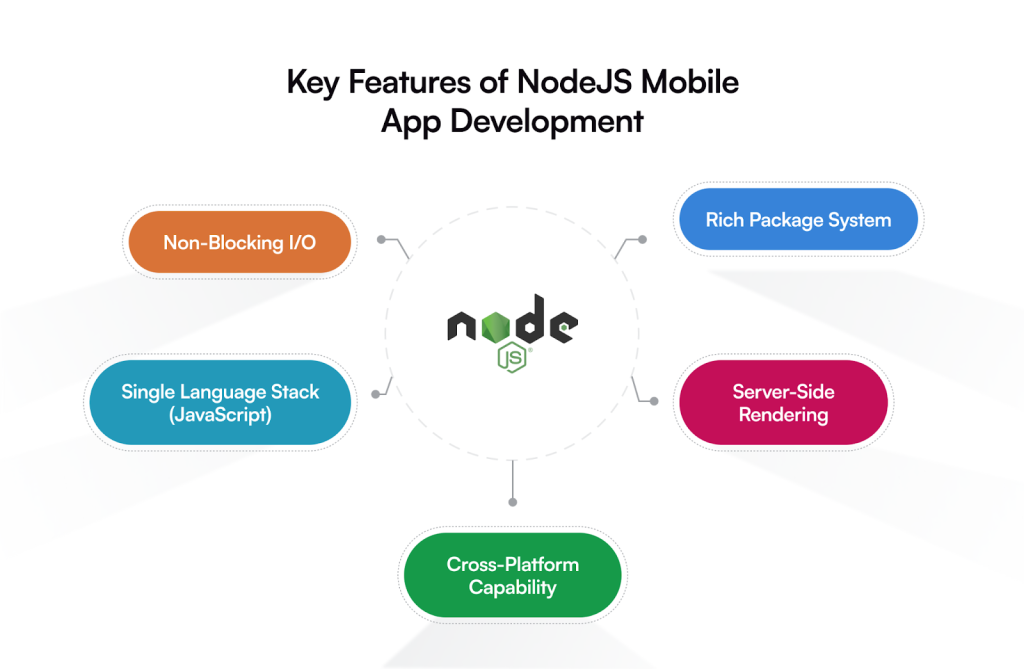
- Non-Blocking I/O
Node.js doesn’t wait around. One request doesn’t block another. That matters when mobile apps fire multiple calls at once, APIs, notifications, and live updates. With NodeJS app development, performance stays stable even when traffic spikes.
- Single Language Stack (JavaScript)
One language. Frontend. Backend. Less translation. Fewer misunderstandings. JavaScript keeps teams aligned and development cycles shorter. For mobile app development, this speeds things up without cutting corners.
- Cross-Platform Capability
Mobile apps talk to many clients. iOS. Android. Web. Node.js doesn’t care. The same backend supports all of them. Same logic. Same APIs. Less duplication. More control.
- Server-Side Rendering
Not every mobile app needs it, but when it does, Node delivers. SSR improves initial load, supports hybrid apps, and helps with content layers. Clean. Efficient. No heavy lifting.
- Rich Package System
Rich package system saves time. A lot of it. Authentication. Payments. Caching. Real-time features. NodeJS mobile app development benefits from a massive ecosystem that’s already tested in production. You build faster. You break less.
That’s the core strength. Node.js doesn’t overpromise. It simply supports modern mobile app development in a way that scales, adapts, and keeps teams moving forward.
Use Cases of NodeJS in Enterprise Development
NodeJS in enterprise development shows its value when systems get complex. When traffic is unpredictable. When speed and stability both matter. These use cases aren’t theoretical. They’re where NodeJS app development actually performs.
- Real-Time Communication Apps
Chats. Notifications. Live collaboration. Real-time systems don’t tolerate delay. Node.js handles continuous connections without slowing down the server. For enterprise messaging platforms, collaboration tools, or live tracking apps, NodeJS app development keeps interactions instant and reliable.
- High-Traffic APIs & Microservices
Enterprises run on APIs. Thousands of requests. Sometimes millions. NodeJS handles high concurrency without burning resources. Its lightweight nature makes it ideal for microservices-based architectures where services scale independently, and failures stay isolated.
- IoT, Streaming, and Data Dashboards
IoT systems generate data constantly. Streams don’t stop. Node.js processes events in real time, making it a strong choice for dashboards, monitoring tools, and streaming platforms. Enterprises use NodeJS development to keep data flowing without bottlenecks.
- eCommerce & Marketplace Backends
Product listings. Payments. Inventory updates. User sessions. Everything happens at once. NodeJS app development supports high transaction volumes while maintaining performance. For marketplaces and large eCommerce platforms, this balance is critical.
- Serverless & Edge Apps
Node.js fits naturally into serverless and edge environments. Fast cold starts. Small footprints. Easy scaling. Enterprises adopt NodeJS development here to deploy features closer to users without managing heavy infrastructure.
Complete Process for NodeJS App Development
NodeJS app development isn’t a straight line. It’s a flow. Decisions stack early. Mistakes show up later. That’s why each phase matters more than it looks.
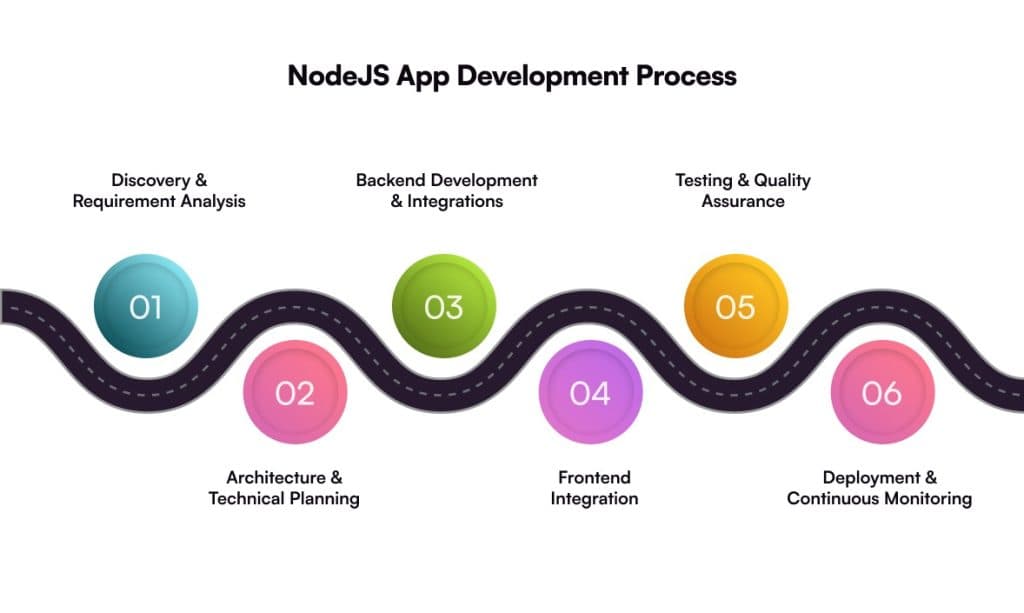
- Discovery & Requirement Analysis
This is where clarity starts. What are you building? Who is it for? What breaks if it fails? Enterprise NodeJS app development depends on this step more than the code itself. Miss details here, and everything downstream slows down.
- Architecture & Technical Planning
Now the real thinking begins. Monolith or microservices? APIs or event-driven flows? Cloud, serverless, or hybrid? Good NodeJS architecture absorbs growth instead of resisting it. This phase decides scalability before traffic ever arrives.
- Backend Development & Integrations
This is where Node.js gets to work. APIs take shape. Databases connect. Third-party services plug in. Payments. Auth. Notifications. NodeJS backend development keeps things fast, non-blocking, and stable under load.
- Frontend Integration (React, Next.js, Mobile Apps)
The backend doesn’t live alone. It talks to interfaces. Web apps. Mobile apps. Dashboards. NodeJS app development works smoothly with React, Next.js, and mobile frameworks, keeping data flow predictable and clean.
- Testing & Quality Assurance
Things will break. Better here than in production. Automated tests. Load tests. Edge cases. This phase protects performance, security, and sanity, especially for enterprise-grade NodeJS applications.
- Deployment & Continuous Monitoring
Launch isn’t the finish line. It’s the checkpoint. NodeJS apps go live, then get watched. Logs. Metrics. Alerts. Continuous monitoring keeps systems healthy and issues visible before users complain.
That’s the complete lifecycle of NodeJS development. When done right, NodeJS app development stays scalable, maintainable, and ready for whatever growth throws at it.
Best Practices for NodeJS Mobile App Development
NodeJS mobile app development works best when you follow the right practices that ensure clean code. Node gives speed. Best practices keep that speed from turning into chaos. They are not rules; they are proven strategies that help keep the project on track.
- Optimize Application Performance
Performance isn’t optional. Mobile users don’t wait. Optimize async operations. Reduce blocking code. Cache smartly. Monitor memory usage early, not after things break. In NodeJS app development, small inefficiencies scale fast.
- Using Microservices for Scalability
One giant service rarely ages well. Break it down. Use microservices where it makes sense. Independent services scale better and fail cleaner. For enterprise-grade NodeJS mobile app development, this keeps growth manageable.
- Use a Robust Error-Handling Strategy
Errors will happen. Plan for them. Centralize error handling. Log everything that matters. Return clean responses, not stack traces. A good error strategy keeps systems stable and teams sane.
- Implement Security Best Practices
Security isn’t a feature you add later. Validate inputs. Protect APIs. Secure authentication flows. Keep dependencies updated. In NodeJS app development, security gaps spread quickly if ignored.
- Leverage Third-Party Modules with Care
NPM saves time. It also adds risk. Use well-maintained packages. Avoid overloading the app with unnecessary dependencies. Fewer modules mean fewer surprises during updates.
NodeJS mobile app development rewards teams that think ahead. Optimize early. Structure smartly. Stay cautious where it matters. That’s how apps remain fast, secure, and scalable long after launch.
Conclusion
NodeJS app development comes down to this. Speed that holds. Scale that doesn’t crack. And systems that stay calm under pressure. From APIs and real-time apps to enterprise platforms, Node.js keeps teams shipping and growing without friction. When built right, it lasts.
That’s where Galaxy Weblinks fits in. As a trusted NodeJS development company, we design, build, and scale NodeJS applications that survive real traffic and real business demands. Clean architecture. Secure code. Long-term thinking. If you’re serious about building NodeJS apps that perform today and scale tomorrow, Galaxy Weblinks is the partner to build with.
FAQs
Q. Is NodeJS suitable for large-scale enterprise applications?
A. Yes. NodeJS app development handles high traffic without panic. It manages concurrent requests well. APIs, microservices, real-time systems—this is where Node.js performs. Scale grows. Performance stays steady.
Q.Can NodeJS be used for mobile app backend development?
A. Absolutely. NodeJS for mobile app development is a common choice. It powers fast backends for Android, iOS, and cross-platform apps. Clean APIs. Smooth data flow. Easy to scale as users grow.
Q. Is NodeJS secure enough for enterprise use?
A. It is, when built correctly. Security in NodeJS depends on implementation. Input validation. Secure authentication. Updated dependencies. Strong error handling. Do these right, and NodeJS becomes enterprise-ready.
Q. How does NodeJS compare to other backend technologies?
A. NodeJS stands out for speed and efficiency. Development moves faster. Real-time apps run more smoothly. But it’s not universal. The right choice still depends on the use case and long-term goals.
Q. How long does it take to build a NodeJS application?
A. It varies. Simple NodeJS apps take weeks. Enterprise-grade systems take months. Architecture, features, and scalability decide the timeline, not just the tech stack.