


You want to build a website. Or maybe a web app. The idea is clear. The goal is set. Then you hit the wall. NodeJS vs Python. Which one do you choose?
You’re not stuck alone. Not even close. A lot of founders, CTOs, and product teams face this exact decision. And it slows things down. Badly.
Both NodeJS and Python are powerful backend technologies. Proven. Scalable. Trusted across industries. Startups use them. Enterprises rely on them. Each comes with its own strengths. And a few trade-offs too.
NodeJS shines when speed and real-time performance matter. Python wins hearts with simplicity and versatility. That’s why the debate never really ends.
Stats back this up. According to Statista, around 40.8% of developers use NodeJS. Python? It never drops off the radar. Its adoption stays consistently high year after year. That tells you something. Both are solid. Both are in demand.
But choosing the right one depends on your product. Your use case. Your long-term plans.
That’s exactly what this guide helps with. In this NodeJS vs Python comparison, we break everything down. Features. Advantages. Limitations. Real differences that actually affect your project.
No fluff. No bias. Just clarity. So you can pick the backend technology that fits your business. And move forward with confidence.
Python vs NodeJS Difference: A Quick Overview
The following table provides a brief comparison of NodeJS vs Python, two leading technologies for backend development.
| Factor | NodeJS | Python |
| Type | It’s a runtime environment for running JavaScript outside the browser. | It’s a high-level programming language used for various applications. |
| Architecture | Uses an event-driven, non-blocking I/O model, making it great for real-time apps. | Works mostly in a synchronous way, which can make it slower for real-time tasks. |
| Performance | Very fast because it runs on Google’s V8 engine and handles multiple requests at once. | Slower compared to NodeJS due to its single-threaded and interpreted nature. |
| Scalability | Easy to scale both horizontally and vertically for large applications. | It can be scaled too, but may need extra tools or frameworks to handle heavy loads. |
| Learning Curve | Easier for JavaScript developers to learn and start with. | Simple syntax and beginner-friendly, good for newcomers in programming. |
| Use Cases | Ideal for chat apps, streaming services, gaming servers, and APIs. | Best for data science, AI, web development, and automation tasks. |
| Community Support | Backed by a huge developer community with tons of libraries on npm. | Also has a massive community with strong support, especially in AI and data science. |
Now, let’s look at the nitty-gritty of these two powerful backend technologies and see what the hype is really about.
NodeJS
NodeJS is a runtime environment that works on multiple platforms and is available as open source. It is based on V8, the JavaScript engine developed by Google Chrome. Just as stated earlier, numerous developers place NodeJS at the top of their list because it creates quick, scalable, and live applications, such as streaming services or APIs, etc.
It is practically utilized for server-side web development. NodeJS is built for speed. Its non-blocking I/O lets it handle thousands of connections at once. No waiting. No choking under load.
Requests flow in parallel. Responses go out fast. That’s the point. This is why teams choose NodeJS for modern web apps. Real-time. High traffic. Always-on systems. If concurrency matters, NodeJS usually wins.
Key Features of NodeJS:
- Due to its event-driven and non-blocking architecture, it is capable of handling multiple requests at the same time, and code execution is fast.
- Can easily code outside a web browser with the help of TCP sockets, which makes it more resource-efficient.
- NodeJS delivers remarkable and smooth performance since it allows developers to run JavaScript code on Google’s V8 engine.
| Adavantages | Disadvantages |
| Delivers fast execution and excellent performance, since it compiles JavaScript into native machine code. | Slow down the performance for data processing or machine learning tasks because of heavy computation. |
| Perfect for developing scalable & real-time applications because of its non-blocking architecture. | The code sometimes looks messy and difficult to understand because it manages too many callbacks. |
| A simplified development process with smooth collaboration, as it supports full-stack JavaScript. | Lacks built-in libraries for particular areas, like data science or machine learning. |
Python
Python is easy to read. Almost friendly. Clean syntax. Fewer surprises. That’s why teams pick it fast. It’s grown steadily over the last decade. And recently? Even more. Between 2024 and 2025, usage jumped by nearly seven points. That’s not small. That’s momentum.
For web development, Django and Flask lead the way. No debate there. They help teams build web apps, full-scale websites, and custom portals without overthinking things. Fast setup. Clear structure. So why does Python keep winning in web development, machine learning, data analysis, and AI? Simple reason. Massive libraries. An active community. Answers everywhere.
You rarely build from scratch. Someone’s solved it already. That saves time. And time, honestly, is the real advantage.
Key Features of Python:
- Handles complex details, like memory management, that let developers focus on logic and problem-solving.
- Supports OOP concepts, such as classes and inheritance, promoting clean, reusable, and organized code.
- Has a huge global community that makes it 10x easier for everyone to learn or troubleshoot any issue through its continuous shared tutorials, etc.
| Adavantages | Disadvantages |
| Easy-to-read and simple Syntax that makes it great for beginners. | A little slower than other languages, like Java or C++, because it is an interpreted language |
| Powers a huge collection of libraries for web development, data science, AI, and more. | It is not suitable for mobile application development. |
| Versatile technology that can be used for almost anything, from web app development to AI and data analysis. | It is less efficient for high-performing tasks since it leverages high memory. |
Key Differences Between NodeJS vs Python in Detail
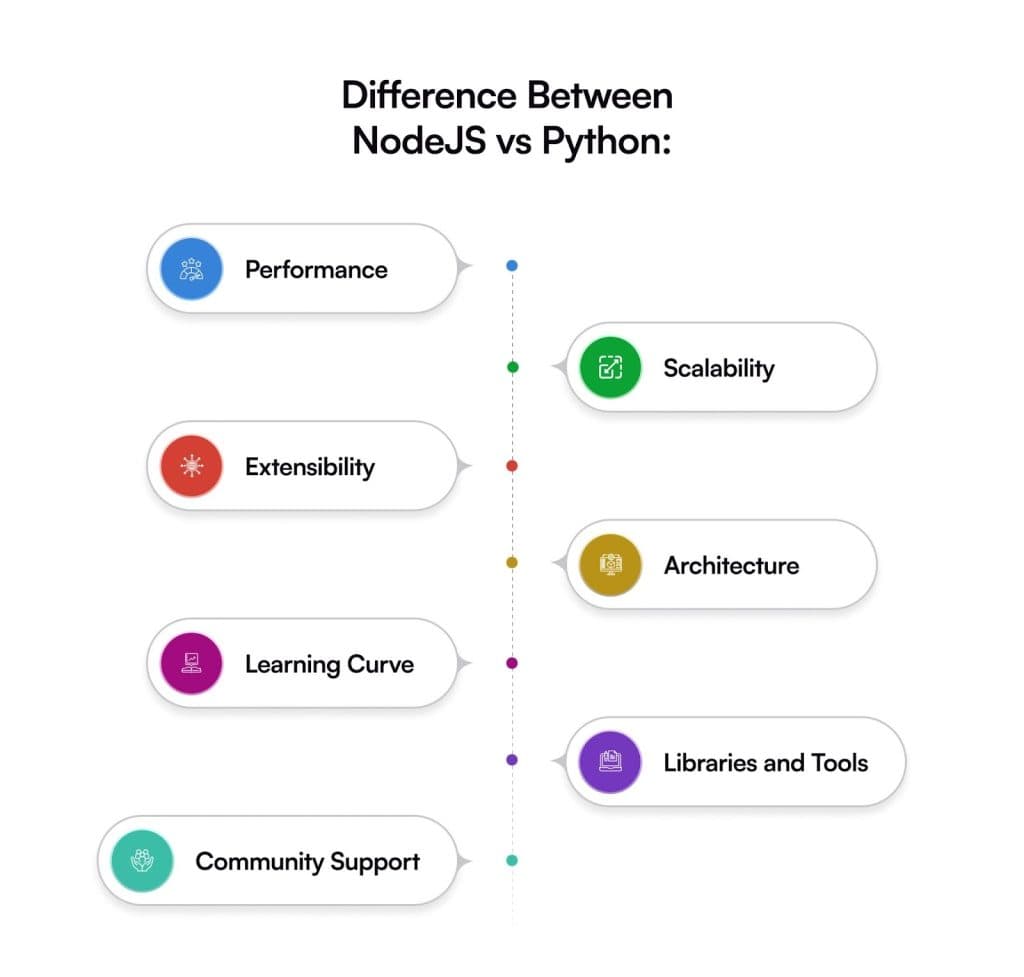
The comparison between NodeJS vs Python is really based on what the project requires. For example, NodeJS can run smoothly, just like its non-blocking architecture. Nevertheless, if the matter comes down to syntax and ease of learning, Python would be the top choice.
Node.js isn’t a language. It’s a runtime. It lets you run JavaScript outside the browser. That’s the big shift. You build apps using JavaScript. Pair it with HTML and CSS. Same stack, front to back. Faster iteration. Less context switching. Teams like that.
Python plays a different role. It’s a full programming language. Clean. Flexible. Powerful. You build backend apps using frameworks like Django or Flask. Great for data-heavy logic. AI. Automation.
So what’s better? Depends on you.
Both backend technologies are solid. Proven. Production-ready. The real decision comes down to your business needs, team skills, and where the product is headed. Choose what fits. Not what’s trending.
Here is a deep comparison based on various features to make an informed choice.
- Performance
NodeJS beats Python significantly due to its non-blocking design and Google’s V8 JavaScript engine, as already stated previously.
If your application needs speed, NodeJS fits better. Real-time apps. Streaming data. High concurrency. No waiting around. NodeJS handles requests in parallel. Keeps things moving. Feels snappy under load.
Python? Still strong. Still reliable. But it slows down when requests stack up. The synchronous flow and GIL limitations get in the way. So if fast processing matters, go with NodeJS.
If not, Python still does the job. Just know the trade-offs.
The Python interpreter can further impact its performance, resulting in a slower output of web application development.
- Scalability
Now, talking about scalability, again, NodeJS is superior, thanks to its event-driven architecture and clustering module. As a result, it facilitates easy vertical and horizontal scaling of web apps. That being said, NodeJS is the perfect choice for businesses with higher-level scalability & concurrency requirements.
On the other hand, Python has restricted scalability because of GIL and slower runtime interpretation. The limited architecture capabilities of Python result in poor scalability, which makes it unsuitable for businesses with high-performance expectations.
- Extensibility
NodeJS has access to an extensive network of open-source libraries and packages that can be found in NPM (Node Package Manager). It allows developers to easily extend the capabilities and integrate other tools by using the existing packages. Teams can also introduce new functionalities without the risk of damaging the core application due to the modular design.
Python is known for having a very rich standard library and also for an open-source package support that is available through the PyPI (Python Package Index). Developers extensively use the pre-built modules that are available in areas like web frameworks, database management, machine learning, and data analytics to empower their work.
- Architecture
The architecture of NodeJS is event-driven, which results in asynchronous input and output, resulting in less development time. This capability makes NodeJS an ideal choice for web games or chat application development. Moreover, it uses a single-thread event loop to manage multiple clients simultaneously.
Python is synchronous, which can slow down its performance. Python relies on a multi-process approach, adding complexity compared to NodeJS’s simple event-driven model.
- Learning Curve
NodeJS syntax resembles JavaScript to a great extent; therefore, a developer who is proficient in JS can quickly become a Node.js developer. In fact, one can argue that the NodeJS learning curve is somewhat steep; however, it is still feasible for someone with a JavaScript background.
Now, if we compare Python vs NodeJS skills, Python’s syntax (or learning curve) is more accessible or more beginner-friendly. Python has clean & concise syntax, thus developers find it easy to read and write the code. Consequently, developers can implement a simplified development process; it also makes the debugging process easier.
- Libraries & Tools
NodeJS has Node Package Manager (NPM) with approximately 1.3 million packages. That results in a simplified and smooth development process. Request, Hapi.js, Express.js, Async.js, and Socket.io are some of the top Node.js libraries.
Now, if NodeJS has NPM, Python has PIP (Install Packages). It helps in streamlining the management of dependencies and libraries installation. Additionally, it has a huge collection of libraries that includes Pyinstaller, Scrapy, Tornado, Flask, and FastAPI.
- Community Support
On GitHub, Node.js has a bigger and more lively community. It has been forked 23.4K times and starred 87.4K times, which indicates the substantial size and commitment of the user base.
Python also has a big and lively community, which is actually bigger than the community of most other programming languages. You can go to a place like Stack Overflow; there, you can ask your questions and get some tips from other members of the community.

NodeJS or Python: Which One Should You Pick
Basically, both Node.js and Python are robust backend technologies that come with their own advantages and disadvantages. Therefore, both backend technologies are valid choices; it aldepends onof business requirements and goals.
These two technologies have a fundamental difference, which is why they operate differently. NodeJS is a software that is utilized in building real-time apps, chat apps, microservice apps, and server-side web apps.
On the other hand, Python is a programming language that can be used to develop any type of application.
Here is a quick summary for you: in case you want speedier business performance along with flexible syntax and efficient code-sharing, NodeJS is the way to go. On the other hand, Python is a general programming language that has a lot of advantages, like a full set of libraries, ease of use, and AI support.
Ultimately, it’s you and your company’s needs that will determine which technology is best to choose. If even this, though, you are not in a position to decide on, then you require the proper tech partner who can build a way for you.
At Galaxy Weblinks, we have an experienced & professional team that can help you pick the suitable technology, aligning with your business goals and long-term business growth.
So, book a consultation now and leave all your confusion behind!
FAQs
Q: How do you choose between NodeJS and Python?
A. It depends. Always does. Start with your project goals. If you need speed. High concurrency. Real-time features. APIs that scale fast. NodeJS fits better. It handles traffic smoothly and performs well under load.
If your product leans toward AI, machine learning, or heavy data processing, Python makes more sense. Its ecosystem is built for that. Libraries are mature. Development feels simpler.
There’s no “best” language. Only the right one for your use case.
Q: Why is NodeJS faster than Python?
A. Architecture. That’s the key. NodeJS runs on Google’s V8 engine. It uses a non-blocking, event-driven model. That means it can handle many requests at the same time without waiting. Perfect for high-traffic apps.
Python works differently. It executes code sequentially. And the Global Interpreter Lock (GIL) limits true parallel execution in many cases.
So when concurrency matters, NodeJS usually wins. Not because Python is weak. Just built for a different job.
Q. Which of the two technologies is more scalable, Node.js or Python?
A. Speaking about more scalability, NodeJS has better scalability due to its event-driven model and clustering module present by default. It supports vertical as well as horizontal scaling. Once again, Python is limited in scalability due to the GIL and its synchronous nature.
Q. Are NodeJS and Python both possible to use together?
A. Yes, absolutely! You can request NodeJS and Python integration and utilize both strengths for your large project. Python is utilized mainly for data processing, AI, or machine learning tasks. NodeJS handles real-time features or client interactions.
Q. When would I use Python over Node.js?
A. If your project is AI, machine learning, data science, or automation, it is time to opt for Python. Apart from that, it will be helpful if you need clean & readable code with long-term maintainability over mere performance.