

Building an enterprise SaaS platform isn’t just tech work. It’s business strategy, product design, and future-proofing all tangled together. The global SaaS market was valued at over $315 billion in 2025 and is forecasted to explode further toward the trillion-dollar mark in the next decade.
That’s because businesses everywhere are ditching old on-premises apps and pivoting to cloud-first models. This shift makes SaaS Architecture not optional, but central to success.
And when architecture becomes the backbone of your platform, there is no room for guesswork. Enterprise users expect uptime. No excuses. Security that holds. Scalability that doesn’t blink. Performance that feels steady from day one.
This guide skips the buzzwords and gets practical. It shows how to plan and build a modern enterprise SaaS platform that actually works at scale. Clear steps. Real decisions. Focused on what matters.
What Is an Enterprise SaaS Platform
An enterprise SaaS platform is not your typical cloud app. It’s bigger. Built for scale. Built for organizations that run entire operations on software. Not just a few users clicking around.
Think thousands of users. Different departments. Different access levels. Tons of data are moving every second. Finance teams, operations teams, leadership dashboards. All inside one enterprise SaaS application.
That’s the reality of enterprise SaaS development today. And honestly, small SaaS tools don’t survive in this environment.
Enterprise systems handle complex workflows. Multi-role permissions. Heavy integrations with CRMs, ERPs, payment systems, and analytics tools. Security layers everywhere. Because one breach? That’s reputation damage and legal risk.
Another thing people underestimate is scale. Enterprise software isn’t built for 100 users. It’s built for thousands, sometimes millions. Across regions. Across time zones. Which means the SaaS architecture behind the platform cannot be simple.
What Makes Enterprise SaaS Platforms Different from Regular SaaS
An enterprise SaaS platform plays in a completely different league. Bigger systems. Higher stakes. More pressure.
Regular SaaS tools? They often start small. A few teams. A few hundred users. Manageable. But enterprise SaaS applications run inside large organizations. Thousands of employees. Multiple departments. Different countries sometimes. Data flows everywhere.
Below are the areas where enterprise SaaS platforms truly stand apart:
- Scale by Design
An enterprise SaaS application is built for scale from day one. Not later. Not “we’ll optimize after growth.” It must handle thousands of users logging in at the same time. Teams across regions. Heavy data processing.
Traffic spikes happen. Product launches. Marketing campaigns. End-of-quarter reporting. The platform must survive all of it. This is why SaaS application architecture in enterprise systems focuses heavily on scalability. Load balancing. Distributed systems. Microservices. Cloud infrastructure.
Regular SaaS tools often scale gradually. Enterprise systems don’t get that luxury. They must work at scale from the start.
- Multi-Tenancy with Strict Isolation
Most SaaS platforms use multi-tenant architecture. Multiple customers share the same infrastructure. But in enterprise SaaS architecture, isolation becomes critical.
Each tenant’s data must remain fully separated. Logically. Sometimes physically. Databases may be partitioned. Access layers are tightly controlled. Encryption everywhere. Why? Because enterprises handle sensitive information. Financial records. Customer databases. Internal reports.
One tenant accessing another tenant’s data? That’s a disaster. So modern enterprise SaaS platform development focuses heavily on secure multi-tenancy models that balance efficiency with strict data isolation.
- Complex User Roles and Permissions
Enterprise organizations rarely operate with simple user roles. Inside a typical enterprise SaaS application, you’ll see multiple permission layers.
- Admins manage system settings
- Managers access team-level data
- Employees see only operational dashboards
- Auditors review compliance logs
Everyone sees something different. That’s why enterprise application development requires advanced role-based access control (RBAC). Sometimes, even attribute-based access control (ABAC). Regular SaaS tools keep permissions simple.
- Security and Compliance at the Core
Security in enterprise SaaS platforms is not an afterthought. It’s the foundation. Large organizations demand strict compliance frameworks, like SOC 2, ISO 27001, GDPR, and HIPAA.
These are not optional checkboxes. They are mandatory requirements before enterprise buyers even consider a product. This forces cloud application development teams to implement encryption, identity management, audit logging, monitoring, and secure authentication from the beginning.
Data protection becomes part of the SaaS architecture itself. Regular SaaS tools sometimes add compliance later. Enterprise platforms cannot take that risk.
- Integration-Heavy Ecosystems
Enterprise companies rarely use a single tool. Instead, they operate within massive digital ecosystems. A typical enterprise SaaS platform must integrate with:
- CRMs like Salesforce
- ERP systems
- Business intelligence platforms
- Identity providers
- Payment gateways
- Internal enterprise systems
This is why strong API architecture is critical in enterprise SaaS development. Clean REST APIs. Webhooks. Event-driven systems. Because enterprise SaaS rarely works alone. It connects with everything.
And when those integrations run smoothly, the platform becomes deeply embedded in the organization’s workflow. Which is exactly where enterprise software wants to be.
Top Advantages of Enterprise SaaS Platform Development
Enterprise SaaS platforms are built for efficiency at scale. They cut operational friction. They adapt fast as businesses grow. Systems keep running without constant manual effort. That’s why enterprises move to SaaS over traditional software models. The advantages go beyond cost. They shape how teams work and scale.
- Cost-Effective: No heavy upfront infrastructure costs. Enterprises pay for what they use, optimize resources over time, and avoid expensive hardware maintenance.
- Scalability & Flexibility: The platform scales as the business grows. Users, features, and workloads scale without disrupting existing operations.
- Streamlined Operations: Centralized systems reduce complexity. Fewer moving parts. Cleaner control. Automation improves workflows, cuts manual effort, and keeps teams aligned across functions.
- Automatic Updates: New features roll out quietly. Security patches are applied on time. Performance improves without disruption. No manual intervention needed. The platform stays current by default.
- Seamless Integration: Enterprise SaaS platforms connect easily with CRMs, ERPs, and analytics tools. Third-party services fit in without friction. Systems integrate fast, and data moves where it should.
Core Features Every Enterprise SaaS Platform Must Have
Enterprise SaaS Platforms don’t win on flashy UI alone. They win on structure, control, and how quietly things work when scale hits.
This is where SaaS platform architecture shows its real value.
- Multi-Tenancy and Role-Based Access
One platform, multiple customers, shared infrastructure, and clean separation, where admins need full visibility, and teams need limited views. Users should only see what they’re allowed to. Nothing more. Nothing less.
When roles are flexible, enterprises move faster. Fewer approvals. Less chaos. Better governance. Good multi-tenancy keeps costs down and performance stable, even when users grow fast.
- Security, Data Isolation, and Permissions
Enterprises don’t gamble with data as they demand protection at every layer. Data isolation ensures one customer’s data never touches another’s. Even internally. Encryption protects data at rest and in transit. Always on. No exceptions.
Permissions define exactly who can access what, and when. Every action is logged. Every change traceable. If something goes wrong, there’s a record. No blind spots. A mature SaaS platform architecture assumes attacks will happen. So, defences are built in early, not patched later.
- Custom Workflows and Integrations
This is where platforms feel enterprise-ready or not. No two companies work the same way. Forcing them to adapt breaks adoption. Enterprises need workflows that match their processes, not the other way around.
Integrations with CRMs, ERPs, analytics tools, and internal systems. No friction.
APIs that behave. Webhooks that don’t fail silently. This flexibility turns Enterprise SaaS Platforms into long-term systems, not short-term tools.
Put together, these features do one thing well:
- They reduce friction at scale.
- They let enterprises grow without rebuilding everything again.
- And they prove that the SaaS platform architecture was designed for reality, not demos.
How to Choose the Right Enterprise SaaS Architecture
Architecture is not a backend decision. It shapes how the product behaves under pressure. Growth pressure. Usage spikes. Enterprise expectations.
This is where SaaS platform architecture stops being theory and starts affecting real outcomes.
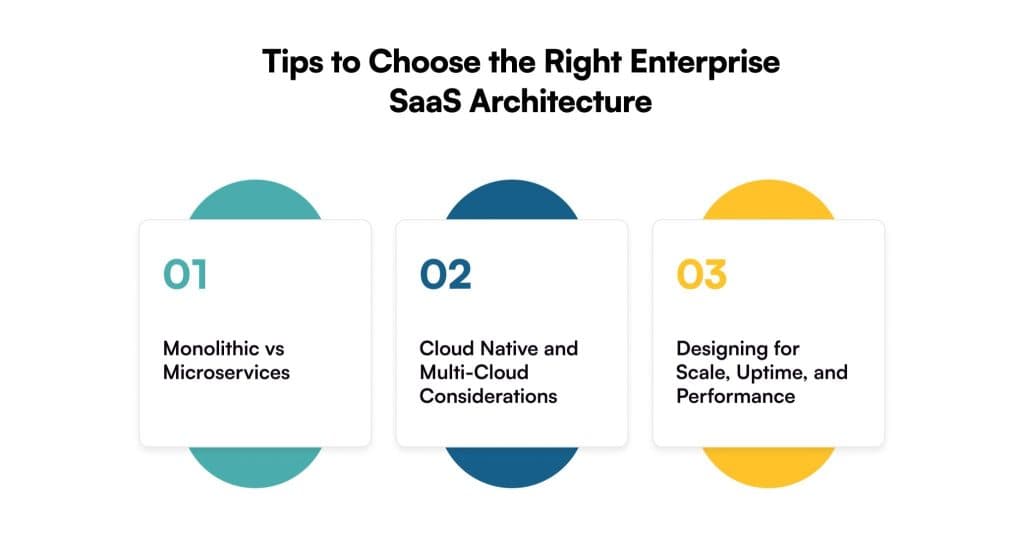
- Monolithic vs Microservices
Monolithic architecture keeps everything tightly coupled. One application, release cycle, and one failure can affect everything. It works early on. Fewer moving parts and faster initial development. But as features grow, changes slow down. Scaling becomes expensive. Small updates feel risky.
Microservices split the platform into independent services. Each service owns a specific responsibility. They scale, deploy, and in fact, fail independently.
For Enterprise SaaS Platforms, this means faster innovation without breaking stability. Teams move in parallel. Downtime is contained. The platform grows without collapsing under its own weight.
- Cloud-Native and Multi-Cloud Considerations
Enterprise platforms are expected to scale on demand. Cloud-native design makes that possible.
Containers, orchestration, managed services. Resources adjust automatically, costs align with usage, and deployments become repeatable, not fragile.
Multi-cloud strategies reduce risk. No single provider dependency. Better disaster recovery. Workloads can shift when outages happen. A modern SaaS platform architecture treats infrastructure as elastic. Not fixed. Not fragile.
- Designing for Scale, Uptime, and Performance
Enterprises don’t tolerate downtime. Availability is assumed.
Designing for scale means planning for growth before it happens. More users. More data. Same experience.
High uptime depends on redundancy, load balancing, health checks, and failover systems. No single point of failure. Ever.
Performance comes from intentional design, efficient APIs, smart caching, and async processing where needed. The system stays responsive, even under stress. When architecture is done right, growth feels invisible. And that’s exactly what enterprises want.
Types of Enterprise SaaS Platforms
Enterprise SaaS platforms exist for one simple reason. Scale breaks things. Processes. Teams. Visibility. And these platforms are built to fix that, before chaos becomes normal.
Each type of enterprise SaaS solves a very specific business problem. Not vaguely. Not “nice to have.” Real operational pain. The kind that shows up when teams grow fast, and systems don’t talk to each other.
- Customer Relationship Management (CRM)
CRMs give enterprises one source of truth for customers. No scattered spreadsheets. No guessing who spoke to whom. Sales pipelines become visible. Follow-ups get automated. Teams stop stepping on each other’s toes. Marketing, sales, and support finally see the same data. That alone saves hours. And mistakes. Customer experience becomes consistent, even when teams are large and distributed.
- Enterprise Resource Planning (ERP)
ERP platforms handle the heavy stuff. Finance. Procurement. Inventory. Supply chain. All under one roof. Instead of jumping between tools, enterprises operate from a single system. Data silos shrink. Decisions get faster. Forecasting gets sharper. It’s not flashy software. But it’s the backbone. When ERP works well, operations feel boring. And boring is good at scale.
- Human Resource Management Systems (HRMS)
People operations don’t scale on emails and spreadsheets. HRMS platforms manage the entire employee lifecycle. Hiring. Payroll. Performance. Compliance. Everything tracked. Everything logged. HR teams spend less time chasing data and more time planning growth. Policies stay consistent. Employees get clarity. Managers get insights. Fewer surprises. Fewer fires.
- Business Intelligence & Analytics
Enterprises generate data constantly. The problem isn’t a lack of data. It’s a lack of clarity. BI platforms pull data from multiple systems and make it readable. Dashboards replace manual reports. Trends surface early. Leadership stops reacting blindly. Decisions become backed by numbers, not instincts alone. It’s control. Quiet control.
- Collaboration & Communication Platforms
Work doesn’t happen in one office anymore. Collaboration tools keep teams connected across locations and time zones. Chats replace long email threads. Files stay shared, not lost. Updates happen in real time. Work moves faster. Teams feel aligned, even when they’re not sitting together. Less friction. More momentum.
Enterprise SaaS isn’t about adding tools. It’s about removing friction. When the right platforms are in place, large organizations don’t just function. They move. Smoothly. At scale.
Step-by-Step Process of Enterprise SaaS Platform Development
Enterprise SaaS platform development is not random. It follows a loop. Structured. Intentional.
Built to handle scale before scale even shows up. And security before anyone asks for it. Here is a step-by-step process of the entire enterprise SaaS platform development:
- Ideation and Conceptualization
This is where the real problem gets named. Not guessed. You define the enterprise use case, the industries, and how big this needs to scale. Product vision meets business reality here. Long-term goals. Operational limits. Budget truths. If this step is weak, everything later breaks. Slowly. Then all at once.
- Requirement Analysis and Planning
Now teams ask questions. And write everything down. Features. Tech stack. Security rules. Compliance needs. Nothing optional here. Multi-tenancy is planned early, not patched later.
Architecture, timelines, and resources are mapped to enterprise load, not startup optimism.
- Design and Prototyping
UI/UX design is created for real users, not demo screens. Role-based access, permissions, and data flow come first. Looks come later. System architecture and data models are built for performance and extensibility. Quick prototypes test assumptions. Some fail. That’s the point.
- Minimum Viable Product (MVP) Development
In MVP development, the goal isn’t to build everything. It’s to build the right things first. Authentication. Access control. Core workflows. Essential integrations. That’s it. No feature stuffing. No unnecessary dashboards. No “nice-to-have” features just for show. It is basically for user validation.
- Development and Testing
This is where things get serious. Features scale up. Integrations deepen. Edge cases appear everywhere. Security testing. Load testing. Performance tuning. Over and over again.
Enterprise systems don’t get second chances after launch.
- Deployment and Launch
Cloud infrastructure is set up for uptime, not convenience. CI/CD pipelines reduce human errors. Monitoring catches issues early. Rollouts are controlled. Downtime is avoided. Enterprises notice every minute of instability. Every single one.
- Post-launch Optimization and Maintenance
Launch is not the finish line. It’s the exposure. Usage data is tracked. Bottlenecks are fixed. Features are refined. Compliance rules change. Scale increases. Users behave differently than expected. The platform evolves, or it slowly becomes irrelevant. No middle ground.
How Much Does It Cost to Build an Enterprise SaaS Platform
There’s no flat price here, and anyone quoting one is guessing. Enterprise SaaS cost depends on scope, scale, and how serious the platform needs to be. A basic enterprise MVP may start around $50,000–$80,000, covering only core features like authentication, role-based access, limited workflows, and basic integrations.
A mid-level platform with multi-tenancy, stronger security layers, analytics, and third-party integrations usually falls between $120,000–$250,000, which is where most serious enterprise products sit.
Fully mature enterprise SaaS platforms often cost $300,000+, driven by high availability, advanced compliance, custom workflows, heavy load handling, and continuous optimization. The real cost driver isn’t features alone. It’s scale, security, and long-term maintenance. Cheap platforms fail quietly. Expensive ones survive pressure.
Conclusion
Enterprise SaaS platforms are not built just for speed. They are built for endurance. Long-term scale. Heavy usage. Constant change. Thousands of users. Different departments. Sensitive data is moving every second. That’s the reality of a serious enterprise SaaS platform.
And here’s the thing, most companies realize a bit late that architecture decisions stick around much longer than product features. Choose the wrong SaaS architecture, and the system starts slowing down. Scaling becomes painful. Infrastructure costs rise. Suddenly, every new feature feels harder to ship.
That’s why smart companies think carefully about enterprise SaaS development from the beginning. And even partner with experienced enterprise SaaS development companies that have already built complex platforms before.
Teams like Galaxy Weblinks, for example, help businesses design scalable enterprise SaaS applications, modern SaaS application architecture, and reliable enterprise platforms that can actually grow with demand.
In short, building a powerful enterprise SaaS platform isn’t easy. But building it right from day one? That decision pays off for years.
FAQs
Q. How long does it take to build an enterprise SaaS platform?
A. Honestly, it depends. A lot. For most companies building an enterprise SaaS platform, a solid MVP usually takes around 6 to 12 months. Sometimes a bit faster if the scope is tight. But real enterprise SaaS development, the kind with integrations, security layers, analytics, and permissions, takes longer.
Q. Is enterprise SaaS different from regular SaaS?
A. Yes. Very different, actually. Regular SaaS products usually target smaller teams. Simple workflows. Limited data volume. But an enterprise SaaS platform supports massive organizations. Thousands of users. Complex operations. Strict compliance.
Q. Do enterprise SaaS platforms need microservices?
A. Not always. And not immediately. Many enterprise SaaS platforms start with a modular monolith. Easier to build. Easier to launch fast. But as the platform grows, with more users, more integrations, and more data, teams usually shift toward a microservices architecture. Why? Better scalability. Independent deployments. Faster updates.
Q. Can enterprise SaaS platforms scale after launch?
A. Technically, yes. But it’s painful if scalability wasn’t planned earlier. Scaling later means rewriting infrastructure. Changing databases. Refactoring services. It becomes expensive and messy. That’s why good enterprise SaaS architecture plans scalability from day one. When scalability is designed early, the platform grows smoothly. Without chaos.
Q. What is the biggest mistake in enterprise SaaS development?
A. Ignoring architecture and security in the early stages. It happens more often than people think. Teams rush to ship features. Investors want quick launches. But weak SaaS architecture shows up later. Systems slow down. Integrations break. Security gaps appear. Fixing those issues inside a live enterprise SaaS platform becomes expensive and risky.