

Travel relied on fixed systems for years. Legacy booking engines. Static pricing grids. Manual forecasts are built on historical averages. It worked. Until volatility became constant.
Complexity increased. Competition intensified. Airlines began mirroring each other’s pricing logic. Hotels delivered similar packages. Differentiation narrowed. Margins tightened. Loyalty became fragile.
At the same time, traveler expectations accelerated.
The integration of AI is no longer peripheral in travel operations. It is moving into revenue management, customer engagement, and service optimization. The global AI in travel market is projected to exceed $138.8 million by 2030. Growth at that magnitude indicates structural transformation, not isolated pilots.
Hospitality investment reflects the same urgency. The AI segment within tourism and hospitality is expanding at close to 30 per cent CAGR through 2026. Organizations are embedding personalization engines, predictive analytics, and automated support layers. Purposeful adoption. Not experimentation.
Traveler behavior is shifting in parallel. A substantial share of U.S. travelers already use AI-driven tools for planning and comparison. That being said, AI in travel is becoming foundational infrastructure. It shows clear signs of businesses in the travel industry moving towards AI development for a sustainable future.
In this guide, you will examine how AI is transforming airlines, hotels, and tourism platforms. And the real business impact AI is creating in the travel industry. Along with top use cases, and much more.
What Is AI in Travel?
AI in travel refers to the strategic use of artificial intelligence to improve how travel companies operate, price, and engage customers. It extends beyond basic automation. The system learns from data. It identifies patterns. It supports decisions with limited manual input.
At an operational level, AI evaluates booking history, pricing fluctuations, seasonal demand, and traveler preferences. It adjusts fares dynamically. Recommends relevant offers. Forecasts occupancy and route demand with greater precision. The goal is clearer forecasting. Fewer assumptions.
With AI in travel and tourism, adoption spreads across the ecosystem. Airlines apply it to route planning and disruption management. Whereas, AI in hospitality use it to personalize guest interactions and anticipate occupancy changes. Digital travel platforms integrate conversational systems that assist users during search and booking.
Most of this intelligence operates in the background. Machine learning models refine outcomes continuously. Natural language processing supports responsive chat systems. Predictive analytics detects demand shifts before they become visible trends.
AI in Airlines: Operational Intelligence & Revenue Growth
Airlines operate under constant pressure. Margins remain thin. Disruptions escalate quickly. One delay affects multiple routes. One pricing error impacts thousands of seats.
This is where AI in travel begins to matter in practical terms.
It improves operational control. Strengthens revenue management. Supports customer engagement without expanding costs at the same rate.
The shift is measurable.
- Predictive Maintenance & Fleet Optimization
Aircraft produce continuous performance data. Engine temperature. Component stress. Fuel patterns. AI systems analyze these signals in real time. They detect irregularities early. Maintenance becomes predictive rather than reactive.
Unexpected groundings reduce. Repair cycles become more controlled. Fleet availability increases. AI also optimizes aircraft allocation. It evaluates route demand, turnaround efficiency, utilization ratios. Scheduling improves. Asset productivity rises.
- Dynamic Pricing & Revenue Management
Airfare pricing changes rapidly. Demand fluctuates daily. Competitor adjustments occur within minutes. AI-driven revenue platforms assess booking velocity. Historical demand. Seasonality, and external variables simultaneously. Pricing adapts continuously.
Seats are valued based on demand probability, not static categories. Load factors improve. Yield per passenger strengthens. Revenue leakage declines. With AI in travel and tourism, pricing optimization often delivers early, visible return on investment.
- AI-Powered Customer Service & Chatbots
Passenger expectations have evolved. Response time now influences loyalty. AI-powered chat interfaces manage booking changes, flight updates, baggage queries, and disruption support instantly. Natural language systems interpret context. Responses feel more precise.
During operational disruptions, AI scales without delay. High inquiry volumes remain manageable. Operational strain decreases. Customer satisfaction stabilizes. Brand trust improves gradually but consistently.
AI in Hotels: Hyper-Personalization & Smart Operations
Hotels no longer compete only on location. Experience defines loyalty. Guests compare options instantly. Expectations form before arrival.
This is where AI in travel shifts hotel strategy from reactive service to predictive engagement.
It refines personalization. Optimizes revenue. Improves operational visibility, often at the same time.
- Guest Personalization Engines
Hotels collect more data than they sometimes realize. Booking patterns. Room choices. On-property spending. Loyalty history. AI systems interpret these signals. They identify preferences. Predict likely upgrades. Recommend tailored packages.
Communication becomes relevant. Offers feel contextual. Guests sense attention without explicit effort. With AI in travel and tourism, personalization is becoming foundational rather than optional.
- Smart Room Automation & IoT Integration
Smart rooms extend intelligence into the physical space. Lighting adjusts automatically. Temperature adapts to occupancy. Energy usage becomes measurable in real time. AI coordinates these systems. It optimizes comfort and efficiency simultaneously.
Maintenance alerts trigger before failures escalate. Staff intervention becomes proactive, not reactive. Operational costs reduce. Guest satisfaction improves. The intelligence remains mostly invisible, but the experience feels smoother.
- Revenue Optimization & Dynamic Room Pricing
Room demand shifts quickly. Events, seasonality, competitor pricing, and variables change hourly. AI evaluates booking velocity, historical occupancy, and market demand together. Pricing updates dynamically.
Rooms are positioned based on demand probability rather than fixed seasonal tables. Average daily rate improves. Revenue per available room increases. Unsold inventory declines. For hotels, AI strengthens both service delivery and financial performance.

AI in Tourism Platforms & OTAs: Intelligent Discovery & Booking
Tourism platforms and OTAs operate in high-volume environments. Thousands of listings. Constant price shifts. Users are comparing multiple tabs at once.
Attention spans are short. Decision windows are even shorter. This is where AI in travel and tourism becomes commercially critical. It simplifies discovery. Personalizes planning. Protects transactions. All while processing data at scale.
- Conversational & Natural Language Search
Traditional filters feel restrictive. Travelers do not always search in structured categories. They describe intent. AI-powered search interprets natural language queries. “Beach destination under four hours.” “Family-friendly stay with quiet surroundings.” Systems understand context rather than just keywords.
Search results become more relevant. The time to book shortens. Drop-off rates are reduced. Discovery feels guided, not mechanical.
- Personalized Travel Itineraries
Travel planning often overwhelms users. Too many options. Too many combinations.
AI analyzes browsing behavior, booking history, seasonal trends, and budget patterns. It generates tailored itineraries in real time. Recommendations align with traveler interests. Activities, accommodations, and transportation were presented as a cohesive plan.
- Fraud Detection & Secure Transactions
High transaction volumes attract risk. Payment fraud. Account misuse. Data breaches. AI systems monitor behavioral patterns continuously. They detect anomalies in booking frequency, payment activity, and user behavior.
Suspicious transactions are flagged instantly. Verification layers activate automatically. Security strengthens without adding visible friction to legitimate users. For tourism platforms and OTAs, AI functions as both a growth engine and a protective layer.
The Real Business Impact of AI in Travel
Adoption is increasing. Investment is rising. But the real question remains practical.
What does AI in travel and tourism actually change at the business level? The answer is not abstract. It shows up in revenue reports. Cost structures. Retention metrics. Executive dashboards.
Here is where impact becomes measurable.
- Revenue Growth Opportunities
AI improves pricing precision. It identifies demand signals earlier. It adjusts offers dynamically. Airlines optimize seat yield. Hotels increase average daily rate. Tourism platforms improve conversion ratios.
Upselling becomes contextual rather than generic. Cross-selling aligns with traveler intent. Small pricing improvements scale across millions of transactions. Revenue expands incrementally, then noticeably.
- Cost Optimization
Operational inefficiencies are rarely visible at first. They accumulate quietly. AI reduces manual forecasting. Automates routine support queries. Detects maintenance risks before failure.
Energy usage declines in smart properties. Staff allocation becomes data-driven. Marketing spend targets higher-probability segments. Cost structures tighten without reducing service quality. Efficiency improves while operational resilience strengthens.
- Increased Customer Lifetime Value
Retention is often more profitable than acquisition. AI supports continuity. Personalized recommendations encourage repeat bookings. Loyalty programs become more intelligent. Communication feels relevant rather than repetitive.
Satisfied travelers return. They spend more time. Brand trust deepens gradually. Customer lifetime value increases not through volume alone, but through sustained engagement.
- Faster Decision-Making
Travel markets fluctuate quickly. Demand shifts. External events alter projections. AI converts real-time data into actionable insight. Executives receive predictive dashboards instead of historical summaries.
Pricing adjustments occur faster. Inventory allocation becomes proactive. Risk mitigation improves. Decisions accelerate without sacrificing analytical depth.
In the broader view, AI in travel and tourism transforms fragmented data into operational clarity. It strengthens revenue streams. Stabilizes costs. Supports strategic foresight. Through integrated intelligence applied across the ecosystem.
The Top 6 AI Use Cases Transforming the Travel Industry
AI is moving from experimentation to execution. Travel brands are embedding it across pricing systems, customer interfaces, and operational dashboards. The impact is visible. Revenue shifts. Cost lines adjust. Customer behavior responds.
Here are six AI use cases actively transforming the travel industry:
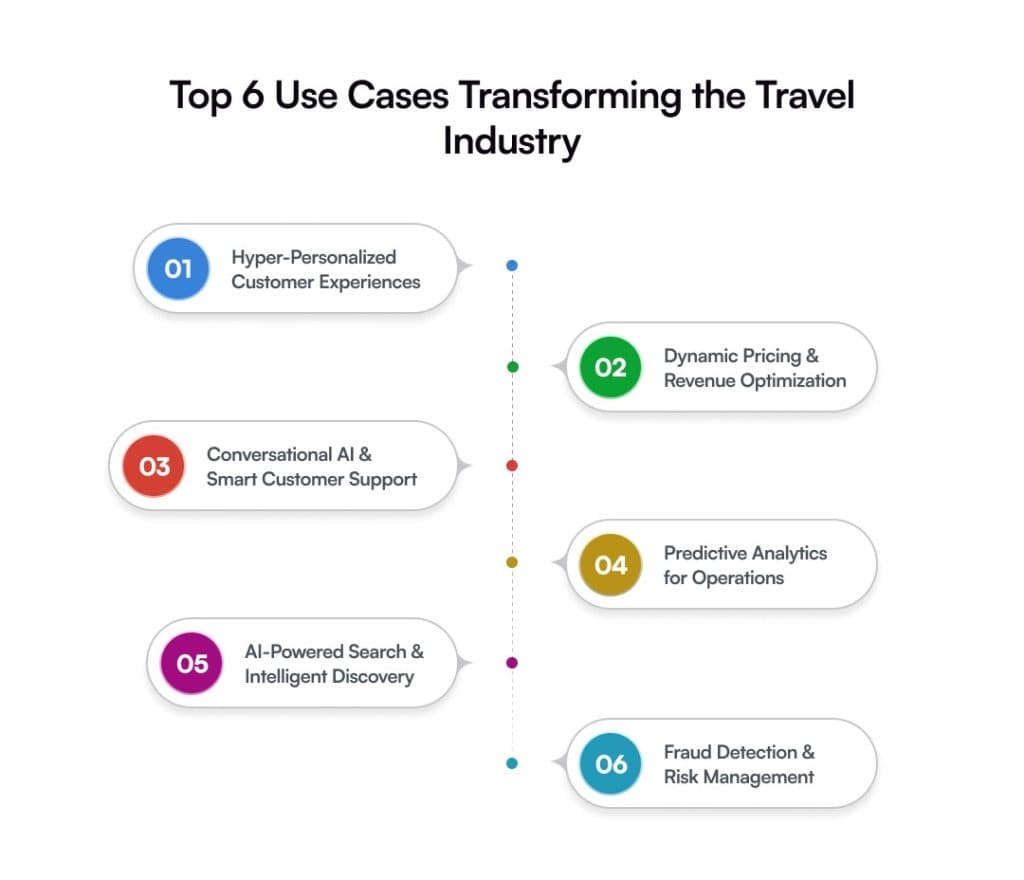
1. Hyper-Personalized Customer Experiences
Travelers expect relevance now. Generic messaging underperforms. AI analyzes browsing behavior, booking history, loyalty signals, and intent patterns. It predicts preferences before explicit selection occurs.
Offers become tailored. Content adjusts dynamically. Communication feels timely. Engagement increases. Repeat bookings improve. Lifetime value strengthens gradually.
2. Dynamic Pricing & Revenue Optimization
Demand changes quickly. Static pricing models struggle. AI evaluates booking velocity, competitor rates, seasonal demand, and market variables simultaneously. Prices adjust in real time.
Yield improves. Revenue per available seat or room increases. Unsold inventory declines. Pricing becomes responsive rather than reactive.
3. Conversational AI & Smart Customer Support
Travel generates constant inquiries. Delays reduce satisfaction.
Conversational AI handles booking updates, cancellations, itinerary questions, and disruption alerts instantly. Natural language systems interpret context with increasing accuracy.
Response time shortens. Operational strain decreases. Service consistency improves. Support scales without proportional staffing growth.
4. Predictive Analytics for Operations
Operational disruption carries measurable cost.
AI forecasts demand shifts, maintenance requirements, occupancy fluctuations, and staffing needs. Leaders receive early insight instead of retrospective data.
Planning improves. Resource allocation tightens. Financial exposure reduces. Decisions accelerate with stronger analytical backing.
5. AI-Powered Search & Intelligent Discovery
Travel discovery often overwhelms users. Too many filters. Limited clarity.
AI interprets conversational queries and behavioral intent. Search results align more precisely with traveler expectations. Time to booking decreases. Abandonment rates decline. Discovery becomes guided rather than mechanical.
6. Fraud Detection & Risk Management
High transaction volume increases financial exposure.
AI monitors behavioral patterns continuously. Anomalies in booking activity or payment behavior trigger immediate review. Revenue leakage decreases. Transaction security strengthens. Trust stabilizes.
Across these use cases, AI shifts travel operations from assumption-based to data-driven execution. Revenue grows more predictably. Costs become more controlled. Customer experience gains consistency.
The transformation is ongoing. Competitive advantage increasingly depends on how effectively these systems are implemented.
Common Mistakes to Avoid While Adopting AI
AI adoption sounds strategic. It often is. But execution gaps weaken results.
Many travel organizations invest in AI technology without preparing the foundation. Expectations rise. Outcomes disappoint.
Here are common missteps that reduce impact.
- Treating AI as a Trend
AI is not a marketing label. It is infrastructure.
When leadership adopts AI to signal innovation rather than solve defined business problems, implementation becomes fragmented. Tools operate in isolation. Value remains unclear.
AI in travel must align with revenue goals, operational efficiency, or customer experience metrics. Otherwise, momentum fades.
- Ignoring Data Readiness
AI depends on structured, reliable data. Many travel systems operate on fragmented datasets.
If booking records, customer profiles, and pricing history lack consistency, AI outputs weaken. Predictions lose accuracy.
Data governance requires attention before deployment. Clean inputs produce stronger intelligence. The reverse is also true.
- No Clear ROI Tracking
Investment without measurable KPIs creates uncertainty.
AI initiatives should connect directly to revenue lift, cost reduction, conversion improvement, or retention growth. Without defined metrics, progress becomes difficult to quantify.
Leadership confidence depends on visibility. AI performance must be tracked with the same rigor as financial indicators.
- Lack of Internal Alignment
Technology teams may understand AI. Operations and marketing teams must as well.
If departments remain misaligned, adoption slows. Resistance increases. Tools remain underutilized.
Cross-functional collaboration strengthens implementation. AI in travel works best when strategy, data, and execution move together.
Future of AI in Travel (2026 & Beyond)
The next phase of AI in travel will extend beyond automation. Intelligence will become embedded deeper into the customer journey.
Expect acceleration across these areas:
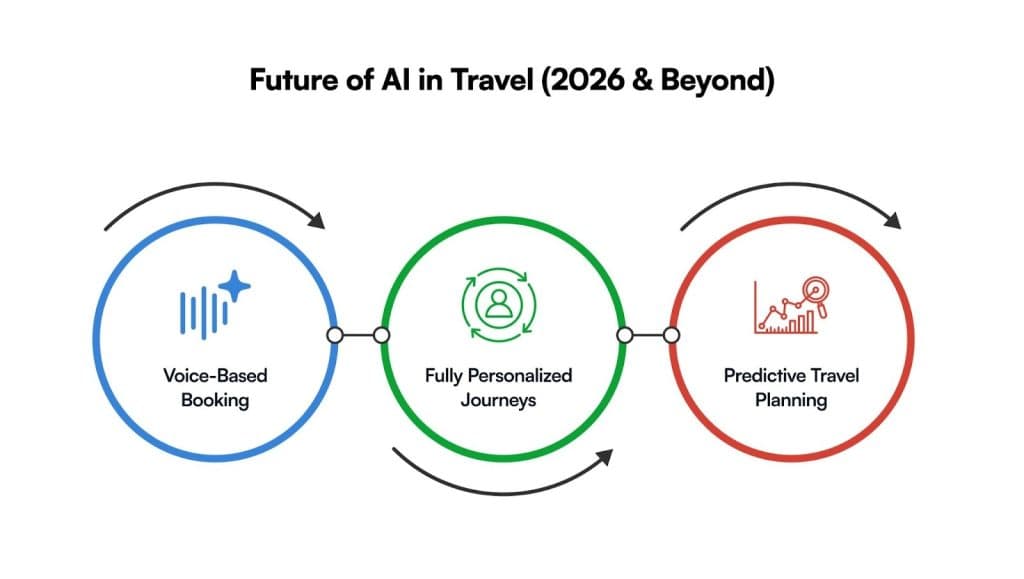
- Voice-Based Booking
Voice interfaces are improving rapidly. Travelers will increasingly search and book through conversational assistants.
Natural language processing will interpret intent, preferences, and constraints simultaneously. Friction reduces. Speed improves.
Booking becomes more intuitive.
- Fully Personalized Journeys
Personalization will move beyond recommendations. Entire travel journeys will adjust dynamically.
AI will coordinate flights, accommodations, activities, and transportation based on real-time context. Preferences will influence pricing, content, and communication automatically.
Experiences will feel curated, not assembled.
- Predictive Travel Planning
AI will anticipate travel intent before explicit search begins.
Behavioral signals, seasonal patterns, and life events will inform proactive offers. Platforms may suggest destinations before travelers initiate research.
Planning becomes guided by foresight rather than reactive comparison.
Conclusion
AI in travel is moving from enhancement to necessity.
Airlines optimize fleets and pricing. Hotels personalize guest experiences at scale. Tourism platforms guide discovery with intelligence. Revenue improves. Costs stabilize. Decisions accelerate.
The transformation is structural, not temporary.
Organizations that align data, strategy, and technology early will build measurable advantage. Those delaying adoption may face widening performance gaps.
AI in travel and tourism is redefining how the industry operates. The opportunity now lies in disciplined execution.
FAQs
Is AI in travel only relevant for large airlines and hotel chains?
No. Mid-sized travel brands and digital platforms are actively implementing AI to strengthen pricing, personalization, and operational visibility.
How long does AI implementation typically take?
Timelines vary by scope and data readiness. Pilot deployments may take months. Enterprise-wide integration requires phased execution.
Is AI expensive to maintain?
Maintenance costs depend on infrastructure and data management. However, measurable revenue gains and efficiency improvements often offset operational expenses.
Can AI integrate with legacy travel systems?
Yes. API-based architectures and middleware solutions allow AI layers to connect with existing booking engines and operational platforms.
What is the biggest benefit of AI in travel and tourism?
Improved decision-making. AI converts fragmented data into predictive insight, strengthening revenue growth, operational control, and customer loyalty simultaneously.