

At some point in a company’s growth journey, every leadership team faces a critical technology question:
“Should we build software tailored to our business, or buy something ready-made?”
On the surface, the decision appears straightforward. Off-the-shelf tools promise quick deployment and lower upfront costs. Whereas custom software development offers precision, flexibility, and long-term control.
But the real challenge lies beneath these surface-level benefits. In fact, the urgency of this decision is growing as organizations accelerate digital transformation. The global custom software development market, valued at $43.21 billion in 2024, is projected to expand rapidly through the next decade due to rising demand for tailored, scalable solutions.
Choose too quickly, and you may lock your organization into rigid workflows. Delay the decision, and you might slow innovation or overspend on tools that no longer fit. The truth is, there is no universal “best” option. Only the one that aligns with your business strategy.
This guide breaks down both paths with clarity so you can make a confident, future-ready decision.
What Is Custom Software
Custom software is designed and developed specifically for your organization. Instead of adapting your processes to fit a tool, the tool is built around your workflows.
Every feature, integration, and interface is intentionally created to support your operational model. Organizations typically pursue custom development when their processes are unique, highly specialized, or central to their competitive differentiation.
Pros of Custom Software Development
- One of the strongest benefits is workflow alignment. Teams operate more efficiently because the software mirrors how they already work, or how they want to work.
- Custom platforms also provide stronger scalability. As your company grows, the software evolves with you instead of forcing costly migrations later.
- Ownership is another major advantage. Your data, architecture, and feature roadmap remain under your control.
Cons of Custom Software Development
- The most obvious challenge is the initial investment. Custom software requires time, planning, and skilled development teams.
- Deployment timelines are longer, and businesses must actively participate in requirement gathering and testing.
- There is also responsibility, maintenance, updates, and security that require ongoing commitment.
Key Features of Custom Software
Custom platforms typically include:
- Workflow-specific functionality
- Deep integration with internal systems
- Role-based access controls
- Advanced reporting tailored to business KPIs
- Automation aligned with operational processes
Most importantly, they are built with your future in mind, not the average user’s.
Also Read: Why modern enterprises are increasingly prioritizing custom app development to drive long-term scalability and innovation.
What Is Off-the-Shelf Software?
Off-the-shelf software refers to ready-made applications designed for broad market use. These tools address common business needs such as accounting, communication, project management, and online selling.
They are pre-tested, widely supported, and typically available via subscription. Many companies, especially early-stage businesses, provide immediate operational stability.
Pros of Off-the-Shelf Software
- Speed is the biggest differentiator. Businesses can deploy these tools almost instantly.
- Costs are predictable, often distributed monthly or annually, reducing financial risk.
- Vendors handle maintenance, updates, and infrastructure, freeing internal teams from technical overhead.
Cons of Off-the-Shelf Software
- You may need to reshape internal processes to match the software rather than the other way around.
- Customization is limited, and integrations may not always support complex ecosystems.
- Over time, subscription stacking can quietly inflate operational costs.
Key Features of Off-the-Shelf Software
Typical characteristics include:
- Rapid deployment
- Standardized workflows
- Vendor-managed updates
- Community support
- Scalable pricing tiers
These tools thrive on simplicity, but may struggle with uniqueness.
Custom Software vs Off-the-Shelf Software: A Quick Takeaway
| Factors | Custom Software | Off-the-Shelf |
| Deployment Time | Longer due to development | Immediate |
| Customization | Fully tailored | Limited |
| Maintenance & Support | Managed internally or via partner | Vendor managed |
| Cost | Higher upfront, lower long-term | Lower upfront |
| Application Areas | Specialized workflows | General business needs |
| Integration | Deep & flexible | Often restricted |
A Detailed Comparison Between Custom vs Off the Shelf Software Development
Choosing the right software approach is rarely a purely technical decision. It’s a business decision. Cost, scalability, control, and long-term flexibility all come into play.
Below is a closer look at how custom software vs off the shelf solutions compare across the factors that usually matter most to decision-makers.
- Development Time and Deployment
Readymade software is designed for immediate use. Businesses can purchase a license, configure a few settings, and begin using the tool within hours or days. This makes off-the-shelf products attractive for companies that need a quick solution.
Custom-built software takes a different path. It starts with discovery. Requirements are defined. Systems are designed, developed, tested, and refined before deployment. That naturally takes more time.
When comparing off the shelf software vs custom software, speed is the biggest advantage of readymade tools. But speed sometimes comes at the cost of flexibility.
Custom solutions take longer to launch, yet they are designed to fit the organization from the start.
- Cost Structure
Upfront cost is often the first concern for companies evaluating off the shelf vs custom software.
Off-the-shelf tools typically operate on subscription models. Monthly or annual fees make the initial investment relatively low. For startups and small businesses, this can be appealing.
Custom software requires a larger upfront investment. Development, testing, deployment, and infrastructure all contribute to the cost.
However, long-term economics can shift. As organizations scale, subscription fees across multiple users, integrations, and add-ons can grow quickly. Over time, a tailored software system may become more cost-efficient because it removes unnecessary licensing expenses.
So while readymade software is cheaper initially, bespoke software can sometimes deliver better value in the long run.
- Customization and Flexibility
Flexibility is where tailored software clearly stands apart.
Off-the-shelf tools are designed for a broad market. They include features that work for thousands of businesses. That also means they cannot adapt deeply to every organization’s unique workflow.
Companies often find themselves adjusting internal processes to fit the tool.
Custom-built software works in the opposite direction. The system is designed around existing workflows, operational requirements, and long-term business goals.
In the custom software vs off the shelf debate, businesses with unique processes usually lean toward bespoke solutions because they remove operational friction.
Simply put, readymade software forces adaptation. Custom solutions enable alignment.
- Scalability and Future Growth
Scalability becomes critical as companies expand operations.
Off-the-shelf software may work well during early stages. But growth introduces complexity, more users, new systems, additional integrations, and advanced functionality.
At that point, limitations can appear.
Many organizations begin with readymade tools but eventually outgrow them. Feature constraints, user limits, or rigid system architecture can slow down operational growth.
Custom software is designed with future scalability in mind. Because the organization owns the architecture, new features, integrations, and capabilities can be added when needed.
When evaluating off the shelf software vs custom software, companies planning rapid growth often prioritize systems they can evolve over time.
- Integration with Existing Systems
Modern businesses rarely rely on a single piece of software. CRM platforms, analytics tools, finance systems, marketing platforms, and internal dashboards all need to communicate with each other.
Off-the-shelf tools often offer integrations. But those integrations may be limited to popular platforms or require third-party connectors.
This can create operational friction.
Custom-built software allows deeper system integration. APIs can be designed specifically to connect internal tools, automate workflows, and streamline data flow across departments.
In many cases, businesses exploring custom vs off the shelf software discover that integration complexity is one of the main reasons they shift toward bespoke systems.
- Ownership and Control
Ownership is another major difference between these two approaches.
When using off-the-shelf software, the vendor controls the product roadmap. Updates, feature changes, pricing adjustments, and platform decisions all sit with the provider.
Businesses must adapt to those changes.
Custom software gives organizations full ownership of the system. They decide when to release updates, which features to prioritize, and how the platform evolves over time.
For companies that rely heavily on technology to drive operations, this level of control can be a strategic advantage.
That’s why many enterprise leaders consider ownership a major factor in the custom software vs off the shelf conversation.
- Security and Compliance
Security requirements vary widely across industries.
Off-the-shelf products typically include standard security features that meet general market expectations. For many organizations, that level of protection is sufficient.
However, companies operating in regulated industries—finance, healthcare, logistics, or enterprise SaaS- often require stricter security protocols.
Custom-built software allows organizations to design security frameworks specifically around their compliance requirements, internal policies, and infrastructure.
In the off the shelf vs custom software comparison, security customization can become a decisive factor for companies managing sensitive data.
- Maintenance and Updates
Maintenance responsibilities differ significantly between the two models.
With readymade software, vendors handle updates, bug fixes, and system improvements. This reduces the internal workload for businesses.
However, updates can sometimes introduce unwanted changes or remove familiar features.
Custom software requires dedicated maintenance and technical support. Development teams must monitor performance, fix issues, and release improvements.
While this adds responsibility, it also ensures the system evolves exactly according to business needs.
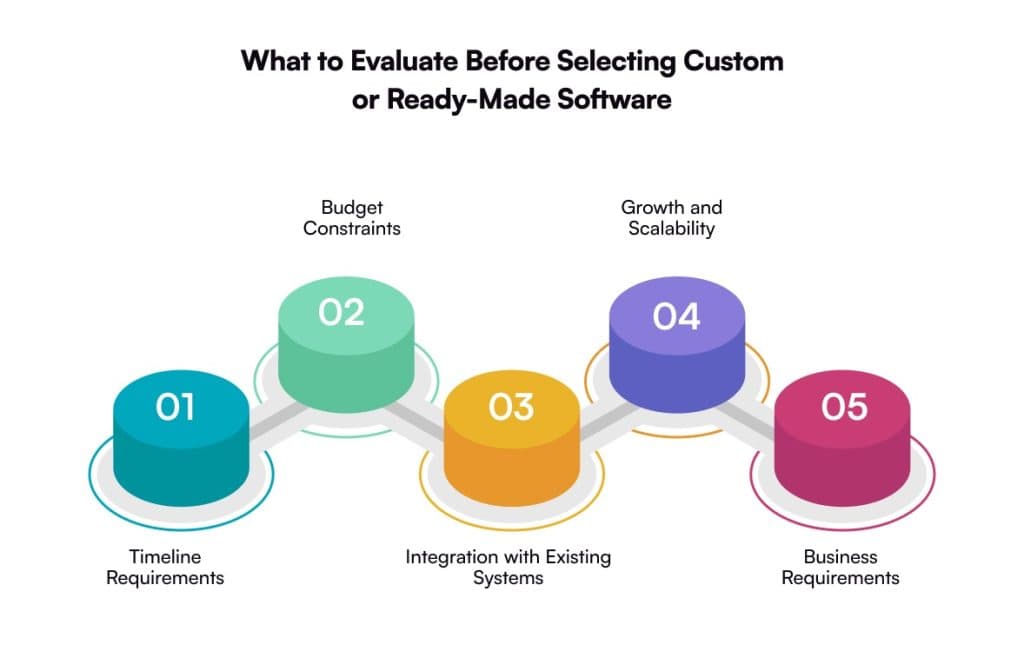
Key Factors to Consider Before Choosing Custom Software or Off the Shelf Software
- Timeline Requirements
If speed is critical, such as launching a startup or stabilizing operations, off-the-shelf tools are often the practical choice.
Custom development is better suited for organizations planning long-term digital maturity rather than immediate deployment.
- Budget Constraints
Early-stage companies typically prioritize cash flow predictability.
Subscription models reduce financial strain. However, businesses with stable revenue streams often view custom software as a capital investment rather than an expense.
- Integration with Existing Systems
Fragmented technology stacks create operational silos.
If your organization already relies on multiple platforms, custom software can unify them into a cohesive ecosystem.
Off-the-shelf tools integrate well within popular environments but may struggle with highly specialized architectures.
- Growth and Scalability
Ask yourself:
Where will our business be in three to five years?
If rapid expansion is part of the roadmap, building scalable infrastructure early prevents disruptive migrations later. Short-term convenience should never sabotage long-term agility.
- Business Requirements
Not every organization needs custom software. If your processes mirror industry standards, ready-made tools may serve you exceptionally well.
Customization becomes essential when your workflows are:
- Complex
- Regulated
- Data-intensive
- Operationally unique
Common Mistakes Businesses Make
Below is a list of the most common mistakes that businesses must avoid.
- Choosing Custom Software Too Early
Ambition can sometimes outpace operational maturity. Startups often invest in custom platforms before validating product-market fit. The result? Expensive rebuilds.
Begin with flexibility, not perfection.
- Staying on Off-the-Shelf Too Long
The opposite mistake is equally costly.
When teams spend more time bypassing software limitations than doing meaningful work, it is a signal.
Comfort should not prevent evolution.
- Underestimating Future Growth
Software decisions should anticipate tomorrow, not just solve today’s problems. Migrating systems mid-growth is disruptive, expensive, and risky.
Strategic foresight saves far more than reactive upgrades.
- Ignoring Internal Adoption
Even the most powerful software fails if teams resist using it. Change management, onboarding, and usability must remain central to your decision.
Technology succeeds when people embrace it.
How to Decide: A Simple Decision Framework
If you are still weighing options, use this quick strategic lens:
Choose off-the-shelf if:
- You need immediate deployment
- Your workflows are standard
- Budget flexibility is limited
- Speed outweighs differentiation
Choose custom software if:
- Technology is core to your value proposition
- Your processes are unique
- You anticipate rapid scaling
- Data control is critical
- Long-term ROI matters more than short-term savings
Most importantly, align the decision with business strategy, not just IT preference. Software is not merely an operational purchase. It is an organizational commitment.
Custom Software vs Off the Shelf Software Development
Cost is usually the first thing leadership teams examine when comparing custom software vs off the shelf software. At a glance, commercial tools seem cheaper. But the full picture takes a bit more unpacking.
Commercial off-the-shelf software typically runs on subscriptions. Monthly fees. Per-user licenses. Add-ons for integrations. It feels affordable early on. Especially for small teams getting started.
But things shift as usage grows. More employees join. New tools need integration. Extra modules get added. Over time, the total cost of commercial off-the-shelf software can quietly climb.
Custom software works differently. The upfront investment is higher. Design, development, testing, it all happens before launch. Still, once the system is live, businesses aren’t paying licensing fees for every user.
In practice, companies weighing custom software vs off the shelf software often look beyond the first year and consider the five-year cost horizon. The right planning is to think long-term, as bespoke software solutions tend to offer more value at reduced costs.
Concluding Words
The choice between custom software and off-the-shelf solutions is not about which is better; it is about which aligns with your strategic direction.
High-performing organizations treat technology as a long-term growth enabler, not just an operational tool. The real question is whether you are solving for immediate efficiency or building capabilities that scale with your ambition.
Because software does more than support your business, it shapes how resilient, adaptable, and competitive you can become.
At Galaxy Weblinks, we help enterprises translate business vision into scalable digital solutions, whether through custom development or strategic technology integration. If you are evaluating your next technology move, connect with Galaxy Weblinks to build a software strategy designed for sustainable growth.
FAQs
Q. Is custom software more expensive than off-the-shelf software?
A. Custom software usually requires a higher upfront investment, while off-the-shelf tools are cheaper initially but can accumulate costs through subscriptions and add-ons over time.
Q. Is off-the-shelf software suitable for startups?
A. Yes, many startups use off-the-shelf tools because they are affordable, quick to deploy, and designed for common operational needs.
Q. Can off-the-shelf software be customized?
A. Most off-the-shelf tools allow limited customization, but core functionality usually cannot be significantly modified.
Q. Which option is better for long-term scalability?
A. Custom software is generally better for long-term scalability because it can evolve with business requirements and infrastructure.
Q. Do companies combine custom and off-the-shelf software?
A. Yes, many organizations adopt a hybrid approach—using commercial tools for standard functions while building custom systems for strategic operations.