


In 2026, building medical software isn’t just a technical task anymore. It comes with pressure. Constant pressure. Teams are expected to move fast, stay compliant, and never compromise on safety.
Healthcare and MedTech teams are shipping products in an environment that keeps changing. Regulations evolve. Systems need to integrate without friction. Data has to move securely. And even small software failures can lead to real-world consequences.
That’s why medical software development has shifted from being a support function to becoming the foundation. If the software isn’t stable, secure, and validated, nothing else matters. Not the device. Not the platform. Not the launch.
This shift is also reflected in the market itself. The SaMD market is valued at USD 31.6 billion in 2025 and is projected to grow at a CAGR of 22.2%, reaching $191.7 billion by 2034. Growth like this signals one thing clearly. Software is now central to how medical products are built, regulated, and delivered.
Now, this is where many teams get stuck. Not on what to build, but how to build it right. What actually matters in 2026? Where do compliance, usability, and scalability intersect?
That’s exactly what this guide is designed to answer. It breaks medical software development down into clear, practical steps. From early planning to validation and deployment. No noise. No confusion. Just what you need to build software that passes audits, scales safely, and earns long-term trust.
What is Medical Software Development?
Medical software development means building software for healthcare. You design it, test it, and maintain it for years. These systems handle patient records. They support diagnostics, automate clinical workflows, and sometimes they talk directly to medical devices.
At the core, medical software development lives inside regulations. FDA guidelines, IEC 62304, HIPAA, and ISO 13485. These aren’t suggestions. They define how you build. How do you test? How do you release? Every feature is validated, and every update is documented. Even the small ones.
The goal is simple. Building a medical software that meets compliance. Works in real clinical settings. Stays safe under pressure. And performs when it actually matters. That’s what medical software development is really about.
Types of Medical Software Transforming the Healthcare Industry
Medical software development is changing how the healthcare industry actually works. Not in theory. In daily practice. How systems run. How doctors diagnose. How care gets delivered at scale.
Below is a list of the top 6 different types of medical device software you must know:
- Clinical Decision Support Software
This software helps clinicians decide faster and smarter. It analyzes patient data. Matches it with clinical guidelines. Does it in real time? In medical software development, accuracy isn’t a feature. It’s the baseline. The logic must be explainable, and the data flow must be clean. And EHR software integration? Non-negotiable. If it doesn’t fit into clinical workflows, it won’t be used.
- Medical Imaging Software
Medical imaging software turns raw scans into usable insights. X-rays. MRIs. CT scans. Ultrasounds. All of it. The margin for error is tiny. Medical device software development matters a lot here. Compliance is strict. Performance has to stay high. Images must load fast. Stay precise. And never distort clinical truth.
- AI-Driven Diagnostics Tools
AI diagnostics promise speed, early detection, and better outcomes. But they also raise questions, in fact, big ones. These tools use machine learning to spot patterns and predict conditions. Medical software development here moves carefully. Models are validated. Decisions are traceable. Ethics matter. Regulators are watching. Innovation only works when trust stays intact.
- Patient-Facing Medical Software
This is what patients actually see. Apps. Web platforms. Portals. Tools to track health data. Book appointments. Access care remotely. Sounds simple. It isn’t. The UI/UX design has to feel effortless. Data privacy must be airtight. Architecture must scale without cracks. Medical software development in this space balances ease with serious security.
- Remote Patient Monitoring Software
Remote monitoring keeps an eye on patients, even outside hospitals. Wearables. Sensors. Connected devices. Vitals stream in continuously. In real time. Medical device software development focuses on accuracy here. Interoperability too. Systems must talk to each other. Data must stay secure while moving fast. Delays or drops are not acceptable.
Steps to Build a Medical Software Solution
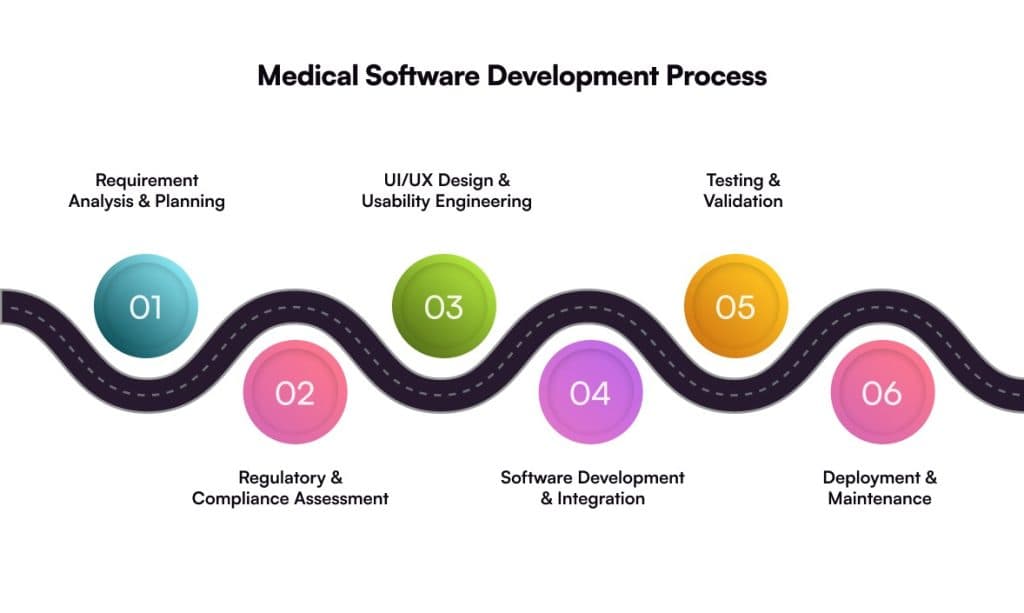
Building a medical software solution requires a structured approach that balances innovation, compliance, and patient safety. Each step plays a critical role in ensuring the software is reliable, secure, and ready for real-world healthcare use.
- Requirement Analysis & Planning: This stage focuses on defining clinical needs, user roles, regulatory requirements, and risk factors to create a clear development roadmap.
- Regulatory & Compliance Assessment: Early evaluation of applicable standards such as FDA, IEC 62304, and HIPAA helps avoid rework and compliance gaps later.
- UX/UI Design & Usability Engineering: Design decisions prioritize ease of use, error reduction, and accessibility, especially for clinicians working in high-pressure environments.
- Software Development & Integration: Developers build core features, implement security controls, and integrate the solution with EHRs, devices, or third-party systems.
- Testing & Validation: Comprehensive testing ensures functionality, performance, security, and compliance with medical software regulations.
- Deployment & Maintenance: After deployment, continuous monitoring, updates, and documentation keep the medical software secure, compliant, and scalable.
How Much Does It Cost to Develop Medical Software
Estimating the cost of medical software isn’t simple math. It depends on a lot. Complexity. Features. Compliance requirements. The tech stack you choose. Every decision shifts the number.
Here is an average estimation that you can expect:
| Type of Medical Software Solution | Estimated Cost Range (USD) |
| Basic Patient-Facing Medical Apps | $50,000 – $150,000 |
| Clinical Decision Support Software | $150,000 – $400,000 |
| Medical Imaging Software | $200,000 – $500,000 |
| AI-Driven Diagnostics / SaMD Solutions | $500,000+ |
| Enterprise Healthcare Platforms | $500,000 – $1,000,000+ |
| Ongoing Maintenance & Compliance | 20% – 30% of initial cost (annually) |
Regulatory Requirements for Medical Software Development
Medical software doesn’t survive on code alone. It survives on rules. Regulations run the show. They decide how you design and how you test.
- FDA (U.S. Food and Drug Administration): The FDA sets the bar in the U.S. Safety comes first. Effectiveness isn’t debated. Medical software and SaMD must prove they work. Not once. Every time. Validation is mandatory. Evidence isn’t paperwork. It’s protection.
- IEC 62304: IEC 62304 controls the software lifecycle. From the first idea to long-term maintenance. It brings order. Clear steps. Clear ownership.
- ISO 13485: ISO 13485 is about quality discipline. End-to-end. How teams build. How do they document? How do they fix gaps? A strong QMS keeps things repeatable. Audits feel calmer. Releases feel safer.
- HIPAA: HIPAA guards patient data. Medical software must lock down health information. Access rules. Encryption layers. Audit logs.
- GDPR: GDPR tightens everything in the EU. Personal health data gets extra care. Consent is clear. Transparency is expected. Medical software must respect data rights. Or step aside.
- Risk Management (ISO 14971): ISO 14971 keeps risk visible. Identify it early. Assess it properly. Reduce it continuously. Medical software development isn’t about zero risk. It’s about control before damage happens.
- Usability Engineering (IEC 62366): Poor UX creates errors. Real ones. IEC 62366 fixes that mindset. Design for people, not manuals.
Advantages of Medical Software Solutions for Patients and Healthcare Providers
Medical software development creates value you can actually measure. Not buzzwords. Real impact. It improves how care is delivered. How decisions are made. How operations run day to day. The benefits don’t sit on one side. Patients gain. Providers gain. Clinical outcomes and business goals move forward together.
For Patients
- Improved Outcomes: Medical software supports early diagnosis. Continuous monitoring. Faster interventions. Problems get caught sooner. Treatment starts earlier to improve care results.
- Enhanced Engagement: Patient-facing medical software keeps people involved. Health tracking. Reminders. Clear communication. Patients stop guessing. They start participating. That shift matters more than it sounds.
- Personalized Care: Medical software development makes care less generic and more personal. Treatment plans adapt to patient data, history, and real-time signals. One-size-fits-all fades out. Context steps in.
- Anywhere Access: Cloud-based medical software removes location limits. Patients can access records, book consultations, and check updates anytime, anywhere. Care doesn’t pause because someone isn’t on-site.
- Informed Decisions: Medical software translates data into clarity. Patients see what’s happening. Why it matters. What comes next? Better understanding leads to better choices. And less anxiety.
For Healthcare Providers
- Streamlined Workflows: Medical software automates the boring, heavy stuff. Admin tasks. Clinical processes. It results in less manual work and fewer delays. Teams spend time where it counts.
- Cost Savings: Good medical software development reduces waste. Fewer errors. Less rework. Smarter use of resources. Costs drop quietly, but consistently.
- Better Data Management: Centralized systems keep data clean and connected. Accurate storage. Smooth interoperability. Secure exchange. Information flows without friction or chaos.
Top Trends in Medical Software Development
Medical software development in 2026 looks different. Today, healthcare providers need smarter, faster, and more connected solutions. The push is clear. Better care delivery. Real-time data. Systems that actually talk to each other.
These trends aren’t hype; they’re reshaping outcomes, patient experience, and operational efficiency, all at once.
- Telemedicine and Remote Patient Monitoring: Care no longer stays inside hospital walls. Telemedicine platforms enable virtual consultations securely. Remote patient monitoring tracks vitals in real time. No waiting. No gaps.
- AI and Machine Learning in Diagnostics: AI is changing how diagnoses happen. Medical software now analyzes massive clinical datasets. Fast. Consistently. Patterns surface earlier.
- Wearable Technology: Wearables never sleep. They collect data nonstop. Heart rate. Activity. Signals that matter. Medical device software development turns this data into alerts, insights, and preventive care actions.
- Interoperability and Data Integration: Disconnected systems slow care down. Interoperable medical software fixes that. EHRs connect. Devices sync. Platforms share data smoothly. Information flows where it’s needed.
Challenges in Medical Software Development and Their Solutions
Medical software development comes with pressure. Different kind. Here, technical choices don’t stay technical. They touch compliance. Security. Patient safety. Miss something early, and it shows up later. Address these challenges upfront, and risk drops. Adoption improves. Systems last longer.
- Regulatory Compliance
Regulations keep shifting. That’s the reality. Navigating them isn’t easy. But structured development helps. Clear processes. Clean documentation. Early compliance planning. Audits feel manageable. Approvals stop being roadblocks.
- Data Security & Privacy
Medical software handles sensitive data. Very sensitive data like patient records and health history. Strong encryption is a must. So are access controls. Continuous security testing, too. One weak layer, and everything is exposed.
- Integration with Legacy Systems
Many healthcare systems still run on old systems. Medical software must adapt. Interoperability matters. Standardized APIs help. Data needs to move without breaking workflows. Or trust.
- User Adoption & Training
Great software can still fail. If no one uses it. Adoption is the real test. Intuitive design helps. So does structured training. Clinicians and staff need confidence, not confusion. That’s what drives real usage.
Technologies Used for Developing Medical Software Solutions
Following is a list of technologies developers use for building medical device software development:
- Programming Languages: Java, C++, Python, and C#
- Frontend Technologies: React, Angular, and Vue
- Backedn Frameworks: Spring Boot, .NET, and NodeJS
- Cloud Platforms: AWS, Microsoft, Azure and Google Cloud
Conclusion
Medical software development in 2026 asks for more. More than clean code and fast releases. It needs a real understanding of healthcare workflows. Regulations. Data security. Patient safety. Miss any of these, and the software fails. Even if it “works.”
The level of reliability doesn’t come from shortcuts. Or generalist teams learning on the job. Medical device software development is heavy. Validation is complex. Documentation is constant. Compliance starts on day one and never really ends.
This is where experience counts. An experienced development team knows the standards. Plans for audits early. Integrates smoothly with existing systems. Scales without breaking safety or performance.
If your goal is clear. Build compliant and future-ready medical software. Software that earns trust and passes audits. Then partner smart. Galaxy Weblinks is your reliable partner. Contact us now to get your idea turned into reality. You can see how this approach works in practice through our custom virtual healthcare solution. Built with compliance, usability, and long-term scalability at the core.
FAQs
1. What is medical software development?
Medical software development is about building software for healthcare use. Designing it. Testing it hard. Maintaining it long-term. It must meet strict safety and regulatory standards. No flexibility here. Patient safety comes first.
2. How is medical software different from healthcare software?
Medical software touches clinical decisions or medical devices. That’s the line. It’s regulated. Closely. Healthcare software is broader. Admin tools. Operations. Engagement platforms. Useful, yes. But not always clinically critical.
3. Which regulations apply to medical software development?
It depends on where and what you’re building. FDA rules in the U.S., IEC 62304 for lifecycle control. ISO 13485 for quality systems. HIPAA for patient data. GDPR in the EU. Different regions. Same pressure.
4. How long does it take to develop medical software?
There’s no fixed timeline. Complexity drives it. So does compliance. Most projects take months. Some cross a year. Validation alone takes time. Rushing here usually costs more later.
5. Why should businesses hire experts for medical device software development?
Because mistakes are expensive. Experts reduce compliance risk. Handle validation properly. Build security early. And deliver software that scales without breaking trust. Or audits.